
Applying high pressure, such as 360 MPa, using a laboratory press is mechanically essential to overcome the inherent rigidity of solid-state materials. Unlike liquid electrolytes that naturally permeate porous electrodes, solid components require immense physical force to induce plastic deformation, ensuring that the cathode, anode, and electrolyte layers fuse into a unified, conductive stack.
The Core Insight The fundamental challenge in all-solid-state batteries is the "solid-solid interface." Without high-pressure fabrication, microscopic gaps prevent ionic movement. The laboratory press effectively eliminates these voids, creating the low-impedance physical foundation required for the battery to function.
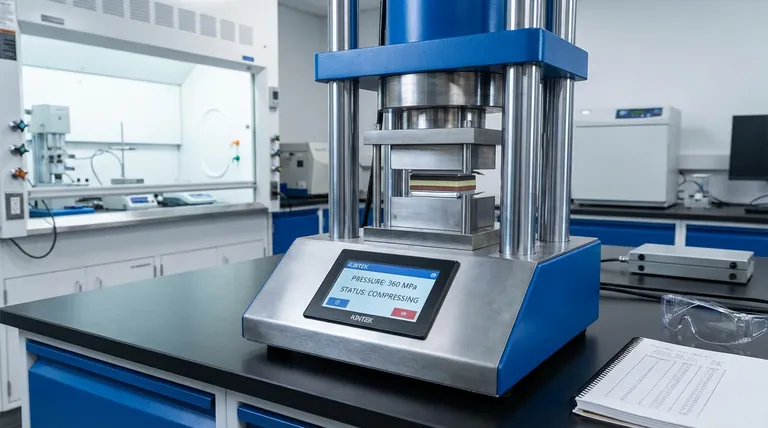
The Physics of Densification
Inducing Plastic Deformation
At pressures as high as 360 MPa, solid materials stop behaving like rigid objects and undergo plastic deformation.
This forces the material layers to physically yield and change shape. This deformation is not a defect; it is a requirement to reshape the internal structure of the cell.
Eliminating Interstitial Voids
Raw solid-state materials, particularly electrolytes like Li7P3S11, often begin as powders or porous layers.
High-pressure compaction crushes these powders, significantly reducing interstitial voids between particles.
This transforms a loose collection of particles into a dense, non-porous pellet or layer.
Preventing Dendrite Penetration
A dense electrolyte layer is a safety imperative.
By minimizing porosity through high-pressure compaction, you create a physical barrier that resists the growth of lithium dendrites.
This structural integrity prevents short circuits and extends the safe operating life of the battery.
Overcoming Interfacial Resistance
Bridging Surface Roughness
Even polished solid surfaces possess microscopic roughness. When two solids touch, they initially contact only at high points, leaving gaps elsewhere.
Applying pressure (e.g., during final stacking) flattens these asperities. This creates a seamless physical contact between the cathode, electrolyte, and anode.
Establishing Ion Transport Pathways
Lithium ions cannot "jump" across air gaps; they require continuous matter to travel.
The intimate contact achieved through pressing creates continuous pathways for ion diffusion.
This directly lowers the interfacial impedance, which is the primary bottleneck for battery performance.
Pre-Sintering Preparation
For oxide-based electrolytes (like LGVO), high pressure is a critical pre-step to heat treatment.
Compacting the mixed oxide powder at 360 MPa increases the contact area between particles.
This high-density "green pellet" ensures that subsequent solid-phase reaction sintering results in a cohesive, single-phase ceramic.
Understanding the Trade-offs and Precision
The Role of Precision Equipment
Using a laboratory press is not just about raw force; it is about reproducibility.
A specialized press ensures the sample is molded with a consistent thickness and a fine, closed organizational structure.
Avoiding Defects
While pressure is vital, uncontrolled force can be detrimental.
A laboratory press allows for controlled application, preventing common defects such as overflow at mold edges or the entrapment of air bubbles.
Properly regulated pressure ensures the structural integrity of the cell without crushing sensitive active materials or causing uneven stress distributions.
Fabrication vs. Operating Pressure
It is important to distinguish between fabrication pressure and operating pressure.
Pressures like 360 MPa are often used to form the materials (densification). Lower pressures (e.g., 60-74 MPa) may be used to maintain contact during the cell's operation or initial stacking.
Making the Right Choice for Your Goal
To maximize the efficacy of your assembly process, align the pressure magnitude with your specific objective:
- If your primary focus is Electrolyte Densification: Apply extreme pressure (e.g., 360 MPa) to induce plastic deformation and eliminate voids within the pellet to prevent dendrites.
- If your primary focus is Interfacial Contact: Apply moderate-to-high pressure (e.g., 60–74 MPa) to flatten surface roughness and reduce impedance between already-formed layers.
- If your primary focus is Reproducibility: Utilize the laboratory press to standardize sample thickness and prevent edge overflow defects across all test cells.
The application of high pressure is not merely a manufacturing step; it is the mechanism that activates the electrochemical potential of the solid-state battery.
Summary Table:
| Objective | Recommended Pressure Range | Key Benefit |
|---|---|---|
| Electrolyte Densification | ~360 MPa | Induces plastic deformation, eliminates voids, prevents dendrites. |
| Interfacial Contact | 60–74 MPa | Flattens surface roughness, reduces impedance between layers. |
| Reproducibility & Standardization | Controlled by press | Ensures consistent sample thickness and prevents defects. |
Ready to perfect your all-solid-state battery assembly?
KINTEK's precision laboratory presses are engineered to deliver the controlled, high-pressure conditions essential for your R&D. Whether you are densifying solid electrolytes or optimizing interfacial contact, our automatic lab presses, isostatic presses, and heated lab presses provide the reproducibility and performance your laboratory needs.
Contact us today using the form below to discuss how our solutions can enhance your battery development process.
Visual Guide

Related Products
- Laboratory Hydraulic Press 2T Lab Pellet Press for KBR FTIR
- 24T 30T 60T Heated Hydraulic Lab Press Machine with Hot Plates for Laboratory
- Manual Heated Hydraulic Lab Press with Integrated Hot Plates Hydraulic Press Machine
- Laboratory Hydraulic Press Lab Pellet Press Button Battery Press
- Laboratory Hydraulic Pellet Press for XRF KBR FTIR Lab Press
People Also Ask
- What is the role of a laboratory pressure machine and KBr in FTIR? Master Sample Preparation for Flame Retardants
- What is the role of a laboratory hydraulic press in high-loading NCM811 cathode prep for solid-state batteries?
- What role does a laboratory hydraulic press play in reaction pellets? Optimizing Lunar Soil and Metal Fuel Density
- Why is a laboratory hydraulic press necessary for sample preparation? Precise Pelleting for Spiro Heterocyclic Analysis
- Why is a laboratory hydraulic press required for M-N-C catalyst characterization? Enhance XAS and Mössbauer Accuracy



















