
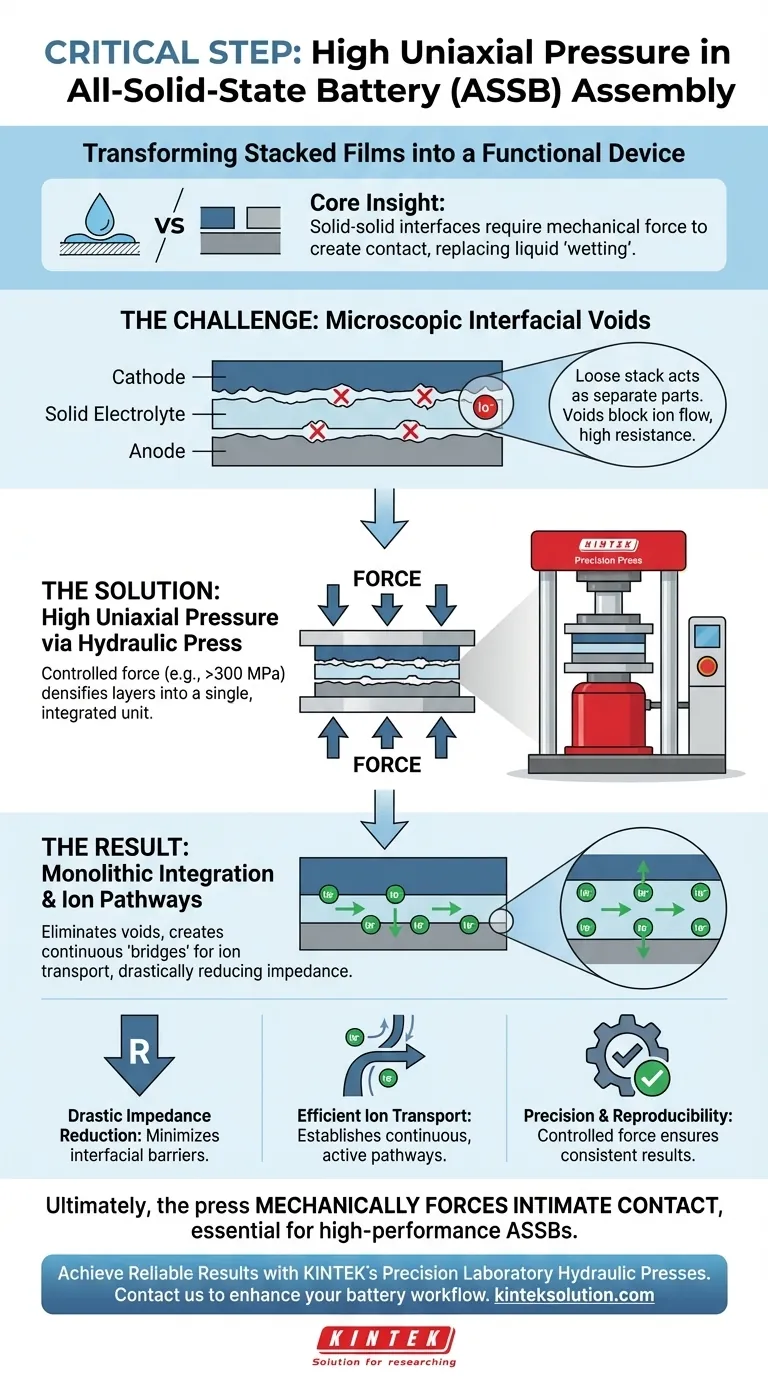
Applying high uniaxial pressure is the decisive mechanism that transforms a stack of loose films into a functional energy storage device. This process densifies the individual layers—cathode, solid-state electrolyte, and anode—into a single, integrated unit, ensuring the physical continuity required for ions to move between components.
The Core Insight In liquid batteries, the electrolyte naturally wets the electrodes to create contact. In solid-state batteries, this "wetting" must be mechanically forced; without high pressure to eliminate microscopic voids, the internal resistance is too high for the battery to function.
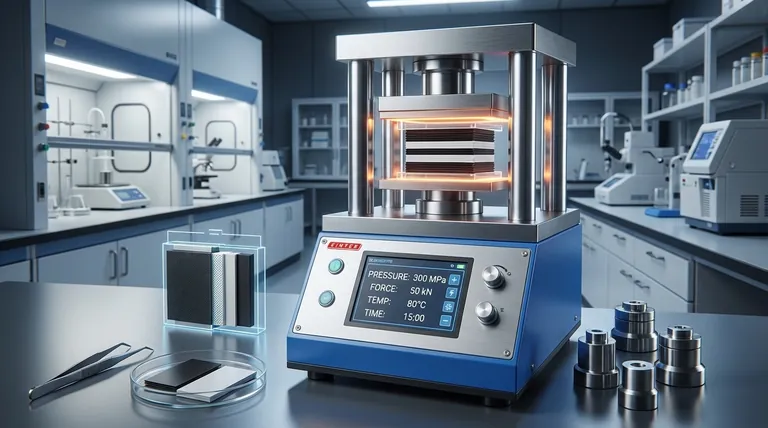
The Physical Challenge of Solid Interfaces
The fundamental hurdle in all-solid-state batteries (ASSBs) is the "solid-solid" interface. Unlike liquids, solid materials do not naturally conform to each other's surfaces.
Eliminating Interfacial Voids
On a microscopic level, even smooth-looking films have rough surfaces. When stacked loosely, these irregularities create gaps or voids between the layers.
These voids act as insulators. If they are not removed, they block the flow of ions, rendering the battery inefficient or completely non-functional.
Achieving Monolithic Integration
The hydraulic press forces the separate layers to merge physically. This transforms a stack of independent components into a monolithic cell.
This mechanical integration guarantees that the cathode, electrolyte, and anode act as one cohesive unit rather than three adjacent parts.
Electrochemical Implications
The physical densification driven by the hydraulic press translates directly into electrochemical performance. The press is not just holding the battery together; it is "activating" the ion pathways.
Drastic Reduction of Impedance
The primary goal of this pressure is to minimize interfacial resistance.
By forcing the materials into intimate contact, the press reduces the barrier that ions face when crossing from the anode to the electrolyte, and from the electrolyte to the cathode.
Establishing Ion Transport Pathways
Efficient ion transport relies on continuous pathways.
High pressure ensures that the active material in the electrodes is pressed firmly against the solid electrolyte, creating the "bridges" necessary for lithium or sodium ions to travel freely.
Understanding the Precision Trade-offs
While pressure is essential, the application must be handled with the precision of a laboratory hydraulic press, not just brute force.
The Necessity of Controlled Force
References indicate that specific pressures (e.g., 300 MPa for electrolyte powder compaction) are required to achieve the correct density.
The hydraulic press allows for precisely controlled pressure, ensuring the force is sufficient to bond the layers without causing uncontrolled deformation that might damage the delicate films.
Sequential Densification
The assembly is often a multi-stage process. The press may first compact electrolyte powder into a high-density separator, and then subsequently bond the anode and cathode to it.
Skipping these steps or applying pressure unevenly results in a distinct trade-off: poor physical contact leads to unstable performance and inaccurate evaluation data.
Making the Right Choice for Your Goal
The application of pressure is the variable that most significantly dictates the quality of your solid-solid interface.
- If your primary focus is Maximizing Power Density: Ensure you are applying sufficient pressure to completely eliminate interfacial voids, as these are the primary bottleneck for current flow.
- If your primary focus is Research Reliability: Use the hydraulic press to establish a standardized, reproducible pressure protocol to ensure that variations in performance are due to material chemistry, not assembly inconsistencies.
Ultimately, the hydraulic press replaces the "wetting" action of liquid electrolytes, mechanically forcing the intimate contact required for high-performance solid-state energy storage.
Summary Table:
| Key Factor | Impact on Battery Assembly |
|---|---|
| Pressure Application | Mechanically forces solid-solid contact, replacing liquid electrolyte 'wetting' |
| Void Elimination | Removes microscopic gaps that block ion flow, drastically reducing impedance |
| Layer Integration | Transforms loose film stack into a monolithic, functional unit |
| Controlled Force | Enables precise, reproducible protocols for research reliability and power density optimization |
Ready to achieve reliable, high-performance solid-state battery assembly? KINTEK's precision laboratory hydraulic presses—including automatic, isostatic, and heated models—deliver the controlled uniaxial pressure essential for eliminating interfacial voids and establishing efficient ion pathways. Our lab press machines are engineered to support your research and development goals, ensuring reproducible results and maximizing power density. Contact our experts today to discuss how KINTEK can enhance your battery prototyping and testing workflow.
Visual Guide
Related Products
- Laboratory Hydraulic Press Lab Pellet Press Button Battery Press
- Laboratory Hydraulic Press 2T Lab Pellet Press for KBR FTIR
- Laboratory Hydraulic Press Lab Pellet Press Machine for Glove Box
- 24T 30T 60T Heated Hydraulic Lab Press Machine with Hot Plates for Laboratory
- Automatic Laboratory Hydraulic Press Lab Pellet Press Machine
People Also Ask
- How is a laboratory hydraulic press used for HAP composite gels? Master Mineral Substrate Standardization
- What role does a laboratory hydraulic press play in the preparation of piezoelectric ceramic discs for DC-PG? | KINTEK
- What role does a laboratory hydraulic press play in reaction pellets? Optimizing Lunar Soil and Metal Fuel Density
- Why is a laboratory hydraulic press required for PBAT and PLA sample preparation? Achieve Flawless Characterization
- What role does a laboratory hydraulic press play in the assembly of all-solid-state battery test cells? Expert Guide



















