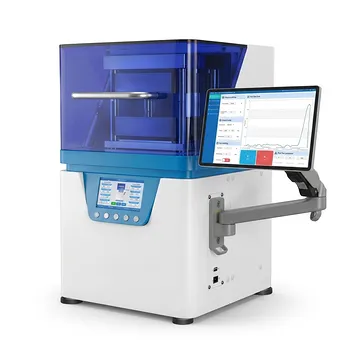
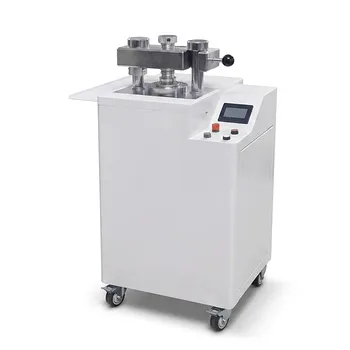
High-precision laboratory hydraulic pressing is the bridge between theoretical chemistry and functional battery architecture. By applying controllable, uniform stack pressure, these presses force solid electrolyte and electrode materials into the intimate contact required for electrochemical activity. This process eliminates the microscopic gaps and pores that naturally occur in solid-state systems, ensuring efficient ion transport and preventing catastrophic failure.
Core Takeaway: Laboratory hydraulic pressing is essential because it overcomes the inherent lack of "wetting" in solid materials, creating the dense interfaces and uniform current distribution necessary to inhibit lithium dendrites and lower interfacial impedance.
Overcoming the Solid-Solid Interface Challenge
Eliminating Interfacial Impedance
Unlike traditional lithium-ion batteries that use liquid electrolytes to "wet" electrodes, all-solid-state batteries (ASSLBs) rely on physical contact between solids. High-precision pressing forces these materials together at a microscopic level, significantly reducing interfacial resistance.
This reduction in resistance is critical for ion transmission efficiency. Without sufficient pressure, the gaps between the electrolyte and electrodes act as insulators, effectively stalling the battery’s ability to charge or discharge.
Promoting Lithium Metal Creep
In batteries utilizing lithium metal anodes, hydraulic pressure promotes a phenomenon known as lithium metal creep. This allows the soft lithium metal to flow into the surface irregularities of the solid electrolyte.
By filling these pores and gaps, the press increases the effective contact area. This ensures that the electrical load is spread across the entire interface rather than being concentrated at a few contact points.
Densification and Structural Integrity
Achieving High-Pressure Densification
Laboratory presses often apply extreme static pressure, sometimes reaching 400 MPa, to induce plastic deformation in electrolyte particles. This process transforms loose powders into high-density thin films or pellets.
This densification eliminates internal voids that would otherwise obstruct the movement of lithium ions. It creates a continuous pathway, or ion transport channel, which is a physical requirement for a functional solid-state battery.
Preventing Interlayer Delamination
As batteries cycle, materials expand and contract, which can lead to interlayer delamination—the peeling apart of the battery's layers. Precise and continuous pressure helps maintain the mechanical bond between these layers.
By ensuring the layers remain tightly bound, hydraulic pressing enhances the cycle life and long-term stability of the system. This is especially vital for maintaining performance in high-energy applications like energy storage.
Safety and Performance Optimization
Inhibiting Lithium Dendrite Growth
Dendrites are needle-like structures of lithium that can grow through the electrolyte, causing short circuits. Hydraulic pressing reduces local current density by ensuring a uniform flux of lithium ions.
Uniform ion flux prevents the "hot spots" where dendrites typically begin to form. By maintaining a flat, pressurized interface, the press acts as a primary defense against internal short-circuiting and localized overheating.
Enhancing Test Accuracy
In a research environment, high-precision pressing minimizes mechanical relaxation during experiments. This ensures that the resulting data reflects the electrochemical properties of the materials rather than mechanical inconsistencies.
Using high-precision molds and controllable pressure allows researchers to produce reproducible results. Without this precision, it is impossible to determine if a battery’s performance is due to its chemistry or simply how well the cell was hand-tightened.
Understanding the Trade-offs and Constraints
Material Brittle vs. Ductile Response
While high pressure is beneficial for sulfide electrolytes, it can be problematic for brittle oxide electrolytes like LLZO. Excessive pressure on brittle materials can cause micro-cracks, which actually facilitate dendrite growth rather than preventing it.
The Risk of Over-Compression
Applying pressure beyond the material's elastic limit can lead to internal short circuits if the electrolyte layer becomes too thin or deformed. Finding the "sweet spot" of pressure is a complex balancing act that varies for every material composition.
How to Apply Pressing Parameters to Your Research
Recommendations Based on Material Goals
To achieve the best results in the lab, your pressing strategy must align with your specific material choices and assembly goals:
- If your primary focus is Sulfide-based Electrolytes: Use moderate to high pressure (approx. 80-100 MPa) to take advantage of their high plasticity and create seamless interfaces.
- If your primary focus is Oxide-based Electrolytes: Prioritize uniform pressure distribution over raw force to avoid cracking these ceramic-like materials.
- If your primary focus is Lithium Metal Anodes: Focus on maintaining constant stack pressure during cycling to manage the volume changes of the lithium metal.
- If your primary focus is Composite Cathodes: Use high-pressure densification (up to 400 MPa) to ensure the active material particles are in direct contact with the solid electrolyte conductive network.
By mastering the application of precision pressure, researchers can transform solid-state theory into a high-performance, safe, and durable energy storage reality.
Summary Table:
| Key Factor | Impact on Solid-State Batteries | Scientific Benefit |
|---|---|---|
| Interfacial Impedance | Eliminates microscopic air gaps between solids | Significantly reduces resistance for faster ion flow |
| Material Densification | Applied pressure up to 400 MPa induces plastic deformation | Creates a continuous, void-free ion transport channel |
| Lithium Metal Creep | Forces lithium metal into electrolyte surface irregularities | Increases effective contact area and current distribution |
| Dendrite Inhibition | Maintains uniform flux and flat pressurized interfaces | Prevents internal short circuits and localized overheating |
| Structural Integrity | Prevents interlayer delamination during cycling | Enhances long-term mechanical stability and cycle life |
Elevate Your Solid-State Research with KINTEK Precision
Unlock the full potential of your battery architecture with KINTEK’s superior laboratory pressing solutions. Whether you are working with sulfide or oxide-based electrolytes, our equipment provides the controllable, uniform pressure necessary to bridge the gap between theoretical chemistry and high-performance energy storage.
Our Range Includes:
- Manual, Automatic, and Heated Hydraulic Presses
- Multifunctional & Glovebox-Compatible Models
- Cold and Warm Isostatic Presses for specialized densification
Don't let manual inconsistencies compromise your experimental results. Contact our battery research experts today to find the ideal pressing system for your lab and ensure the reproducibility your breakthrough deserves.
References
- Jianfang Yang, Xia Lu. Research Advances in Interface Engineering of Solid‐State Lithium Batteries. DOI: 10.1002/cnl2.188
This article is also based on technical information from Kintek Solution Knowledge Base .
Related Products
- Automatic Hydraulic Hot Press with Large Plate and Precision Temperature Control for Advanced Material Sample Preparation and Industrial Research
- Automatic Heated Hydraulic Lab Press with Programmable Touch Screen Controls and Precision Temperature Regulation
- Automatic High Temperature Heated Hydraulic Press Machine with Heated Plates for Lab
- 24T 30T 60T Heated Hydraulic Lab Press Machine with Hot Plates for Laboratory
- Laboratory Hydraulic Press 2T Lab Pellet Press for KBR FTIR
People Also Ask
- What are the specific features and applications of hydraulic hot press machines? Precision Solutions for Modern Labs
- How does an automatic hydraulic press operate? Achieve Precision and Consistency in Lab Pelleting
- What are the advantages and common applications of an automatic hydraulic press? Elevate Your Lab's Precision
- What is the technical significance of setting a precise dwell time? Achieve Peak Material Density and Stability
- When is an automatic hydraulic press more suitable than a manual press? Scale Your Lab with Precision & Speed