
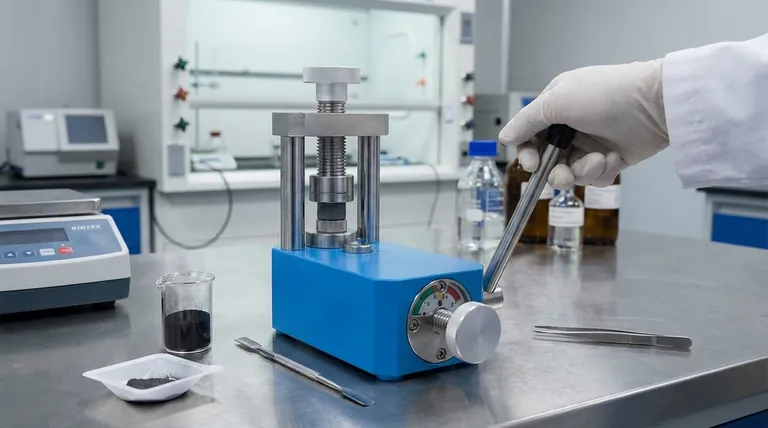
High-pressure forming is the definitive step that transforms a loose powder mixture into a functional electrochemical system. By applying significant force via a laboratory hydraulic press, you mechanically compel solid particles into intimate contact, establishing the physical continuity required for the battery to function.
In solid-state batteries, materials do not naturally "wet" each other like liquid electrolytes do. Consequently, high-pressure forming is the only mechanism to convert weak "point contacts" into broad "surface contacts," drastically reducing interfacial impedance and enabling the efficient ion transport necessary for high performance.
Overcoming the Solid-Solid Interface Challenge
Eliminating Internal Voids
The primary mechanical goal of the hydraulic press is densification. A loose mixture of active materials and solid electrolytes contains significant interstitial air voids. Applying uniaxial pressure compacts these particles, effectively eliminating voids and creating a uniformly dense electrode sheet or pellet.
Forcing Plastic Deformation
Rigid components, such as garnet-type electrolytes, resist natural bonding with electrode materials. Pressure forces softer materials (like metallic lithium or polymers) to undergo plastic deformation. This deformation allows the softer material to flow into and fill microscopic surface irregularities on the harder particles, maximizing the effective contact area.
Establishing the Conductive Network
Creating Pathways for Transport
A battery cannot function without a continuous highway for charged particles. High-pressure forming establishes a dense, interconnected network that facilitates both ion and electron transport. This microstructure is fundamental; without it, isolated particles become electrochemically inactive, severely limiting capacity.
Reducing Interfacial Impedance
The greatest barrier to solid-state battery performance is high resistance at the particle boundaries. By physically forcing particles together, you lower the interfacial impedance. This low-impedance environment is a prerequisite for achieving superior rate performance and high power output.
The Synergistic Role of Hot Pressing
Enhancing Contact through Softening
When heat is combined with pressure (hot pressing), the fabrication process becomes significantly more effective. Controlled temperatures soften polymeric components (like PEO) or electrolytes with low bulk modulus. This softening allows the binder or electrolyte to "wet" and encapsulate active material particles, creating a seamless interface similar to a liquid electrolyte.
In-Situ Annealing and Crystallinity
Hot pressing serves a dual purpose: formation and treatment. The process acts as an in-situ annealing treatment during the densification phase. This can improve the crystallinity of the electrolyte, which directly enhances the ionic conductivity of the final composite electrode.
Critical Considerations in Fabrication
The Necessity of "Active" Force
Unlike liquid systems, solid-state components are mechanically passive. They will not settle or bond over time on their own; the interface established during pressing is the interface you are stuck with. Therefore, the initial application of pressure determines the permanent mechanical integrity and stability of the cathode.
Efficiency via Sintering
For high-loading electrodes, standard cold pressing may be insufficient. High-pressure, high-temperature sintering creates rapid densification. This advanced technique achieves excellent interfacial contact in a very short time, making it ideal for high-performance applications.
Making the Right Choice for Your Goal
To maximize the effectiveness of your laboratory press, align your technique with your specific material properties:
- If your primary focus is basic mechanical integrity: Utilize cold uniaxial pressure to establish the initial density and strength required for handling electrode sheets.
- If your primary focus is polymer-based or hybrid electrolytes: Employ a heated platen (hot press) to soften the polymer matrix, ensuring it flows around and encapsulates the active material particles.
- If your primary focus is maximizing ionic conductivity: Combine heat and pressure to induce in-situ annealing, improving the crystallinity of the electrolyte while densifying the structure.
Ultimately, the laboratory press is not just a shaping tool; it is the architect of the low-resistance pathways that define your battery's potential.
Summary Table:
| Aspect | Cold Pressing | Hot Pressing |
|---|---|---|
| Primary Goal | Mechanical integrity, basic densification | Enhanced particle contact, in-situ annealing |
| Best For | Handling strength, initial electrode formation | Polymer-based electrolytes, maximizing ionic conductivity |
| Key Benefit | Eliminates air voids, establishes initial contact | Softens materials, improves crystallinity |
Ready to optimize your solid-state battery electrode fabrication? KINTEK specializes in lab press machines (automatic lab press, isostatic press, heated lab press, etc.), serving laboratory needs. Our hydraulic presses are designed to deliver the precise pressure and temperature control required to build dense, low-impedance composite cathodes. Contact us today to discuss how our solutions can enhance your battery research and development!
Visual Guide

Related Products
- Laboratory Hydraulic Press Lab Pellet Press Button Battery Press
- Laboratory Hydraulic Press 2T Lab Pellet Press for KBR FTIR
- Laboratory Hydraulic Press Lab Pellet Press Machine for Glove Box
- 24T 30T 60T Heated Hydraulic Lab Press Machine with Hot Plates for Laboratory
- Automatic Laboratory Hydraulic Press Lab Pellet Press Machine
People Also Ask
- How is a laboratory hydraulic press used for HAP composite gels? Master Mineral Substrate Standardization
- What role does a laboratory hydraulic press play in the preparation of piezoelectric ceramic discs for DC-PG? | KINTEK
- What role does a laboratory hydraulic press play in reaction pellets? Optimizing Lunar Soil and Metal Fuel Density
- Why is a laboratory hydraulic press required for PBAT and PLA sample preparation? Achieve Flawless Characterization
- What role does a laboratory hydraulic press play in the assembly of all-solid-state battery test cells? Expert Guide



















