
Applying a precise uniaxial pressure of 2 t/cm² is the critical first step in determining the chemical success of your LCO/LATP composite. This specific pressure is required to maximize the packing density of the powder mixture, forcing the cathode (LCO) and electrolyte (LATP) particles into intimate physical contact. Without this high-density interface, the subsequent high-temperature solid-state reaction cannot proceed effectively, leading to a non-uniform product phase.
The "green pellet" stage is not merely about shaping powder; it is about establishing the microscopic architecture of the battery interface. Without sufficient initial density and particle-to-particle contact, subsequent sintering will fail to produce a chemically uniform or mechanically stable conductor.
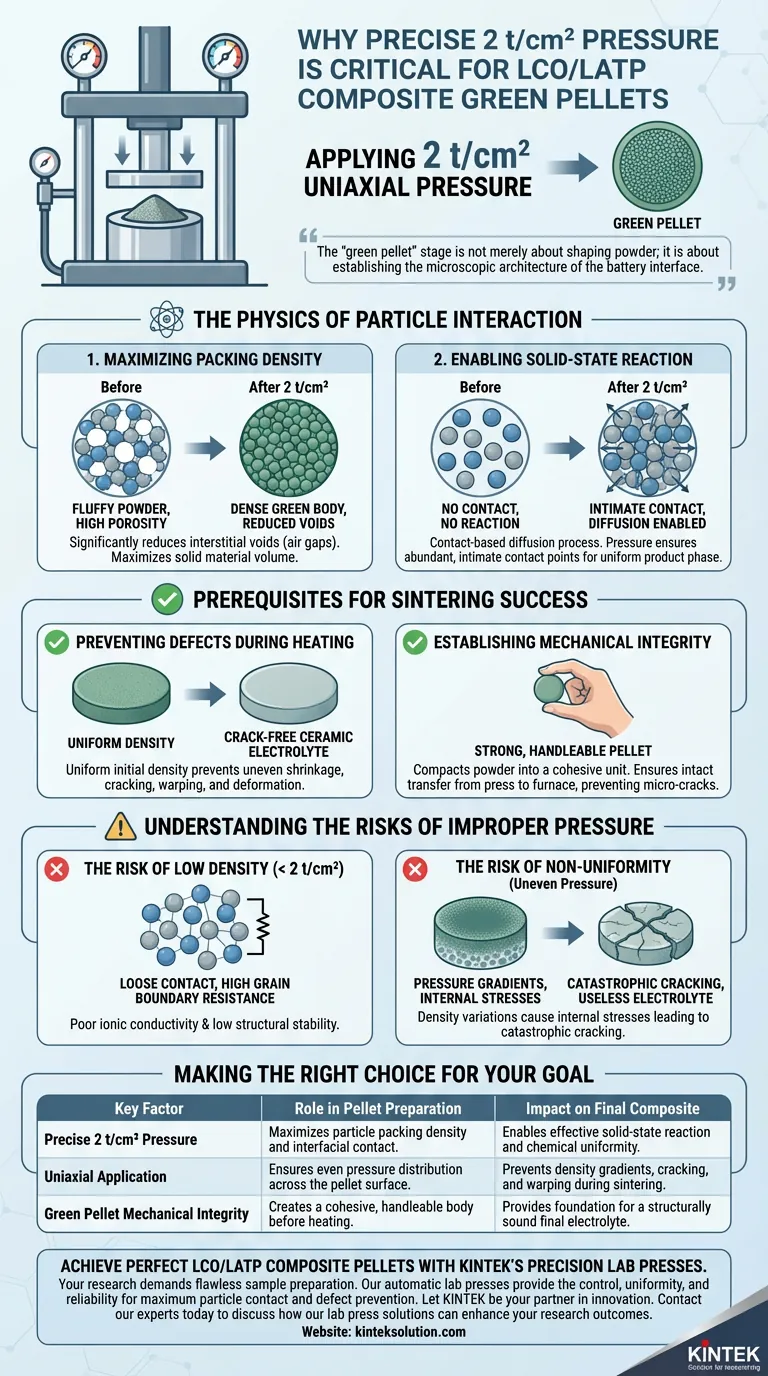
The Physics of Particle Interaction
Maximizing Packing Density
The primary goal of applying 2 t/cm² is to significantly reduce the interstitial voids (air gaps) between loose powder particles.
When you mix LCO and LATP, the powder is naturally fluffy and full of porosity.
High uniaxial pressure compacts these particles, creating a dense "green body" where the volume of solid material is maximized relative to the total volume.
Enabling the Solid-State Reaction
For LCO and LATP to form a composite, they must undergo a reaction during the sintering phase.
This reaction is a contact-based diffusion process. It can only occur if the LCO and LATP particles are physically touching.
The 2 t/cm² pressure ensures these contact points are abundant and intimate, providing the physical foundation necessary for the reaction to form a uniform product phase.
Prerequisites for Sintering Success
Preventing Defects During Heating
A well-pressed pellet is the best defense against macroscopic failure during sintering.
If the initial density is non-uniform or too low, the pellet will shrink unevenly when heated.
This uneven shrinkage is a primary cause of cracking, warping, and deformation in the final ceramic ceramic electrolyte.
Establishing Mechanical Integrity
Before sintering, the pellet must be strong enough to be handled.
Applying precise pressure compacts the loose powder into a cohesive unit with sufficient mechanical strength.
This ensures the sample remains intact during the transfer from the press to the furnace, preventing micro-cracks that could propagate later.
Understanding the Risks of Improper Pressure
While applying pressure is vital, the precision and uniformity of that pressure are equally critical.
The Risk of Low Density
If the pressure is insufficient (significantly below 2 t/cm²), the particle contact remains loose.
This leads to high "grain boundary resistance," where ions cannot easily jump from particle to particle.
The result is a final product with poor ionic conductivity and low structural stability.
The Risk of Non-Uniformity
Using a laboratory hydraulic press is necessary to ensure the pressure is applied evenly across the surface (uniaxial).
Uneven pressure gradients create density variations within the pellet.
During sintering, these variations cause internal stresses that lead to catastrophic cracking, rendering the electrolyte useless for battery testing.
Making the Right Choice for Your Goal
Achieving a high-performance LCO/LATP composite requires viewing the pressing stage as a chemical enabler, not just a shaping step.
- If your primary focus is Chemical Uniformity: Prioritize reaching the full 2 t/cm² to ensure maximum interfacial contact, which is the catalyst for a complete solid-state reaction.
- If your primary focus is Mechanical Stability: Focus on the uniformity of the pressure application to prevent density gradients that lead to cracking during sintering.
By treating the green pellet formation as a precise engineering step, you lay the groundwork for a dense, high-conductivity, and structurally sound solid-state battery component.
Summary Table:
| Key Factor | Role in Pellet Preparation | Impact on Final Composite |
|---|---|---|
| Precise 2 t/cm² Pressure | Maximizes particle packing density and interfacial contact. | Enables effective solid-state reaction and chemical uniformity. |
| Uniaxial Application | Ensures even pressure distribution across the pellet surface. | Prevents density gradients, cracking, and warping during sintering. |
| Green Pellet Mechanical Integrity | Creates a cohesive, handleable body before heating. | Provides foundation for a structurally sound final electrolyte. |
Achieve perfect LCO/LATP composite pellets with KINTEK's precision lab presses.
Your research on solid-state batteries demands flawless sample preparation. The precise 2 t/cm² uniaxial pressure required for successful LCO/LATP composites is exactly what KINTEK's hydraulic presses are designed to deliver. Our automatic lab presses, isostatic presses, and heated lab presses provide the control, uniformity, and reliability necessary to ensure maximum particle contact and prevent sintering defects.
Let KINTEK be your partner in innovation. We specialize in equipment that serves critical laboratory needs, helping you build the foundation for high-performance, high-conductivity battery components.
Contact our experts today to discuss how our lab press solutions can enhance your research outcomes.
Visual Guide
Related Products
- Laboratory Hydraulic Press Lab Pellet Press Machine for Glove Box
- Automatic Laboratory Hydraulic Press Lab Pellet Press Machine
- Manual Laboratory Hydraulic Pellet Press Lab Hydraulic Press
- Laboratory Hydraulic Split Electric Lab Pellet Press
- Laboratory Hydraulic Press Lab Pellet Press Button Battery Press
People Also Ask
- How does a laboratory hydraulic press contribute to the preparation of Li3-3xScxSb samples? Optimize Ionic Conductivity
- What is the function of a laboratory hydraulic press in FT-IR of curcumin-coated MWCNTs? Achieve Optical Clarity.
- Why is a laboratory hydraulic press required for compression molding boron-siloxane? Solve High-Loading Density Challenges
- What role does a laboratory hydraulic press play in reaction pellets? Optimizing Lunar Soil and Metal Fuel Density
- What role does a laboratory hydraulic press play in the preparation of piezoelectric ceramic discs for DC-PG? | KINTEK



















