
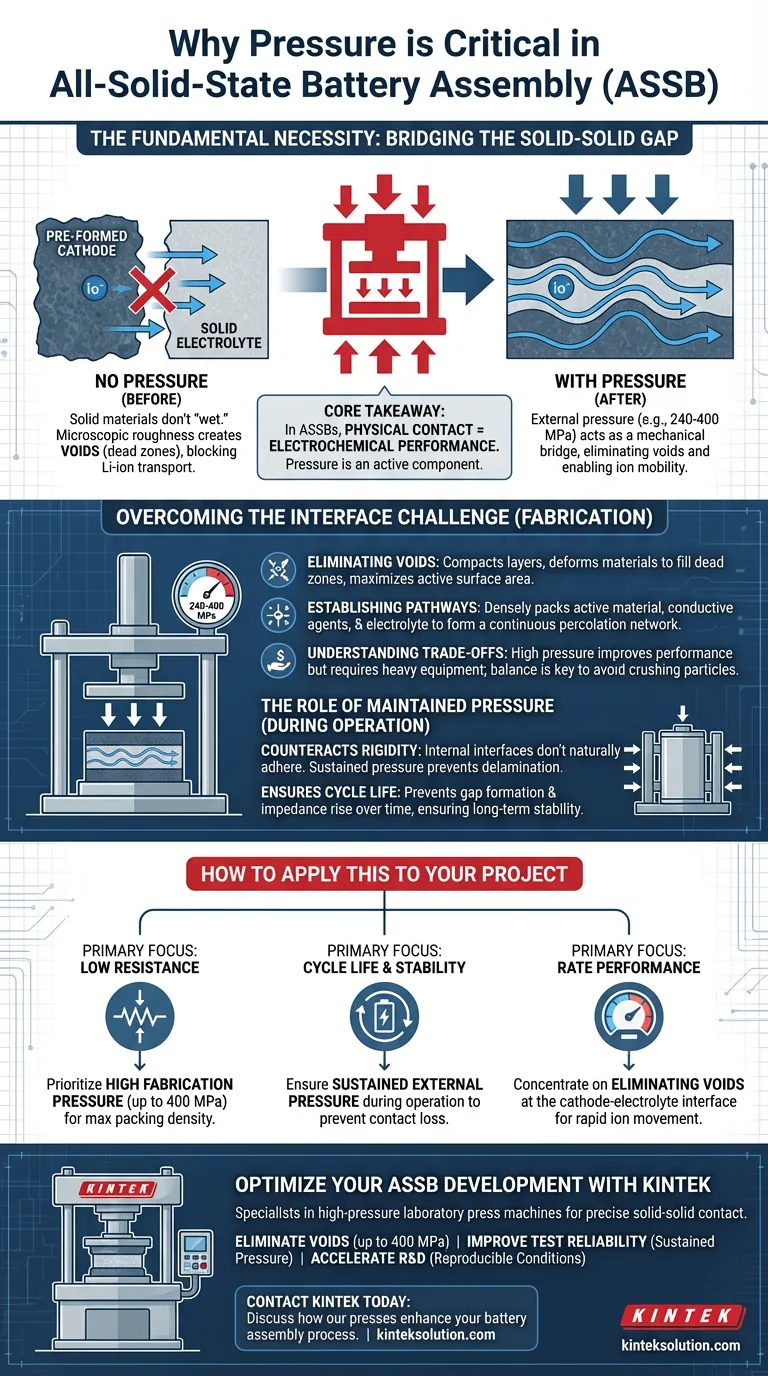
The fundamental necessity of applying and maintaining pressure in all-solid-state battery (ASSB) assembly stems from the inherent inability of solid materials to "wet" a surface.
Unlike liquid electrolytes, which naturally permeate porous electrodes to create contact, solid components are rigid and rough on a microscopic level. You must apply significant external pressure to force the pre-formed cathode sheet and the solid electrolyte into an intimate, seamless interface; without this, the resulting gaps act as insulators that block lithium-ion transport and render the cell non-functional.
Core Takeaway In solid-state batteries, physical contact is synonymous with electrochemical performance. External pressure acts as the mechanical bridge that eliminates voids and lowers interfacial resistance, enabling the ion mobility required for high capacity and long cycle life.
Overcoming the Solid-Solid Interface Challenge
The Physics of Microscopic Roughness
On a microscopic scale, even a "smooth" pre-formed cathode sheet is rough and uneven. When placed against a solid electrolyte layer without pressure, these surfaces only touch at a few discrete points.
Eliminating Voids and Dead Zones
The gaps between the contact points create voids. In an electrochemical system, a void is essentially a dead zone where no ionic transport can occur.
Applying pressure—often between 240 MPa and 400 MPa during fabrication—compacts these layers. This forces the materials to deform slightly, filling these voids and maximizing the active surface area available for reaction.
Establishing Transport Pathways
For a battery to function, it requires continuous pathways for both lithium ions and electrons. Pressure ensures that the active material, conductive agents, and solid electrolyte particles are packed densely enough to touch.
This "intimate contact" creates the necessary percolation network. If this network is interrupted by low pressure, internal resistance spikes, and the battery's ability to deliver power (rate performance) collapses.
The Critical Role of Maintained Pressure
Counteracting Interfacial Rigidity
References indicate that maintaining pressure is just as critical as the initial application. Because the internal interfaces are rigid, they do not naturally adhere to one another like sticky polymers or liquids might.
Ensuring Cycle Life Viability
As the battery operates, the "quality" of the contact directly influences cycle life. If pressure is released or insufficient, the interface may delaminate or degrade.
Sustained pressure keeps the cathode sheet and electrolyte pinned together, preventing the formation of gaps that would otherwise increase impedance over time.
Understanding the Trade-offs
The Engineering Burden
While high pressure is beneficial for electrochemistry, it introduces significant engineering challenges. Achieving pressures like 400 MPa requires heavy, specialized equipment (such as hydraulic presses) that may be difficult to scale for commercial applications.
Balancing Microstructure and Integrity
There is a nuanced balance to be struck regarding fabrication pressure. While higher pressure generally increases packing density and reduces resistance, it must be "appropriate."
The goal is to densify the pellets and sheets without crushing the active particles or damaging the structural integrity of the cell components.
How to Apply This to Your Project
To maximize the performance of your all-solid-state cells, align your pressure strategy with your specific testing metrics:
- If your primary focus is reducing internal resistance: Prioritize high fabrication pressure (up to 400 MPa) to maximize packing density and create the most efficient ion-transport pathways possible.
- If your primary focus is cycle life and stability: Ensure your testing apparatus applies sustained external pressure to prevent contact loss at the rigid interfaces during operation.
- If your primary focus is rate performance: Concentrate on eliminating all internal voids at the cathode-electrolyte interface, as this specific contact resistance acts as a bottleneck for rapid ion movement.
Treat pressure not as a manufacturing step, but as an active component of the battery cell itself.
Summary Table:
| Pressure Parameter | Impact on Cell Performance |
|---|---|
| Fabrication Pressure (240-400 MPa) | Compacts layers, deforms materials to fill voids, and maximizes active surface area for ion transport. |
| Maintained Pressure (During Operation) | Prevents delamination and contact loss at rigid interfaces, ensuring cycle life stability. |
| Primary Focus: Low Resistance | Apply high fabrication pressure (up to 400 MPa) to maximize packing density. |
| Primary Focus: Cycle Life | Ensure testing apparatus applies sustained external pressure during operation. |
Optimize Your All-Solid-State Battery Development with KINTEK
Are you developing pre-formed cathode sheets or other ASSB components? Achieving the precise, high pressures required for intimate solid-solid contact is a major challenge. KINTEK specializes in laboratory press machines, including automatic lab presses and isostatic presses, designed to deliver the controlled, high-pressure conditions your research demands.
Our equipment helps you:
- Eliminate Interfacial Voids: Apply consistent pressures up to 400 MPa to create seamless ion transport pathways.
- Improve Test Reliability: Maintain pressure during cycling to ensure accurate data on cycle life and stability.
- Accelerate R&D: Reproduce precise fabrication conditions batch after batch.
Let our expertise in lab press solutions support your quest for higher energy density and longer-lasting solid-state batteries.
Contact KINTEK today to discuss how our presses can enhance your battery assembly process.
Visual Guide
Related Products
- Warm Isostatic Press for Solid State Battery Research Warm Isostatic Press
- Lab Button Battery Tablet Press Sealing Mold
- Button Battery Sealing Press Machine for Lab
- Laboratory Hydraulic Press Lab Pellet Press Button Battery Press
- Carbide Lab Press Mold for Laboratory Sample Preparation
People Also Ask
- Why must composite cathodes be sealed in vacuum lamination bags for WIP? Ensure Battery Stability and Density
- What is the function of elastic molds in warm isostatic pressing? Achieve Uniform Density in Composite Particles
- How do sacrificial volume materials (SVM) maintain microchannels in isostatic pressing? Ensure Structural Integrity
- How does Warm Isostatic Pressing differ from traditional pressing methods? Unlock Uniform Density for Complex Parts
- What is the role of the flexible material in warm isostatic pressing? Key to Uniform Density & Precision








