
The stainless steel tube acts as a critical mechanical interface between the HIP machinery and the Li2MnSiO4/C powder. Without this encapsulation, the isostatic gas used in the process would simply permeate the porous powder rather than compressing it. The tube provides a deformable barrier that transmits external pressure uniformly while simultaneously functioning as a sealed "micro-reactor" to facilitate synthesis in a controlled environment.
The encapsulation serves two non-negotiable functions: it transforms isostatic gas pressure into the mechanical force required for densification, and it hermetically seals the precursor to ensure chemical purity during high-temperature synthesis.
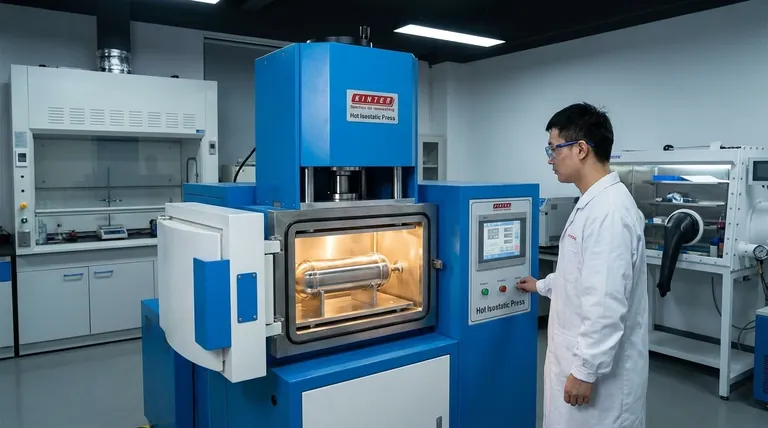
The Mechanics of Pressure Transmission
To understand why encapsulation is necessary, you must first understand the limitations of Hot Isostatic Pressing (HIP) when applied to loose powders.
Converting Gas Pressure to Mechanical Force
HIP systems typically use inert gas (like argon) to apply pressure. If the Li2MnSiO4/C powder were exposed directly to this gas, the gas atoms would penetrate the spaces between powder particles.
Because the internal pressure would equal the external pressure, no compaction or densification would occur. The stainless steel tube creates a physical barrier. As the external gas pressure rises, it squeezes the tube, effectively transmitting that force effectively to the powder inside.
Ensuring Uniform Densification
The references define the stainless steel tube as a "pressure transmission medium."
Because the pressure in a HIP unit is isostatic (applied equally from all directions), the tube deforms uniformly. This ensures that the powder is compacted evenly, preventing density gradients that could lead to structural weaknesses in the final material.
Environmental Isolation and Purity
Beyond mechanics, the tube plays a vital chemical role during the synthesis of Li2MnSiO4/C.
The "Micro-Reactor" Concept
The references describe the tube as a "sealed micro-reactor." This is critical because the process involves not just compaction, but a synthesis reaction under high temperature and pressure.
The tube contains the reactants within a defined volume. This isolation guarantees that the stoichiometry of the Li2MnSiO4/C mixture remains consistent throughout the reaction.
Preventing Cross-Contamination
High-temperature environments increase the risk of chemical impurities. The stainless steel barrier prevents the pressure medium (the gas) from reacting with the sample.
Conversely, it prevents the sample itself from off-gassing or contaminating the HIP vessel. This isolation ensures that the synthesis proceeds in a "controlled and isolated environment," yielding a pure final product.
Critical Process Constraints
While encapsulation enables the HIP process, it introduces specific operational requirements that must be managed to ensure success.
The Requirement for Vacuum Sealing
Encapsulation is not effective if air remains trapped inside the tube. As noted in parallel processes (such as with IN718 powder), air trapped in gaps can lead to atmospheric contamination.
You must evacuate the canister to a high vacuum (e.g., 1.0 × 10⁻³ Pa) to remove air and moisture before sealing. Failure to do so can result in the formation of oxides during the high-temperature phase, compromising the material's mechanical performance.
Material Compatibility
The canister material must be chosen carefully. It acts as a pressure vessel on a micro-scale.
It must be malleable enough to deform under pressure to transmit force, yet robust enough to withstand the high thermal loads without failing or melting into the sample. Stainless steel is selected specifically for its ability to maintain integrity under these dual stresses.
Making the Right Choice for Your Goal
The use of a stainless steel tube is a calculated engineering decision to bridge the gap between loose powder and a solid, high-density component.
- If your primary focus is densification: Ensure the tube geometry allows for uniform deformation to transmit the isostatic pressure evenly to the powder core.
- If your primary focus is chemical purity: Prioritize the vacuum evacuation step to remove all moisture and air from the tube before sealing to prevent oxidation.
Success in this process relies on treating the encapsulation not just as a container, but as an active component in the thermodynamic system.
Summary Table:
| Function | Purpose |
|---|---|
| Pressure Transmission | Converts isostatic gas pressure into mechanical force for uniform powder densification. |
| Environmental Isolation | Creates a sealed micro-reactor to maintain stoichiometry and prevent contamination. |
| Vacuum Sealing Requirement | Ensures removal of air/moisture to prevent oxidation during high-temperature synthesis. |
| Material Compatibility | Uses malleable yet robust stainless steel to withstand thermal and pressure stresses. |
Achieve Perfect Material Synthesis with KINTEK's Expertise
Mastering the nuances of encapsulation and Hot Isostatic Pressing is key to producing high-density, pure materials like Li2MnSiO4/C. KINTEK specializes in providing robust laboratory press solutions, including isostatic presses, that deliver the precise pressure and temperature control required for your advanced material synthesis.
Our equipment ensures uniform densification and a contamination-free environment, helping you achieve consistent, high-quality results. Let our expertise support your research and development goals.
Contact KINTEK today to discuss how our lab press machines can enhance your material synthesis processes.
Visual Guide

Related Products
- Warm Isostatic Press for Solid State Battery Research Warm Isostatic Press
- Electric Lab Cold Isostatic Press CIP Machine
- Electric Split Lab Cold Isostatic Pressing CIP Machine
- Lab Isostatic Pressing Molds for Isostatic Molding
- Manual Cold Isostatic Pressing CIP Machine Pellet Press
People Also Ask
- Why must composite cathodes be sealed in vacuum lamination bags for WIP? Ensure Battery Stability and Density
- What is the function of elastic molds in warm isostatic pressing? Achieve Uniform Density in Composite Particles
- How do sacrificial volume materials (SVM) maintain microchannels in isostatic pressing? Ensure Structural Integrity
- What is the mechanism of a Warm Isostatic Press (WIP) on cheese? Master Cold Pasteurization for Superior Safety
- What is the function of hydraulic pressure in warm isostatic pressing? Achieve Uniform Material Density



















