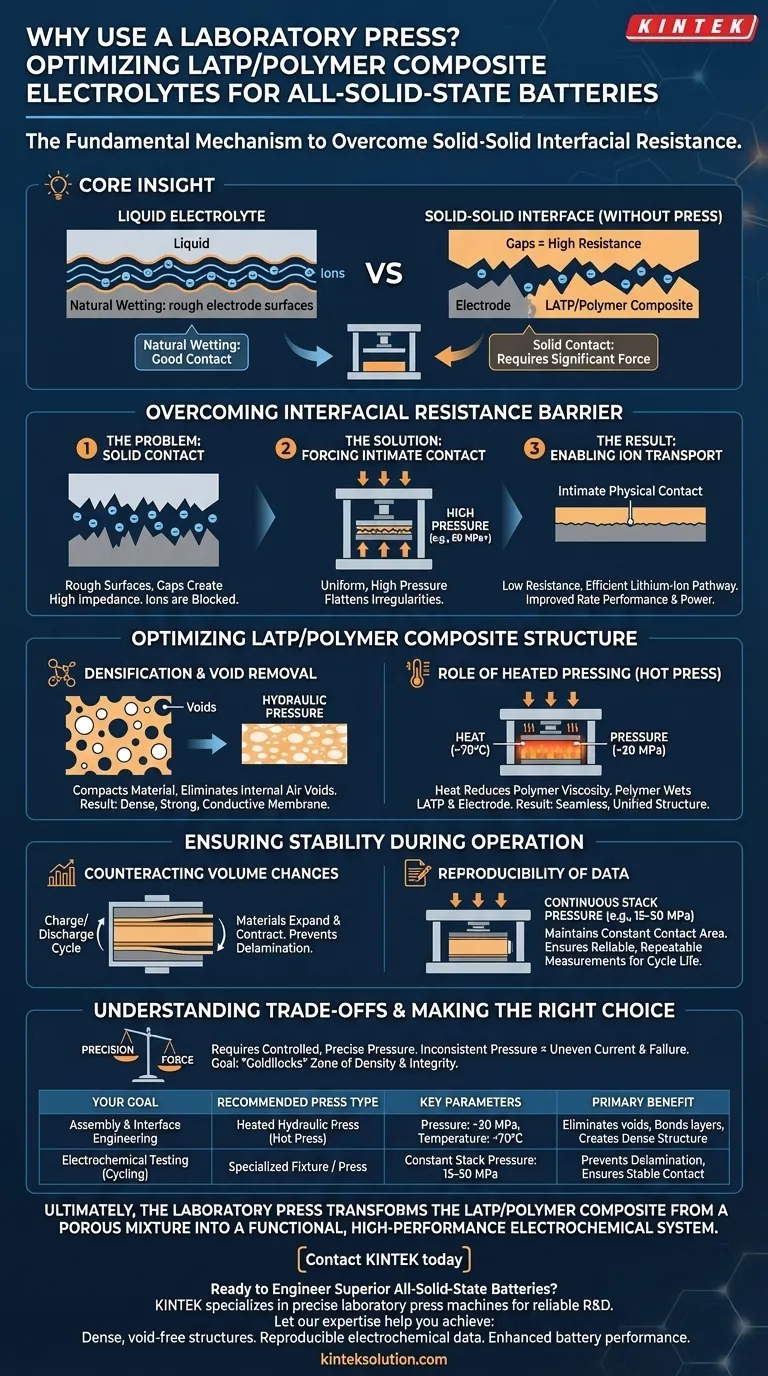
The application of precise pressure via a laboratory press is the fundamental mechanism required to overcome the inherent physical limitations of solid-solid interfaces. Unlike liquid electrolytes that naturally wet electrode surfaces, LATP/polymer composite electrolytes require significant, uniform force to establish the atomic-level contact necessary for lithium-ion transport.
Core Insight In all-solid-state batteries, the "solid-solid" interface is the primary bottleneck for performance due to high interfacial resistance. A laboratory press is not merely for assembly; it acts as an active tool to engineer the material structure, ensuring intimate contact and eliminating voids to create a continuous, low-impedance pathway for ions.
Overcoming the Interfacial Resistance Barrier
The primary challenge in solid-state batteries (SSBs) is moving lithium ions across the boundary between the electrode and the solid electrolyte.
The Problem of Solid Contact
Solids have rough microscopic surfaces. When placed together without force, they touch only at specific peaks, leaving gaps. These gaps create high interfacial resistance (impedance), effectively blocking ion movement.
Forcing Intimate Contact
A laboratory press applies uniform, high pressure (often 60 MPa or more during assembly) to flatten these microscopic irregularities. This creates "intimate physical contact" between the composite electrolyte and the electrodes. This contact is a prerequisite for reducing interfacial resistance and enabling the battery to function effectively.
Enabling Ion Transport
By minimizing resistance, the press establishes efficient pathways for lithium-ion transport. This directly correlates to the battery’s rate performance (how fast it can charge/discharge) and its overall power output.
Optimizing the LATP/Polymer Composite Structure
When working specifically with LATP (Lithium Aluminum Titanium Phosphate) and polymer composites, the press plays a dual role in material engineering.
Densification and Void Removal
Composite electrolytes often begin as loose or porous structures containing internal air bubbles. Hydraulic pressure compacts the material, eliminating these internal voids. This results in a dense, homogeneous membrane that is mechanically stronger and more conductive.
The Role of Heated Pressing
Using a heated laboratory press (hot press) offers a distinct advantage for polymer-based systems. Heat (e.g., 70°C) reduces the viscosity of the polymer binder, allowing it to flow. Combined with pressure (e.g., 20 MPa), the softened polymer wets the LATP filler particles and the electrode surface, creating a seamless, unified structure.
Ensuring Stability During Operation
Pressure is not only required for initial assembly but often must be maintained during testing to ensure data reliability.
Counteracting Volume Changes
Battery materials expand and contract during charge and discharge cycles. Without external pressure, this volume change can cause layers to delaminate or separate. Applying continuous stack pressure (e.g., 15–50 MPa) prevents this separation.
Reproducibility of Data
To measure properties like ionic conductivity accurately, the contact area must remain constant. A press or testing fixture ensures the interface does not degrade over time. This is critical for obtaining repeatable, reliable measurements of cycling stability and cycle life.
Understanding the Trade-offs
While pressure is essential, the "more is better" approach has limitations that require precise control.
The Necessity of Precision
The references emphasize "controlled" and "precise" pressure, not just maximum force. Inconsistent pressure leads to uneven current distribution, which can cause localized failure or inconsistent data.
Balancing Flow and Integrity
In hot pressing, the balance between temperature and pressure is critical. The goal is to soften the polymer enough to flow and fill voids, but not so much that it deforms the cell geometry or squeezes the electrolyte out of the interface. The laboratory press provides the fine control needed to hit this "Goldilocks" zone of density and structural integrity.
Making the Right Choice for Your Goal
Depending on your specific stage of research or development, your use of the laboratory press should adapt.
- If your primary focus is Assembly and Interface Engineering: Use a heated hydraulic press (hot press) to soften the polymer matrix, eliminate voids, and bond the LATP composite to the electrodes into a dense, unified stack.
- If your primary focus is Electrochemical Testing (Cycling): Use a specialized fixture or press to apply constant stack pressure (e.g., 15–50 MPa) to counteract volume expansion and prevent delamination during charge/discharge cycles.
Ultimately, the laboratory press transforms the LATP/polymer composite from a porous mixture into a functional, high-performance electrochemical system.
Summary Table:
| Application Goal | Recommended Press Type | Key Parameters | Primary Benefit |
|---|---|---|---|
| Assembly & Interface Engineering | Heated Hydraulic Press (Hot Press) | Pressure: ~20 MPa, Temperature: ~70°C | Eliminates voids, bonds layers, creates dense structure |
| Electrochemical Testing (Cycling) | Specialized Fixture / Press | Constant Stack Pressure: 15–50 MPa | Prevents delamination, ensures stable contact during cycling |
Ready to Engineer Superior All-Solid-State Batteries?
Precise pressure control is fundamental to overcoming interfacial resistance and optimizing the performance of your LATP/polymer composite electrolytes. KINTEK specializes in laboratory press machines—including automatic, isostatic, and heated lab presses—designed to deliver the exact pressure and temperature control required for reliable R&D and testing.
Let our expertise in lab press technology help you achieve:
- Dense, void-free composite structures for lower impedance.
- Reproducible and reliable electrochemical data for accurate analysis.
- Enhanced battery performance through optimized material engineering.
Contact KINTEK today to discuss your specific application and discover the perfect lab press solution for your laboratory's needs.
Visual Guide
References
- Jiaqi Yang, Jinping Liu. Recent Advances in <scp>LATP</scp> /Polymer Composite Electrolytes for Solid‐State Lithium Batteries. DOI: 10.1002/eem2.70090
This article is also based on technical information from Kintek Solution Knowledge Base .
Related Products
- Warm Isostatic Press for Solid State Battery Research Warm Isostatic Press
- Button Battery Sealing Press Machine for Lab
- Laboratory Hydraulic Press Lab Pellet Press Button Battery Press
- Carbide Lab Press Mold for Laboratory Sample Preparation
- Lab Infrared Press Mold for Laboratory Applications
People Also Ask
- Why must composite cathodes be sealed in vacuum lamination bags for WIP? Ensure Battery Stability and Density
- How do sacrificial volume materials (SVM) maintain microchannels in isostatic pressing? Ensure Structural Integrity
- What is the function of elastic molds in warm isostatic pressing? Achieve Uniform Density in Composite Particles
- What is the mechanism of a Warm Isostatic Press (WIP) on cheese? Master Cold Pasteurization for Superior Safety
- How does Warm Isostatic Pressing differ from traditional pressing methods? Unlock Uniform Density for Complex Parts