
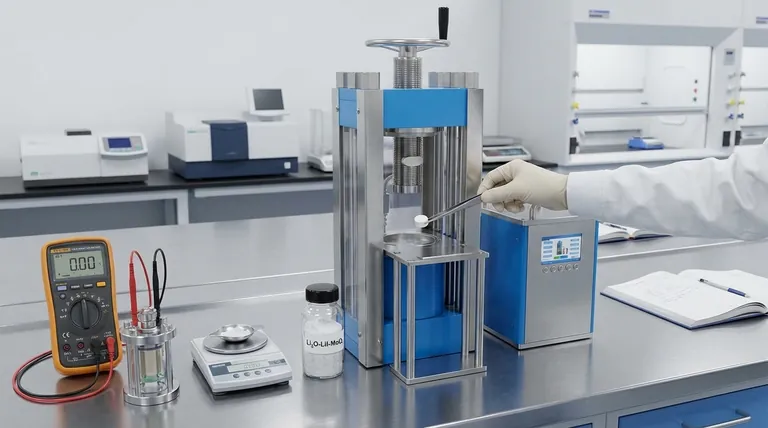
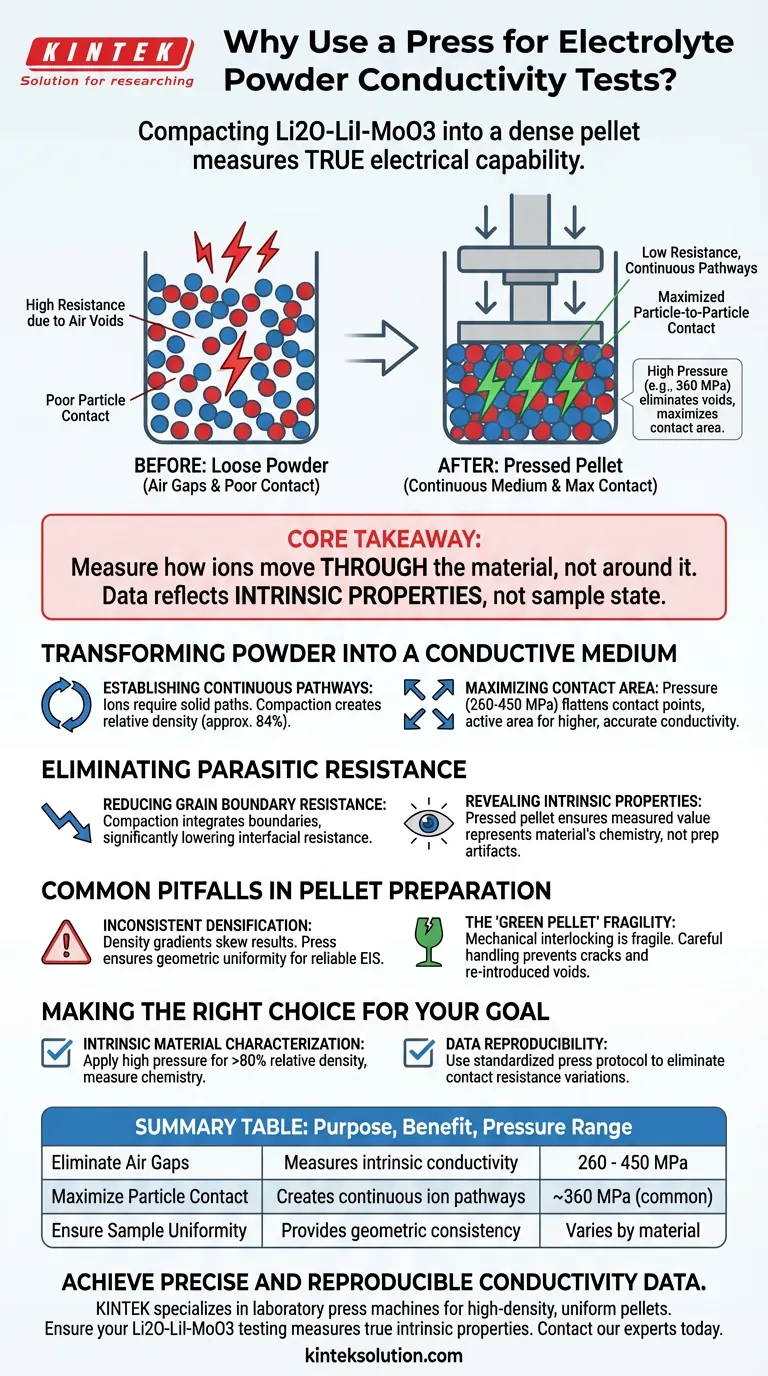
Compacting Li2O-LiI-MoO3 powder into a dense pellet is the only way to measure its true electrical capability. Without this step, you are primarily measuring the high resistance of the air gaps and poor contact points between particles, rather than the intrinsic conductivity of the material itself. To obtain accurate data, you must transform the loose powder into a solid, continuous medium using high pressure (typically around 360 MPa).
Core Takeaway: The goal of conductivity testing is to measure how well ions move through a material, not around it. Using a press machine eliminates voids and maximizes particle-to-particle contact, ensuring the resulting data reflects the intrinsic properties of the electrolyte rather than the physical state of the sample.
Transforming Powder into a Conductive Medium
Establishing Continuous Pathways
Ions in a solid-state electrolyte like Li2O-LiI-MoO3 cannot travel through air. They require a continuous solid path to migrate from one side of the sample to the other.
Loose powder contains significant void space which acts as an electrical insulator. By compressing the material into a pellet with high relative density (approximately 84%), you physically force the particles together to close these gaps.
Maximizing Contact Area
Conductivity is directly dependent on the surface area available for charge transfer. In a loose state, particles barely touch, creating "bottlenecks" for current flow.
Applying varying degrees of high pressure (often ranging from 260 MPa to 450 MPa depending on the specific material) flattens these contact points against each other. This maximizes the active area through which lithium ions can pass, leading to a higher and more accurate conductivity reading.
Eliminating Parasitic Resistance
Reducing Grain Boundary Resistance
The interface where two powder particles meet is called a grain boundary. In loose powders, these boundaries present extremely high resistance to ion flow.
If you test without pressing, the grain boundary resistance dominates the measurement, obscuring the actual performance of the electrolyte. Compaction integrates these boundaries, significantly lowering the interfacial resistance so the current travels primarily through the bulk material.
Revealing Intrinsic Properties
Scientific analysis generally aims to determine intrinsic properties—how conductive the chemical compound is by nature.
Testing unpressed powder creates "extrinsic" artifacts caused by sample preparation flaws. A pressed pellet ensures that the measured conductivity value is a true representation of the material's chemistry, allowing for valid comparisons with other electrolytes.
Common Pitfalls in Pellet Preparation
Inconsistent Densification
Achieving a high-density pellet is not just about applying pressure; it is about applying uniform pressure.
If the pellet has density gradients (areas that are less packed than others), the current will take the path of least resistance, potentially skewing results. A laboratory press ensures the geometric uniformity required for reliable Electrochemical Impedance Spectroscopy (EIS).
The "Green Pellet" Fragility
While pressing creates a solid form, the resulting "green pellet" relies on mechanical interlocking rather than chemical bonding (which occurs during sintering).
It creates a solid foundation for measurement, but the pellet must be handled carefully to maintain its integrity. Any cracks introduced after pressing will re-introduce voids and ruin the validity of the conductivity test.
Making the Right Choice for Your Goal
To get the most out of your Li2O-LiI-MoO3 conductivity tests, align your preparation method with your specific analytical needs.
- If your primary focus is Intrinsic Material Characterization: Apply high pressure (e.g., 360 MPa) to achieve >80% relative density, ensuring you are measuring the chemistry, not the porosity.
- If your primary focus is Data Reproducibility: Use a standardized press protocol for every single sample to eliminate variations in contact resistance that could be mistaken for material differences.
By eliminating the variable of physical contact, you empower your data to tell the true story of your material's performance.
Summary Table:
| Purpose of Pressing | Key Benefit | Typical Pressure Range |
|---|---|---|
| Eliminate Air Gaps | Measures intrinsic conductivity, not air resistance | 260 - 450 MPa |
| Maximize Particle Contact | Creates continuous ion pathways for accurate data | ~360 MPa (common) |
| Ensure Sample Uniformity | Provides geometric consistency for reliable EIS testing | Varies by material |
Achieve precise and reproducible conductivity data for your solid-state electrolytes.
KINTEK specializes in laboratory press machines, including automatic and heated lab presses, designed to create the high-density, uniform pellets essential for accurate material characterization. Ensure your Li2O-LiI-MoO3 testing measures true intrinsic properties—not sample preparation artifacts.
Contact our experts today to find the perfect press for your laboratory's needs.
Visual Guide
Related Products
- Lab XRF Boric Acid Powder Pellet Pressing Mold for Laboratory Use
- XRF KBR Plastic Ring Lab Powder Pellet Pressing Mold for FTIR
- Laboratory Hydraulic Split Electric Lab Pellet Press
- XRF KBR Steel Ring Lab Powder Pellet Pressing Mold for FTIR
- Automatic Laboratory Hydraulic Press Lab Pellet Press Machine
People Also Ask
- Why are pellets used in XRF analysis, and what is their limitation? Boost Accuracy and Speed in Your Lab
- What are the primary factors to consider when deciding between a manual and an automatic XRF pellet press? Optimize Your Lab's Efficiency
- What are the differences between manual and automatic XRF pellet presses? Choose the Right Press for Your Lab's Needs
- What are the different pellet pressing options for XRF sample preparation? Choose the Best Method for Accurate Analysis
- What are specialized XRF pellet preparation presses designed for? Boost Lab Efficiency with High-Throughput Automation



















