
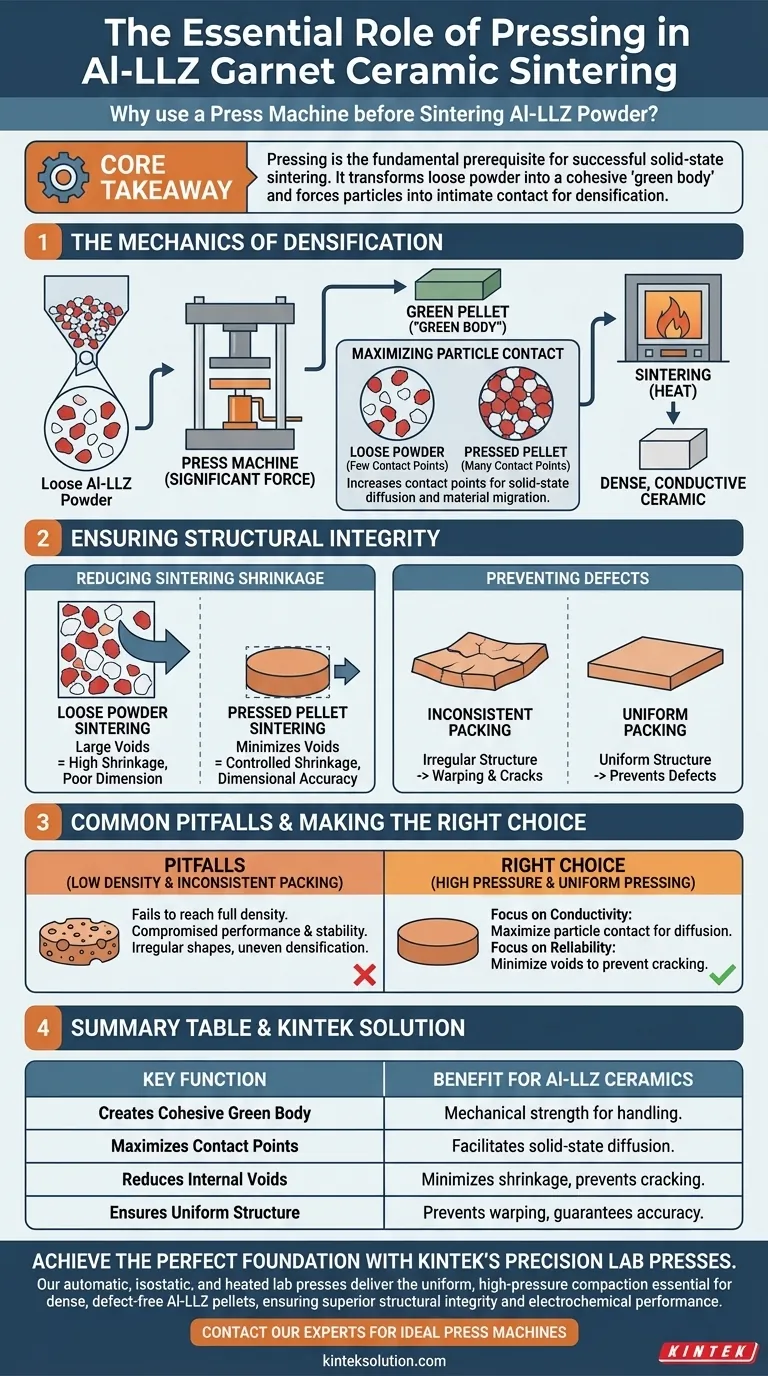
Pressing Al-LLZ powder into a pellet is the fundamental prerequisite for successful solid-state sintering. This process transforms loose precursor powder into a cohesive "green body" with the necessary mechanical strength to withstand handling. More importantly, it forces particles into intimate contact, reducing voids and establishing the physical pathways required for densification at high temperatures.
Core Takeaway Achieving a dense, high-quality ceramic requires more than just heat; it requires an initial mechanical compaction. Pressing the powder minimizes the distance between particles, facilitating the atomic diffusion necessary to turn a porous aggregate into a solid, conductive material while preventing structural defects like cracks.

The Mechanics of Densification
Creating the "Green Body"
Before sintering begins, the loose Al-LLZ powder must be compacted into a solid form known as a green pellet.
Using a hydraulic press applies significant force to tightly pack the powder particles. This creates a foundation with sufficient initial density, which is impossible to achieve with loose powder alone.
Maximizing Particle Contact
Sintering relies on solid-state diffusion, a process where material migrates between particles to bond them together.
Pressing the pellet significantly increases the number of contact points between individual powder grains. These contact points serve as the bridges for chemical reactions and material migration during the heating phase.
Without this mechanical compaction, particles would remain too distant from one another. This would stall the diffusion process, resulting in a porous, weak, or incomplete final product.
Ensuring Structural Integrity
Reducing Sintering Shrinkage
Ceramics shrink as they densify in the furnace.
By reducing the voids between particles before heating, pressing minimizes the total volume change required during sintering. This controlled shrinkage is vital for maintaining the dimensional accuracy of the Al-LLZ ceramic.
Preventing Defects
A major risk in ceramic processing is the development of cracks or deformation during high-temperature treatment.
The text references highlight that proper pellet formation establishes a uniform structure early in the process. This uniformity prevents differential shrinkage, thereby stopping the finished product from warping or cracking under thermal stress.
Common Pitfalls to Avoid
The Risk of Low Green Density
If the initial pressing force is insufficient, the green pellet will retain too many internal voids.
This lack of density prevents effective material migration. The result is often a ceramic that fails to reach full density, compromising its electrochemical performance and structural stability.
Inconsistent Particle Packing
Failing to press the powder uniformly can lead to irregular shapes in the final product.
If the "green body" does not have a uniform structure, densification will occur unevenly. This leads to deformation, where the ceramic twists or bends rather than shrinking uniformly.
Making the Right Choice for Your Goal
To ensure your Al-LLZ ceramics perform as intended, apply these principles to your preparation workflow:
- If your primary focus is maximizing conductivity: Ensure high pressure is applied to maximize particle contact points, which facilitates the diffusion necessary for a fully dense, conductive structure.
- If your primary focus is structural reliability: Prioritize uniform pressing to minimize voids, which directly reduces sintering shrinkage and prevents cracking or warping in the final shape.
By rigorously controlling the pressing stage, you secure the structural foundation required for high-performance ceramics.
Summary Table:
| Key Function of Pressing | Benefit for Al-LLZ Ceramics |
|---|---|
| Creates a Cohesive Green Body | Provides mechanical strength for handling before sintering. |
| Maximizes Particle Contact Points | Facilitates solid-state diffusion for densification. |
| Reduces Internal Voids | Minimizes sintering shrinkage and prevents cracking. |
| Ensures Uniform Structure | Prevents warping and guarantees dimensional accuracy. |
Achieve the perfect foundation for your Al-LLZ ceramics with KINTEK's precision lab presses.
The quality of your final ceramic is determined at the pressing stage. Our automatic lab presses, isostatic presses, and heated lab presses are engineered to deliver the uniform, high-pressure compaction essential for creating dense, defect-free Al-LLZ pellets. By maximizing particle contact and minimizing voids, our equipment ensures your sintering process yields materials with superior structural integrity and electrochemical performance.
Don't let inadequate compaction compromise your research. Contact our experts today to find the ideal press machine for your laboratory's specific needs.
Visual Guide
Related Products
- Automatic Laboratory Hydraulic Press Lab Pellet Press Machine
- Laboratory Hydraulic Press Lab Pellet Press Machine for Glove Box
- XRF KBR Plastic Ring Lab Powder Pellet Pressing Mold for FTIR
- XRF KBR Steel Ring Lab Powder Pellet Pressing Mold for FTIR
- Manual Laboratory Hydraulic Pellet Press Lab Hydraulic Press
People Also Ask
- What is the primary purpose of manual lab hydraulic pellet presses? Achieve High-Precision Sample Preparation for Spectroscopy
- What is the primary purpose of a manual lab hydraulic pellet press? Ensure Accurate Sample Prep for XRF and FTIR
- What are the advantages of an automatic lab hydraulic press for Na-ion/Mg-ion battery development?
- What are the advantages of using an automatic laboratory hydraulic press? Enhance Precision in Sample Preparation
- What are the technical advantages of an automatic laboratory hydraulic press for biomimetic surfaces?



















