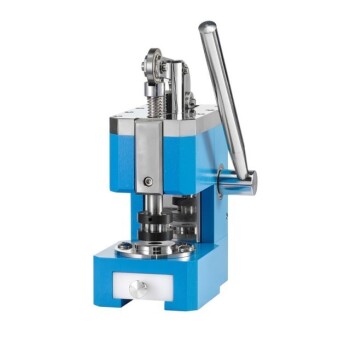
The use of compaction tools is a fundamental requirement for creating accurate and structurally sound stabilized marine clay samples. By applying controlled energy through manual hammers during layered assembly, you actively expel trapped air and force soil particles closer together. This process is the only way to replicate the high-pressure conditions of an actual engineering site and ensure the soil reaches the density required for stabilizers to function.
Core Takeaway The physical act of manual compaction is not merely about shaping the mold; it is a critical density-building process. It eliminates air voids and packs particles tightly to reach maximum dry density, a prerequisite for chemical stabilizers like aluminate cement to achieve their full solidification potential.
The Mechanics of Densification
Expelling Trapped Air
Loose marine clay naturally contains significant pockets of air.
Using a manual hammer applies the necessary force to expel this air from the soil mass. This transforms a loose, aerated mixture into a solid, cohesive block.
Increasing Particle Density
The primary goal of molding is to reduce void space.
By applying controlled energy, you physically rearrange the soil particles. This packing effect drastically increases the density of the particles, creating a tighter internal structure that is more resistant to stress.
Optimizing Chemical Stabilization
Reaching Maximum Dry Density
Chemical stabilizers are designed to work within a specific physical context.
To achieve their full potential, the soil matrix must reach its maximum dry density. Compaction is the physical step that bridges the gap between loose soil and a dense, receptive matrix.
Enabling Solidification
The reference specifically highlights stabilizers like aluminate cement.
These agents cannot solidify effectively in a porous, loose environment. High-density compaction ensures the stabilizer is in close contact with soil particles, allowing the chemical reactions to achieve maximum strength.
Reliability and Simulation
Simulating Site Conditions
Laboratory data is useless if it does not reflect reality.
Manual compaction mimics the heavy pressure and densification that occurs at an actual engineering site. This ensures that the test results you generate in the lab are predictive of how the soil will behave in the field.
The Importance of Layering
Compaction must be done incrementally to be effective.
By dividing the soil into 5 to 8 layers, researchers ensure that the density is uniform throughout the entire mold. Compacting the entire mass at once would likely result in a dense top layer and a loose, weak bottom layer.
Understanding the Trade-offs
Variability in Manual Energy
While manual hammers are effective, they introduce the variable of human effort.
Inconsistent application of force can lead to density variations between layers. It is crucial to standardize the number of blows or energy input per layer to maintain data integrity.
The Risk of Stratification
Layered molding is necessary, but it creates potential weak points.
If the layers are not bonded correctly during compaction, "interfaces" or seams may form. These distinct boundaries can act as failure planes within the sample, artificially lowering the measured strength of the soil.
Making the Right Choice for Your Goal
To ensure your stabilized marine clay samples yield valid data, consider the following approach:
- If your primary focus is Structural Strength: Ensure you compact the soil to its maximum dry density, as this is the primary factor that allows stabilizers to cure effectively.
- If your primary focus is Field Accuracy: Strictly adhere to the 5 to 8 layer protocol to simulate the uniform compression found in real-world engineering projects.
Effective compaction is the physical catalyst that transforms loose ingredients into a reliable engineering material.
Summary Table:
| Feature | Impact on Marine Clay Stabilization |
|---|---|
| Air Expulsion | Eliminates voids to transform loose mixture into a cohesive solid block. |
| Particle Density | Increases packing efficiency, creating a structure resistant to mechanical stress. |
| Chemical Activation | Ensures stabilizers like aluminate cement bond effectively with soil particles. |
| Site Simulation | Replicates real-world high-pressure conditions for predictive lab data. |
| Layered Molding | Guarantees uniform density across the sample by compacting 5-8 distinct layers. |
Elevate Your Material Testing with KINTEK Precision
Achieving the maximum dry density in stabilized marine clay requires controlled energy and professional-grade equipment. KINTEK specializes in comprehensive laboratory pressing solutions, providing the tools you need to replicate field conditions with absolute accuracy.
Whether you are conducting battery research or geotechnical stabilization studies, our range of manual, automatic, heated, and multifunctional models, alongside our cold and warm isostatic presses, ensure your samples meet the most rigorous engineering standards. Don't let inconsistent compaction compromise your research data.
Ready to optimize your lab's densification process? Contact us today to find the perfect pressing solution for your research!
References
- Qirui Bo, Kaiyue Sun. Application of ANN in Construction: Comprehensive Study on Identifying Optimal Modifier and Dosage for Stabilizing Marine Clay of Qingdao Coastal Region of China. DOI: 10.3390/jmse12030465
This article is also based on technical information from Kintek Solution Knowledge Base .
Related Products
- Lab Manual Microtome Slicer for Tissue Sectioning
- Lab Round Bidirectional Press Mold
- Lab Polygon Press Mold
People Also Ask
- Why is a precision disc cutter used to process samples? Ensure Accuracy in Gel Content and Swelling Ratio Testing
- Why is it necessary to use a high-precision disc cutter for coin cells? Ensure Data Accuracy and Prevent Shorts
- How does a precision disc puncher ensure experimental accuracy? Standardize Your Battery Research Samples
- How do chemical etchants assist in Micro EDM microstructure analysis? Reveal Heat-Affected Zones and Recast Layers
- Why is a blade grinder necessary for PLA composites? Master Pretreatment for Perfect Hot-Press Molding