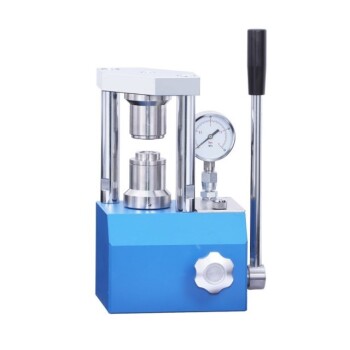
Precision in pressure application is the defining factor determining whether a solid-state battery functions efficiently or fails completely. Because solid-state electrolytes cannot flow into gaps like liquid electrolytes, researchers must use equipment with precise pressure displays to navigate a narrow window of operation. Without accurate real-time feedback, you risk either crushing the delicate material structure with excessive force or failing to establish the necessary ion transport pathways due to insufficient contact.
Core Takeaway Solid-state battery performance relies entirely on finding the "Goldilocks" zone of mechanical pressure. Precise displays are not just for monitoring; they are essential for replicating successful experiments and balancing the competing needs of tight physical contact for ion flow against the structural integrity of the materials.
The Critical Role of Pressure in Solid-State Physics
Establishing Ion Transport
Unlike liquid batteries where the electrolyte fills every void, solid-state batteries rely on mechanical contact to move ions.
If the pressure is too low, microscopic gaps remain between the electrode and the electrolyte. These voids act as barriers, significantly impeding ion transport and increasing internal resistance. You need precise pressure to force these solid materials into intimate contact.
Protecting Material Structure
While high pressure creates better contact, there is a strict upper limit.
According to your primary reference, excessive pressure can damage the material structure, potentially causing internal cracks or short circuits. Equipment with precise displays allows you to stop exactly at the optimal threshold, preventing the degradation of sensitive materials like sulfide or oxide electrolytes.
Managing Volume Expansion
Active materials, particularly high-performance components like silicon anodes, undergo significant volume changes during charge and discharge cycles.
Supplementary data suggests that silicon can require pressures up to 240 MPa to maintain structural integrity. A press with a precise display ensures you are applying enough force to counteract this expansion and maintain the internal electronic conductive network, without applying so much force that you crush the particle structure.
The Necessity of Data for Optimization
Ensuring Reproducibility
In scientific research, a result is only valuable if it can be repeated.
Using a press with a precise digital display transforms pressure from a variable into a controllable parameter. This allows you to accurately record the specific settings that worked for a particular batch, ensuring that subsequent experiments yield consistent, comparable data.
Tailoring to Specific Materials
Different solid electrolytes react differently to mechanical stress.
For example, sulfide electrolytes are softer and more malleable, while oxide electrolytes are brittle and hard. A precise display allows you to micro-adjust the pressure to suit the specific rheological properties of the material you are testing, optimizing performance for each unique chemical composition.
Understanding the Trade-offs
The Risk of Phase Changes
Applying pressure is not a case of "more is better."
Thermodynamic analysis indicates that over-pressurization (often exceeding 100 MPa for certain stacks) can induce unwanted phase changes in the materials. Without a precise display, you are flying blind, unaware if you have crossed the threshold where pressure shifts from being helpful to chemically destructive.
Static vs. Dynamic Pressure
A laboratory press provides static stack pressure, but the battery environment is dynamic.
While precise displays help set the initial conditions to eliminate interface voids, you must remember that the battery will breathe. The trade-off is that a static press setting must be high enough to accommodate future contraction, but low enough to allow for expansion without creating dangerous stress hotspots.
Making the Right Choice for Your Goal
To maximize the utility of your pressing equipment, align your pressure strategy with your specific research objectives:
- If your primary focus is optimizing ion conductivity: Prioritize finding the minimum pressure required to eliminate microscopic voids and maximize surface area contact between the cathode and electrolyte.
- If your primary focus is long-term cycle stability: Use the display to establish a constant pressure baseline that is high enough to suppress lithium dendrite growth and prevent delamination during volume expansion.
- If your primary focus is material synthesis: focus on recording the exact pressure limits where your specific electrolyte (oxide vs. sulfide) begins to show structural degradation or phase changes.
Success in solid-state battery development is not just about the chemistry; it is about the precise mechanical engineering of the interface.
Summary Table:
| Factor | Impact of Precise Pressure | Risk of Inaccuracy |
|---|---|---|
| Ion Transport | Establishes intimate contact between solids | High internal resistance due to microscopic voids |
| Material Structure | Protects delicate electrolyte layers | Crushing, cracking, or internal short circuits |
| Volume Expansion | Counteracts silicon/anode swelling | Delamination or particle structure degradation |
| Reproducibility | Standardizes variables for consistent results | Unreliable data and non-repeatable experiments |
| Phase Stability | Prevents pressure-induced chemical changes | Unexpected material shifts above 100 MPa |
Elevate Your Battery Research with KINTEK
Precise mechanical engineering of the interface is the key to solid-state success. KINTEK specializes in comprehensive laboratory pressing solutions tailored for high-performance battery research. Our range includes manual, automatic, heated, multifunctional, and glovebox-compatible models, as well as cold and warm isostatic presses designed to help you find the perfect pressure threshold for your materials.
Don't let imprecise data stall your innovation. Ensure your electrolytes maintain structural integrity and optimal ion flow with our industry-leading equipment.
Contact KINTEK Today for a Precision Pressing Solution
References
- Needa Mufsera, Prof. Muskan Tahura. Solid State Batteries for EV'S. DOI: 10.5281/zenodo.17658741
This article is also based on technical information from Kintek Solution Knowledge Base .
Related Products
- Warm Isostatic Press for Solid State Battery Research Warm Isostatic Press
- Lab Infrared Press Mold for Laboratory Applications
- Carbide Lab Press Mold for Laboratory Sample Preparation
- Button Battery Sealing Press Machine for Lab
- Laboratory Hydraulic Press Lab Pellet Press Button Battery Press
People Also Ask
- Why must composite cathodes be sealed in vacuum lamination bags for WIP? Ensure Battery Stability and Density
- What is the function of elastic molds in warm isostatic pressing? Achieve Uniform Density in Composite Particles
- How do sacrificial volume materials (SVM) maintain microchannels in isostatic pressing? Ensure Structural Integrity
- What is the function of hydraulic pressure in warm isostatic pressing? Achieve Uniform Material Density
- How does Warm Isostatic Pressing differ from traditional pressing methods? Unlock Uniform Density for Complex Parts