
Maintaining consistent forming pressure with a hydraulic press is the primary method for ensuring a uniform interfacial contact area between the solid electrolyte and the electrodes. In solid-state systems like Li2S/Li6PS5Br, failing to control this mechanical variable leads to significant fluctuations in interfacial resistance, rendering electrochemical data—such as impedance spectra and cycling performance—unrepeatable and scientifically invalid.
The Core Reality: Unlike liquid electrolytes that naturally wet electrode surfaces, solid-state batteries rely entirely on mechanical force to establish ion transport pathways. If your forming pressure varies, your "active area" varies, making it impossible to distinguish between material properties and assembly defects.
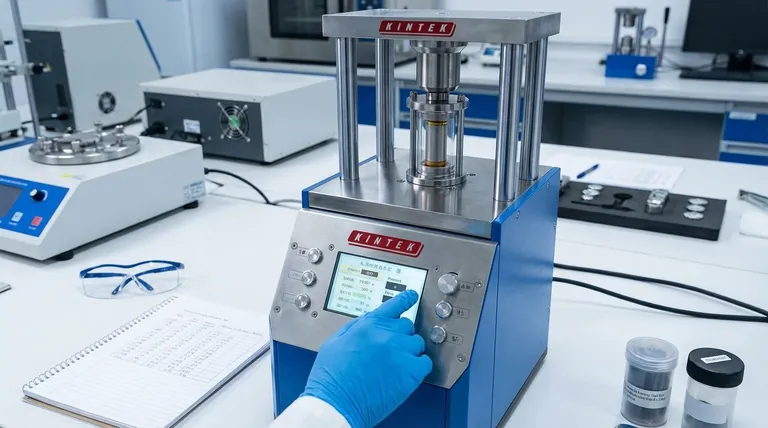
The Physics of Solid-Solid Interfaces
To understand why the hydraulic press is critical, you must look at the microscopic interface between the materials.
Eliminating Interfacial Voids
In a solid-state battery, ions cannot jump across air gaps. A laboratory hydraulic press applies precise external stack pressure to force materials together.
This ensures intimate, void-free physical contact between the lithium metal electrode and the solid-state electrolyte. Without this initial compaction, the effective contact area is significantly reduced.
Facilitating Smooth Ion Transport
The application of controlled pressure—often in the range of 1.5 to 2 tons for specific layers—creates a seamless physical connection.
This "tight" contact is fundamental to lowering the battery's total internal resistance. It creates a continuous pathway that facilitates smooth ion transport across the multilayered structure.
The Impact on Data Reliability
Your ability to trust your test results is directly tied to the consistency of your assembly pressure.
Minimizing Resistance Variability
Interfacial resistance is often the major performance-limiting factor in these cells.
By keeping forming pressure constant, you ensure that the quality of the interface remains constant from one cell to another. This isolation of variables is the only way to obtain repeatable impedance spectra.
Enabling Systematic Investigation
Researchers often need to study specific phenomena, such as how mechanical pressure suppresses lithium dendrite growth.
If the initial forming pressure is inconsistent, it introduces noise into the data. Reliable pressure application allows for the systematic evaluation of battery material properties without assembly artifacts skewing the results.
Understanding the Trade-offs: Forming vs. Stack Pressure
While the hydraulic press sets the initial stage, relying on it alone is a common pitfall. You must distinguish between forming pressure and operational pressure.
The Limitation of "One-Off" Pressing
Using a hydraulic press establishes the initial interface, but solid-state materials often undergo volumetric changes during charge-discharge cycles.
If pressure is removed after forming, contact can degrade. This is why references highlight the need for in-situ compression setups or cell holders that maintain a continuous pressure (e.g., 75 MPa) during testing.
Balancing Pressure Magnitude
Applying pressure is vital, but more is not always better. The goal is a "precise and uniform" application.
Inconsistent or excessive pressure can warp components or create uneven stress distributions. The objective is to reach the threshold where interfacial impedance is minimized without mechanically compromising the separator or electrode structure.
Making the Right Choice for Your Goal
Achieving reliable results requires matching your pressure protocol to your specific research objective.
- If your primary focus is Material Screening: strictly standardize your hydraulic press settings (e.g., 1.5 tons) to ensure that any difference in performance is due to chemistry, not contact area.
- If your primary focus is Cycle Life Stability: prioritize the use of an in-situ cell holder (maintaining ~70-80 MPa) to compensate for volumetric changes and prevent contact loss over time.
Consistency in mechanical pressure is not just an assembly step; it is the calibration standard that makes your electrochemical data valid.
Summary Table:
| Key Factor | Impact on Battery Testing |
|---|---|
| Forming Pressure Consistency | Eliminates variable interfacial resistance between solid electrolyte and electrodes |
| Pressure Range (Typical) | 1.5-2 tons for initial compaction to establish ion transport pathways |
| Operational Pressure Need | Requires ~70-80 MPa in-situ pressure during cycling to maintain contact |
| Primary Benefit | Enables distinction between material properties and assembly defects in data analysis |
Achieve precise, repeatable solid-state battery testing with KINTEK's laboratory press solutions. Our automatic lab presses and isostatic presses deliver the consistent forming pressure required for valid Li2S/Li6PS5Br electrochemical data. Whether you're screening materials or studying cycle life stability, KINTEK's heated lab presses and pressure control systems help eliminate interfacial variability and ensure reliable results. Contact our experts today to discuss how our lab press machines can standardize your battery research protocol.
Visual Guide

Related Products
- Automatic High Temperature Heated Hydraulic Press Machine with Heated Plates for Lab
- Manual Heated Hydraulic Lab Press with Integrated Hot Plates Hydraulic Press Machine
- Heated Hydraulic Press Machine with Heated Plates for Vacuum Box Laboratory Hot Press
- Laboratory Hydraulic Press 2T Lab Pellet Press for KBR FTIR
- Laboratory Hydraulic Press Lab Pellet Press Machine for Glove Box
People Also Ask
- Function of a Laboratory Hydraulic Press with Heated Platens in SSE? Enhance Battery Density & Conductivity
- How does a laboratory heated hydraulic press facilitate PBN sample prep for WAXS? Achieve Precise X-Ray Scattering
- What are the requirements for electrode pressing with high-viscosity ionic liquids like EMIM TFSI? Optimize Performance
- What are the industrial applications of heated hydraulic presses? Master Heat & Force for Precision Manufacturing
- Why is a laboratory hydraulic press with heating plates required for PLA/TEC films? Achieve Precise Sample Integrity



















