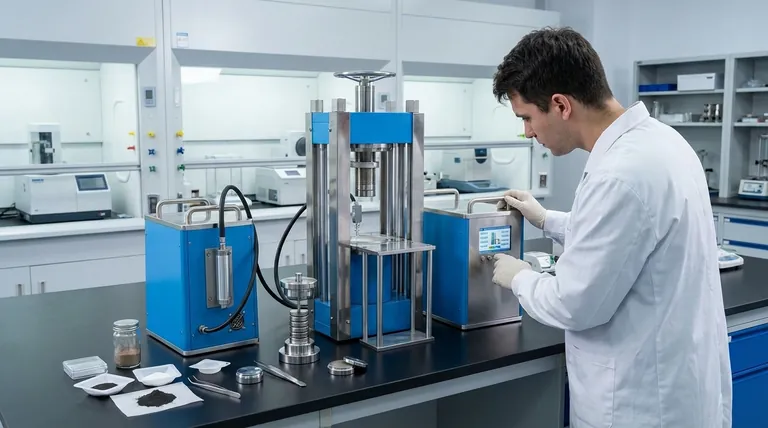
Precise, graded pressure control is essential in the construction of sulfide-based all-solid-state batteries because the distinct layers of the cell stack possess vastly different mechanical properties and densification requirements. A laboratory press capable of applying "stepped" pressure allows you to maximize the density of the cathode and electrolyte without crushing or mechanically degrading the softer anode materials.
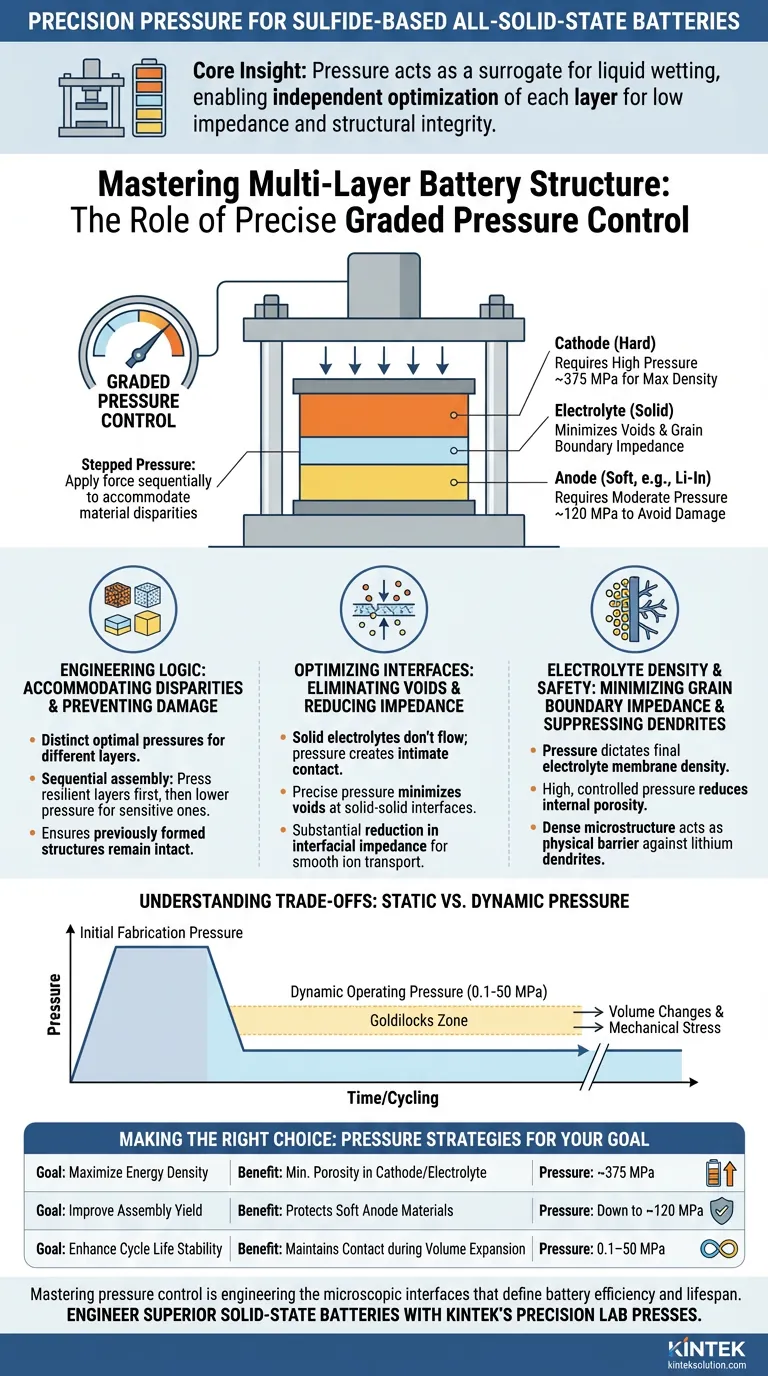
Core Insight: In solid-state battery fabrication, pressure acts as a surrogate for the wetting action of liquid electrolytes. Graded pressure control allows you to independently optimize the density of each layer, ensuring low interfacial impedance and structural integrity, rather than compromising the entire stack with a single, uniform force.
The Engineering Logic Behind Graded Pressure
Accommodating Material Disparities
In a multi-layer battery stack, different materials have distinct optimal forming pressures.
For example, a composite cathode often requires high pressure (e.g., 375 MPa) to achieve maximum density and particle contact.
Conversely, a Lithium-Indium (Li-In) alloy anode is much softer and may only require moderate pressure (e.g., 120 MPa).
Preventing Structural Damage
If you apply the high pressure required for the cathode to the entire stack after the anode is added, you risk damaging the anode structure.
A laboratory press with graded control enables a sequential assembly process. You can press the resilient layers first, then lower the pressure to accommodate sensitive layers added later.
This ensures that previously formed structures remain intact while the new layers are properly integrated.
Optimizing the Solid-Solid Interface
Eliminating Interfacial Voids
Unlike liquid electrolytes, solid electrolytes do not naturally flow into pores.
Cold-pressing powders is the primary method for establishing intimate physical contact between the cathode, electrolyte, and anode.
Precise pressure minimizes voids at these solid-solid interfaces, which is the physical prerequisite for ionic conduction.
Reducing Impedance
The direct result of eliminating voids is a substantial reduction in interfacial impedance.
Lower impedance facilitates smooth lithium-ion transport between the electrode and the electrolyte.
Without this precise initial contact (often established at specific pressures like 60 MPa), the battery will suffer from high internal resistance and poor performance.
Electrolyte Density and Safety
Minimizing Grain Boundary Impedance
The magnitude of fabrication pressure directly dictates the final density of the solid-state electrolyte membrane.
High, controlled pressure reduces internal porosity, which minimizes the grain boundary impedance that obstructs ion movement.
Suppressing Lithium Dendrites
Achieving a highly dense, low-porosity electrolyte layer is critical for safety.
A dense microstructure acts as a physical barrier against lithium dendrites.
If the pressure is insufficient, the resulting porosity can allow dendrites to penetrate the electrolyte, leading to short circuits and failure.
Understanding the Trade-offs
The Risk of Static Pressure
While initial fabrication pressure is high, operating pressure during cycling must be carefully managed.
Materials like Nb2O5 experience significant volume changes during cycling.
Dynamic Pressure Requirements
If the applied stack pressure is too low during operation, particle contact is lost, leading to interface delamination and capacity loss.
Conversely, excessive pressure during cycling can accelerate creep in the lithium metal or cause mechanical stress fractures.
Precise control allows researchers to simulate packaging conditions (0.1 MPa to 50 MPa) to find the "Goldilocks" zone that accommodates volume expansion without breaking contact.
Making the Right Choice for Your Goal
To maximize the utility of your laboratory press for sulfide-based batteries, tailor your pressure strategy to your specific research objective:
- If your primary focus is Maximizing Energy Density: Prioritize high-pressure steps (e.g., ~375 MPa) for the cathode and electrolyte layers to minimize porosity and maximize active material loading.
- If your primary focus is Assembly Yield: Utilize a strict graded pressure protocol, stepping down the force significantly when adding soft anode materials (e.g., down to 120 MPa) to prevent internal shorting or layer collapse.
- If your primary focus is Cycle Life Stability: Focus on precise, lower-range stack pressure (e.g., 0.1–50 MPa) during testing to maintain contact during volume expansion without inducing mechanical fatigue.
Mastering pressure control is not just about compaction; it is about engineering the microscopic interfaces that define the battery's efficiency and lifespan.
Summary Table:
| Pressure Control Goal | Key Benefit | Typical Pressure Range |
|---|---|---|
| Maximize Energy Density | Minimizes porosity in cathode/electrolyte | ~375 MPa |
| Improve Assembly Yield | Protects soft anode materials during stacking | Down to ~120 MPa |
| Enhance Cycle Life Stability | Maintains contact during volume expansion | 0.1–50 MPa |
Engineer superior solid-state batteries with KINTEK's precision lab presses.
Our automatic lab presses, isostatic presses, and heated lab presses are engineered to deliver the exact, graded pressure control required to optimize each layer of your sulfide-based battery stack. By enabling precise densification of cathodes and electrolytes while protecting sensitive anodes, KINTEK equipment helps you achieve low interfacial impedance, suppress dendrite growth, and enhance overall cell performance and safety.
Ready to master the microscopic interfaces that define battery efficiency and lifespan? Contact our experts today to find the perfect lab press solution for your research goals.
Visual Guide
Related Products
- Warm Isostatic Press for Solid State Battery Research Warm Isostatic Press
- Laboratory Hydraulic Press Lab Pellet Press Button Battery Press
- Lab Infrared Press Mold for Laboratory Applications
- Lab Cylindrical Press Mold for Laboratory Use
- Button Battery Sealing Press Machine for Lab
People Also Ask
- Why must composite cathodes be sealed in vacuum lamination bags for WIP? Ensure Battery Stability and Density
- What is the function of elastic molds in warm isostatic pressing? Achieve Uniform Density in Composite Particles
- How do sacrificial volume materials (SVM) maintain microchannels in isostatic pressing? Ensure Structural Integrity
- What is the process involved in warm isostatic pressing? Mastering Uniform Density with WIP Technology
- What is the function of hydraulic pressure in warm isostatic pressing? Achieve Uniform Material Density