
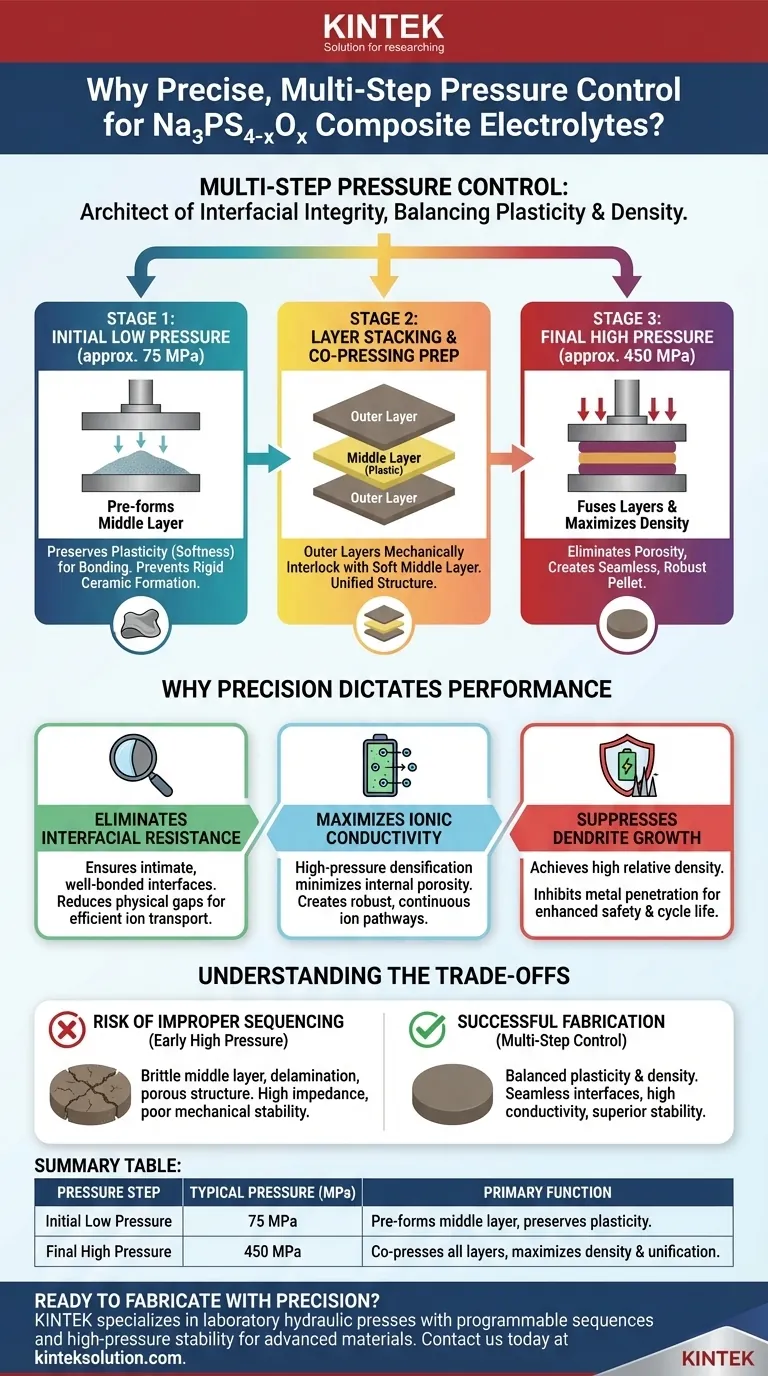
Precise, multi-step pressure control is the architect of interfacial integrity in composite electrolytes. For Na₃PS₄₋ₓOₓ three-layer composites, this feature enables a critical fabrication sequence: applying an initial low pressure (e.g., 75 MPa) to maintain plasticity in the middle layer, followed by a high-pressure (e.g., 450 MPa) co-pressing stage to fuse the layers into a single, cohesive unit.
Core Takeaway The necessity of multi-step control lies in balancing plasticity with density. A programmable pressure sequence allows the middle layer to remain receptive to bonding before the final high-pressure step maximizes ionic conductivity and mechanical strength, effectively solving the problem of high interfacial resistance.
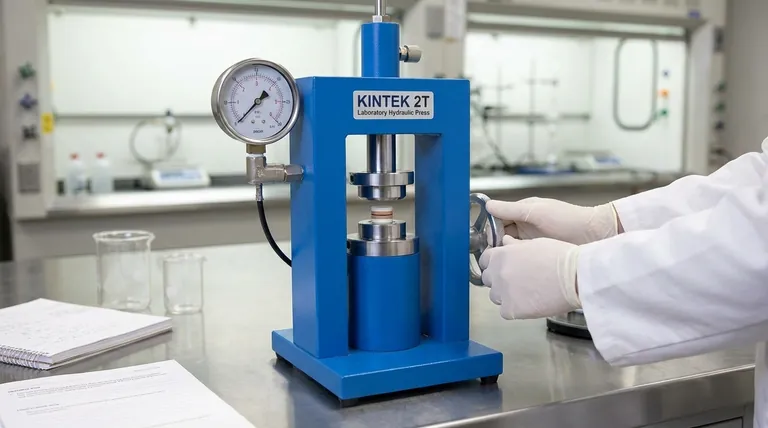
The Mechanics of Layered Fabrication
The Role of Sequential Pressing
Fabricating a three-layer composite is not a "one-and-done" compression task. It requires a specific mechanical recipe to ensure the layers adhere to one another.
The process begins with a low-pressure step (approx. 75 MPa). This pre-forms the middle layer without fully hardening it.
Preserving Material Plasticity
If the middle layer were immediately pressed to maximum density, it would become a rigid ceramic. Subsequent layers would fail to bond effectively, leading to delamination.
By holding the initial pressure low, the press maintains the plasticity of the middle layer. This "softness" allows the outer layers to mechanically interlock with the middle layer during the final stage, creating a unified structure.
Final Co-Pressing for Unification
Once all layers are stacked, the press must ramp up to a high pressure (approx. 450 MPa).
This final step co-presses the entire assembly. Because the middle layer was kept plastic, this high-pressure phase fuses the interfaces, transforming loose powder and pre-formed layers into a seamless, dense pellet.
Why Pressure Precision Dictates Performance
Eliminating Interfacial Resistance
The primary bottleneck in solid-state battery performance is the resistance found at the boundaries between layers (solid-solid interfaces).
Multi-step pressure control ensures intimate, well-bonded interfaces. By minimizing physical gaps between the layers, the press significantly reduces interfacial resistance, facilitating efficient ion transport.
Maximizing Ionic Conductivity
Beyond the layer interfaces, the bulk density of the material itself is critical. The efficiency of ion transport relies on the material being free of voids.
High-pressure densification minimizes internal porosity and maximizes particle contact area. This creates robust, continuous pathways for ions to travel, which is a prerequisite for accurate ionic conductivity measurements.
Suppressing Dendrite Growth
A porous electrolyte is vulnerable to metal penetration. Lithium or sodium dendrites can grow through microcracks and voids, causing short circuits.
Achieving a high relative density (up to 90% for similar materials) through precise high-pressure application effectively inhibits dendrite penetration, enhancing both the safety and cycle life of the battery.
Understanding the Trade-offs
The Risk of Improper Sequencing
Skipping the multi-step process often leads to structural failure. Applying high pressure too early creates a brittle middle layer that repels the outer layers.
Conversely, applying high pressure too late—or not applying enough pressure (e.g., staying below 400 MPa)—leaves the pellet porous. This results in high impedance and poor mechanical stability, rendering the electrolyte useless for practical testing.
Equipment Limitations
Not all laboratory presses can handle the transition from precise low pressure to extreme high pressure (500+ MPa) seamlessly.
Using a press without granular control can result in "pressure overshoot," where the initial step inadvertently densifies the material too much, ruining the plasticity required for the bonding phase.
Making the Right Choice for Your Goal
To successfully fabricate Na₃PS₄₋ₓOₓ composites, your equipment choice dictates your experimental success.
- If your primary focus is Interface Engineering: Ensure your press offers programmable multi-step recipes to automate the transition from low-pressure plasticity to high-pressure bonding.
- If your primary focus is Ionic Conductivity: Prioritize a press capable of stable operation at very high pressures (up to 510 MPa) to ensure maximum relative density and pore elimination.
- If your primary focus is Cycling Stability: Focus on the uniformity of pressure application to prevent microcracks that could lead to dendrite propagation over time.
Ultimately, multi-step pressure control is not just a convenience; it is the fundamental tool for converting loose powder into a unified, high-performance electrochemical system.
Summary Table:
| Pressure Step | Typical Pressure (MPa) | Primary Function |
|---|---|---|
| Initial Low Pressure | 75 MPa | Pre-forms the middle layer while preserving its plasticity for bonding. |
| Final High Pressure | 450 MPa | Co-presses all layers into a dense, unified pellet with minimal porosity. |
Ready to Fabricate High-Performance Solid-State Electrolytes with Precision?
KINTEK specializes in laboratory hydraulic presses with the precise, multi-step pressure control required for fabricating advanced materials like Na₃PS₄₋ₓOₓ three-layer composite electrolytes. Our automatic lab presses, isostatic presses, and heated lab presses are engineered to deliver the programmable sequences and high-pressure stability your research demands.
Contact us today via our contact form to discuss how our equipment can help you achieve superior interfacial integrity, maximize ionic conductivity, and enhance the cycling stability of your solid-state battery prototypes.
Visual Guide
Related Products
- Laboratory Hydraulic Press Lab Pellet Press Button Battery Press
- Laboratory Hydraulic Press 2T Lab Pellet Press for KBR FTIR
- Laboratory Hydraulic Press Lab Pellet Press Machine for Glove Box
- 24T 30T 60T Heated Hydraulic Lab Press Machine with Hot Plates for Laboratory
- Automatic Laboratory Hydraulic Press Lab Pellet Press Machine
People Also Ask
- How is a laboratory hydraulic press used for HAP composite gels? Master Mineral Substrate Standardization
- What role does a laboratory hydraulic press play in the preparation of piezoelectric ceramic discs for DC-PG? | KINTEK
- What role does a laboratory hydraulic press play in reaction pellets? Optimizing Lunar Soil and Metal Fuel Density
- Why is a laboratory hydraulic press required for PBAT and PLA sample preparation? Achieve Flawless Characterization
- What role does a laboratory hydraulic press play in the assembly of all-solid-state battery test cells? Expert Guide



















