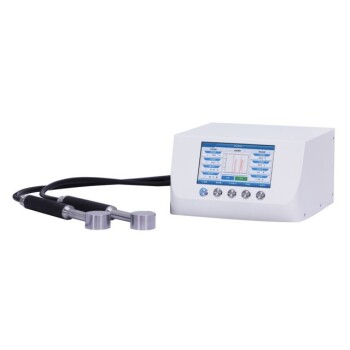
Precise temperature control is the fundamental driver of structural integrity in covalent organic framework (COF) thin films. It ensures a stable thermal environment—often around 60 °C—to perfectly synchronize solvent evaporation with the progression of the Schiff-base reaction. By accurately managing heating duration and intensity, you induce uniform cross-linking of monomers, which is required to form free-standing films without physical defects.
The success of COF film molding relies on a controlled thermal environment that balances evaporation with polymerization. This stability prevents structural defects like cracks or wrinkles, ensuring the final product possesses high crystallinity and mechanical stability.
The Mechanics of Thermal Molding
Synchronizing Reaction and Evaporation
For COF films, the molding process is primarily chemical. You must maintain a specific temperature (e.g., 60 °C) to facilitate the Schiff-base reaction.
Simultaneously, the solvent must evaporate at a controlled rate. Precise heat treatment ensures these two processes—reaction progression and solvent removal—occur in harmony.
Achieving Uniform Cross-linking
The core goal of thermal regulation is to induce uniform cross-linking of monomers on the substrate.
When heat is applied consistently, the monomers bond in an ordered lattice structure. This uniformity is what allows the film to become "free-standing," meaning it holds its shape independently of the substrate.
High Crystallinity and Structure
Temperature directly impacts the microscopic arrangement of the film.
Stable heat treatment results in high crystallinity, which defines the material's quality. This structural integrity is essential for the film to perform its intended function effectively.
Consequences of Thermal Instability
Physical Defects
If the temperature fluctuates or is unevenly distributed, the polymerization process becomes erratic.
This leads to visible physical defects, such as wrinkles and cracks on the film surface. These imperfections compromise the physical durability of the thin film.
Performance Degradation
Beyond visible cracks, uneven heating causes uneven polymerization at the molecular level.
This lack of uniformity degrades the overall performance of the COF film. Without precise control, the film fails to achieve the necessary density and structural coherence required for advanced applications.
Optimizing Your Heat Treatment Strategy
To ensure high-quality COF thin film production, align your equipment settings with your specific quality targets:
- If your primary focus is Structural Integrity: Prioritize uniform heat distribution to prevent uneven polymerization, which causes wrinkles and cracks.
- If your primary focus is High Crystallinity: meaningfuly control the stability of the temperature (e.g., strict adherence to 60 °C) to ensure the Schiff-base reaction progresses ideally.
By treating temperature as a precise reagent rather than a general environmental condition, you transform raw monomers into flawless, high-performance thin films.
Summary Table:
| Factor | Role in COF Molding | Impact of Poor Control |
|---|---|---|
| Temperature Stability | Facilitates Schiff-base reaction (e.g., 60°C) | Erratic polymerization & low crystallinity |
| Evaporation Rate | Synchronizes solvent removal with reaction | Structural defects, cracks, and wrinkles |
| Cross-linking | Induces uniform monomer bonding | Uneven film density and weak mechanical stability |
| Thermal Uniformity | Ensures a free-standing, defect-free film | Physical fragility and performance degradation |
Elevate Your Material Research with KINTEK Precision
Achieving the perfect Schiff-base reaction requires more than just heat; it requires absolute thermal stability. KINTEK specializes in comprehensive laboratory solutions designed for high-stakes applications like COF synthesis and battery research. Whether you need manual, automatic, or heated pressing models, our equipment delivers the uniform environment necessary for defect-free, free-standing films.
Ready to eliminate structural defects and boost crystallinity?
Contact KINTEK today to find your ideal laboratory pressing solution
References
- Rak Hyeon Choi, Hye Ryung Byon. Room‐Temperature Single Li <sup>+</sup> Ion Conducting Organic Solid‐State Electrolyte with 10 <sup>−4</sup> S cm <sup>−1</sup> Conductivity for Lithium‐Metal Batteries. DOI: 10.1002/aenm.202504143
This article is also based on technical information from Kintek Solution Knowledge Base .
Related Products
- Cylindrical Lab Electric Heating Press Mold for Laboratory Use
- Automatic Heated Hydraulic Press Machine with Hot Plates for Laboratory
- Lab Heat Press Special Mold
- Lab Double Plate Heating Mold for Laboratory Use
- Automatic Heated Hydraulic Press Machine with Heated Plates for Laboratory
People Also Ask
- What role does a laboratory electric heated press play in polymer composite fabrication? Key for Standardized Specimens
- How does a laboratory electric heated press ensure sample quality? Optimize SiR-EPDM vulcanization and molding.
- What role does a laboratory electric heating press play in NBR molding? Master Vulcanization & Material Density
- Why is a laboratory electric heating press required for PP/EPDM molding? Achieve Superior Specimen Integrity
- What is the purpose of incorporating cartridge heaters into a lab press mold for MLCC block compression? Optimize Results