
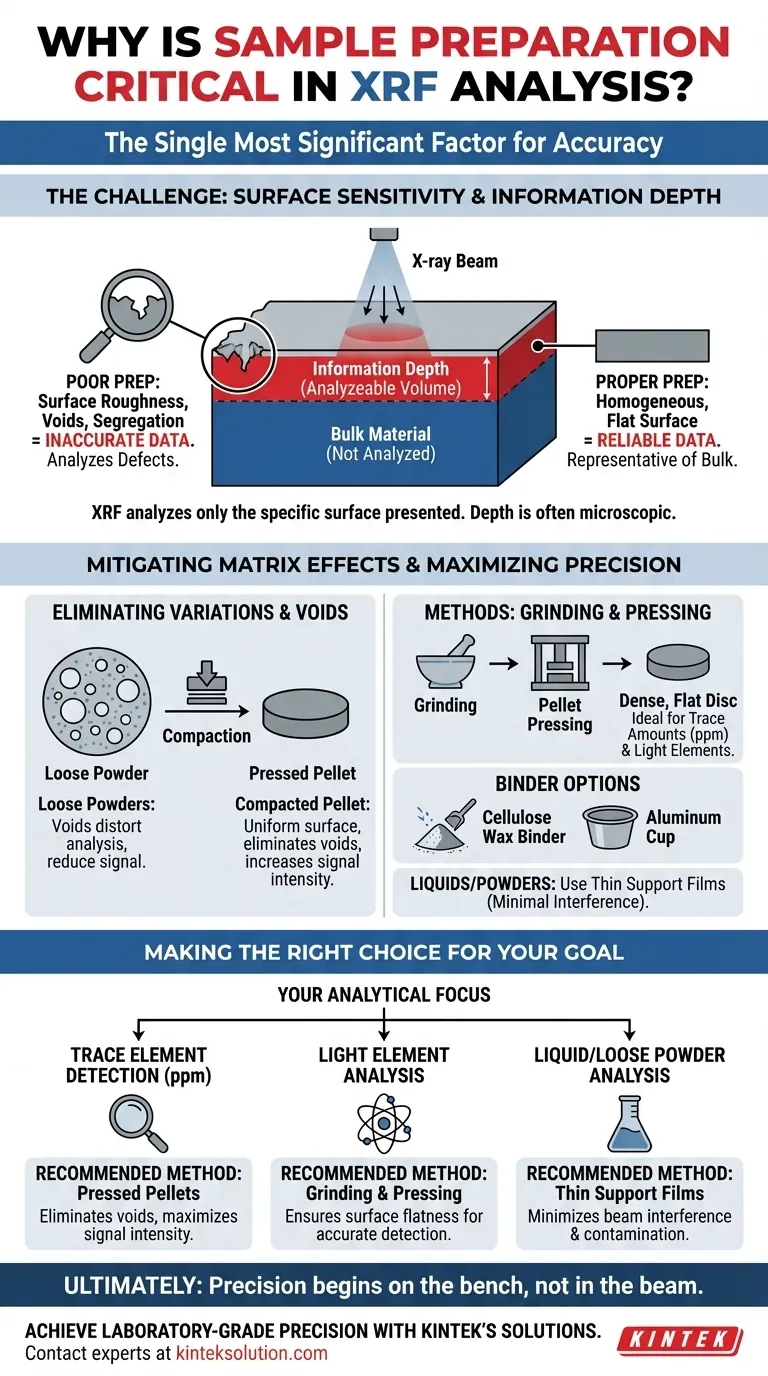
Sample preparation is the single most significant factor determining the accuracy of X-ray Fluorescence (XRF) analysis. Because XRF is inherently a surface-sensitive technique, the instrument does not analyze the entire volume of your material; it analyzes only the specific surface presented to the X-ray beam. Therefore, preparation is not merely about physical handling—it is about engineering a surface that is perfectly homogeneous and representative of the bulk material to ensure reliable data.
Core Insight: The depth from which XRF collects data is often microscopic. If your sample surface contains irregularities, voids, or segregation, the spectrometer will analyze those defects rather than the true composition of your material. Proper compaction and grinding are required to eliminate these "matrix effects" and unlock the instrument's full sensitivity.
The Physics of "Information Depth"
Why the Surface Tells the Story
The critical limitation in XRF is the information depth (or attenuation length). This is the depth from which the instrument can successfully detect fluorescence radiation.
Depending on the energy of the X-rays and the composition of the sample matrix, this depth can be extremely small.
The Impact of Matrix Density
Generally, the heavier the sample matrix, the shallower the information depth becomes.
If you do not prepare the sample to ensure the surface is homogeneous, the XRF may only measure the outer "skin" of the sample. This leads to results that fail to represent the true chemistry of the bulk material.
Criticality for Light Elements
This issue is exacerbated when analyzing light elements. Because low-energy X-rays from light elements are easily absorbed, they escape only from the very top layers of the sample.
Without a perfectly flat and representative surface, the analysis of light elements will likely be inaccurate.
Mitigating Matrix Effects
Eliminating Surface Variations
Sample compaction is necessary to mitigate matrix effects. These are errors that arise from physical inconsistencies, such as surface roughness or localized heterogeneities.
These variations alter the sample's emission spectra. By compacting the sample, you create a uniform surface that allows for consistent X-ray interaction.
Removing Void Spaces
Loose powders contain significant void spaces (air pockets). These voids distort the analysis and reduce the intensity of the signal.
Pressing a sample into a dense pellet eliminates these voids. This results in a more homogeneous representation and significantly higher signal intensities for most elements.
Methods for Stability and Precision
Grinding and Pellet Pressing
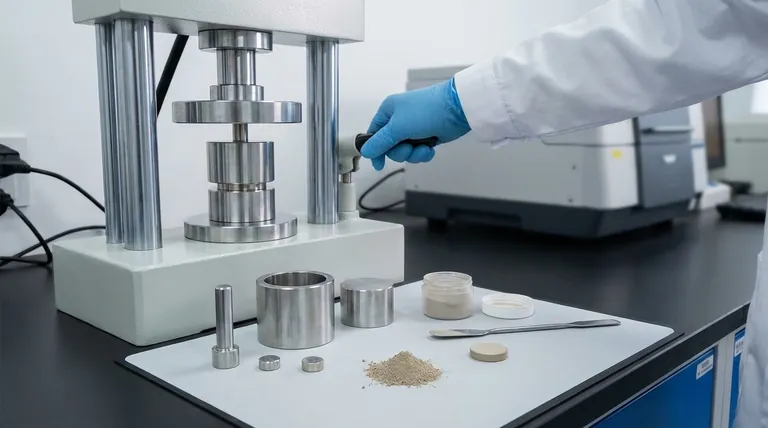
For solid samples, the ideal finish is achieved through grinding followed by pellet pressing.
Pressing creates a dense, flat disc. This method minimizes sample dilution and maximizes particle density, making it excellent for analyzing elements present in trace amounts (ppm range).
Binder Options
To ensure structural integrity during pressing, different methods are available. You may press the powder by itself, or mix it with a cellulose wax binder to prevent the pellet from crumbling.
Alternatively, pressing the sample into an aluminum cup can provide additional mechanical support for fragile materials.
Handling Liquids and Powders
When pressing is not possible, such as with liquids or loose powders, a support film is used. This film must be carefully selected to provide as little interaction with the incident beam as possible to avoid contaminating the signal.
Common Pitfalls and Trade-offs
The Trade-off of Preparation Time
While pressed pellets offer superior accuracy, they require more time and equipment than analyzing loose powders.
However, skipping this step for the sake of speed results in lower signal intensities and reduced sensitivity.
The Risk of Improper Binding
Using a binder adds stability but introduces a foreign material into your sample. While beneficial for cohesion, you must ensure the binder is mixed homogeneously to avoid creating new segregation issues.
Making the Right Choice for Your Goal
To maximize the performance of your XRF spectrometer, align your preparation method with your analytical requirements.
- If your primary focus is trace element detection (ppm): You must strictly use pressed pellets, as they eliminate voids and provide the high signal intensity required for sensitivity.
- If your primary focus is analyzing light elements: You must prioritize surface flatness and homogeneity, as roughness will disproportionately affect low-energy X-ray detection.
- If your primary focus is liquid analysis: You must use thin support films that offer minimal interference with the spectrometer’s beam.
Ultimately, the most expensive XRF instrument cannot correct for a poorly prepared sample; precision begins on the bench, not in the beam.
Summary Table:
| Preparation Goal | Recommended Method | Key Benefit |
|---|---|---|
| Trace Element Detection (ppm) | Pressed Pellets | Eliminates voids, maximizes signal intensity |
| Light Element Analysis | Grinding & Pressing | Ensures surface flatness for accurate low-energy X-ray detection |
| Liquid or Loose Powder Analysis | Thin Support Films | Minimizes beam interference and sample contamination |
Achieve laboratory-grade precision with KINTEK's sample preparation solutions.
Your XRF spectrometer is only as accurate as your sample preparation. KINTEK specializes in lab press machines, including automatic lab presses and isostatic presses, designed to create the perfect homogeneous pellets required for reliable, high-sensitivity XRF analysis. Don't let poor preparation compromise your data—ensure every sample is representative of your bulk material.
Contact our experts today to find the ideal press for your laboratory's needs and unlock the full potential of your XRF analysis.
Visual Guide
Related Products
- Carbide Lab Press Mold for Laboratory Sample Preparation
- Laboratory Hydraulic Pellet Press for XRF KBR FTIR Lab Press
- Lab XRF Boric Acid Powder Pellet Pressing Mold for Laboratory Use
- XRF KBR Plastic Ring Lab Powder Pellet Pressing Mold for FTIR
- XRF KBR Steel Ring Lab Powder Pellet Pressing Mold for FTIR
People Also Ask
- What is the purpose of incorporating cartridge heaters into a lab press mold for MLCC block compression? Optimize Results
- What is the function of a pressing tool in thermoplastic panels? Master Precision Shaping & Fusion Bonding
- Why is precise cooling management of the lab press mold necessary? Protect Core Integrity in Thermoforming
- How does the geometry of laboratory molds influence mycelium-based composites? Optimize Density and Strength
- What is the significance of standardized molds in lab presses? Ensure Precise Seal Material Evaluation













