
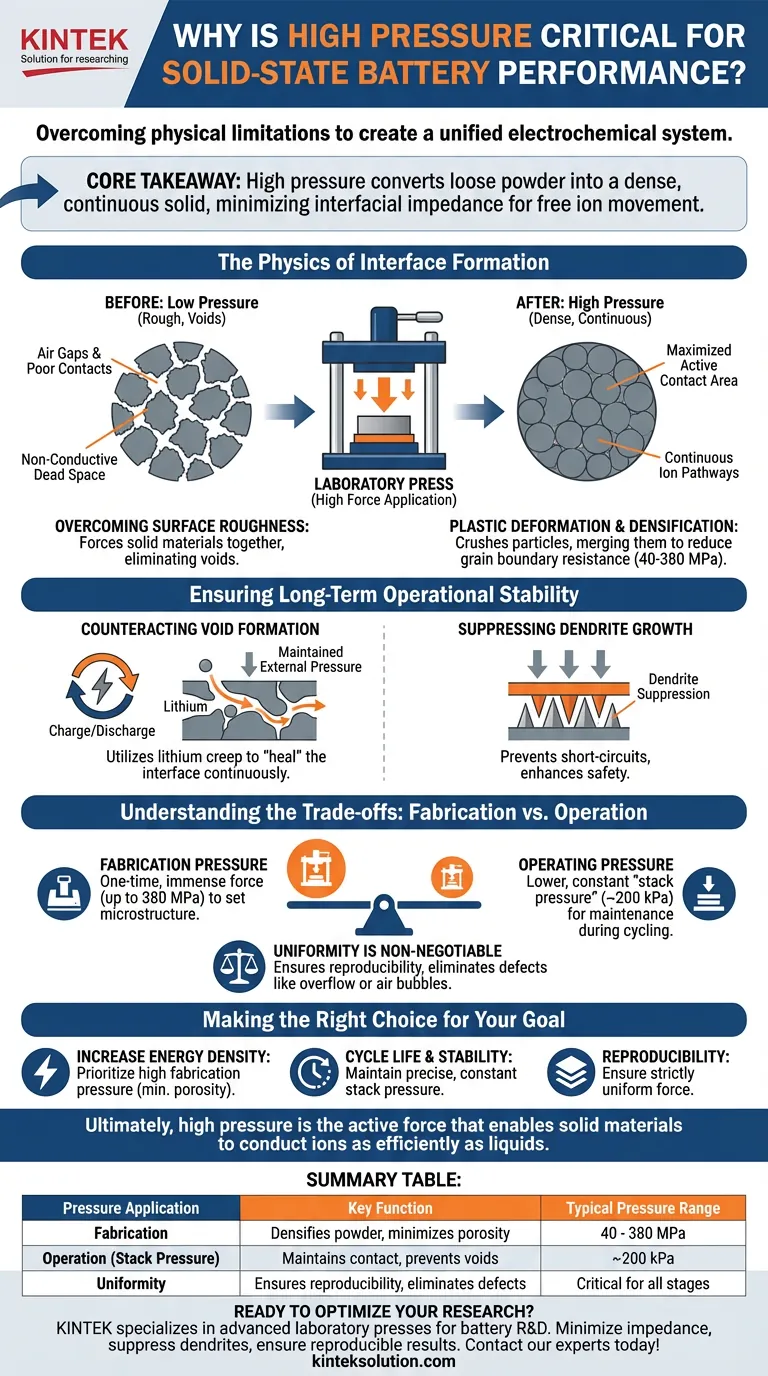
High pressure is the primary mechanism used to overcome the inherent physical limitations of solid materials, forcing them to behave as a unified electrochemical system.
In a solid-state battery (SSB), ions cannot flow through air gaps or poor contacts. A laboratory press applies massive force to physically alter the microstructure of the battery components, eliminating voids and ensuring the mechanical integrity required for efficient ion transport.
Core Takeaway The fundamental role of high pressure is to convert loose powder particles into a dense, continuous solid. This process minimizes interfacial impedance by forcing plastic deformation of electrolytes and electrodes, creating the continuous pathways necessary for lithium ions to move freely.
The Physics of Interface Formation
Overcoming Surface Roughness
Unlike liquid electrolytes, which naturally wet electrode surfaces to create perfect contact, solid electrolytes are rigid and rough.
Without pressure, these solid materials only touch at microscopic points, leaving vast gaps of non-conductive dead space.
A laboratory press forces these materials together, maximizing the active contact area where chemical reactions can occur.
Plastic Deformation and Densification
To achieve high performance, the solid electrolyte particles—particularly sulfide-based ones—must undergo plastic deformation.
High pressure (often ranging from 40 to 380 MPa) crushes these particles together, effectively merging them into a single, dense mass.
This densification fills inter-particle gaps and significantly reduces grain boundary resistance, creating a seamless highway for ion travel.
Minimizing Interfacial Impedance
The greatest barrier to SSB performance is often the resistance found at the junction between layers.
By compressing the cathode mixture and electrolyte into a bilayer composite pellet, the press eliminates internal porosity.
This intimate solid-solid contact drastically lowers interfacial impedance, a prerequisite for rapid charging and discharging.
Ensuring Long-Term Operational Stability
Counteracting Void Formation
During charge and discharge cycles, lithium is constantly stripped and deposited, which can physically erode the interface.
This movement creates voids (empty spaces) that lead to contact loss and a sharp spike in resistance.
Maintained external pressure utilizes the creep properties of lithium metal, physically flowing the lithium into these voids to "heal" the interface continuously.
Suppressing Dendrite Growth
High-pressure environments are critical for safety and longevity.
By maintaining void-free physical contact, the pressure helps suppress the formation of lithium dendrites—sharp metallic spikes that can short-circuit the battery.
Systematic investigation of pressure allows researchers to find the "sweet spot" that inhibits this growth without damaging the cell.
Understanding the Trade-offs: Fabrication vs. Operation
While pressure is vital, understanding the distinction between fabrication pressure and operating pressure is critical for accurate results.
The Fabrication Threshold
Fabricating the cell requires immense force (up to 380 MPa) to cold-press powders into a solid pellet.
This is a one-time event designed to set the microstructure and density of the electrolyte and electrode.
The Operating Balance
During testing (cycling), the cell often requires a lower, constant "stack pressure" (e.g., roughly 200 kPa).
This pressure is maintenance-focused: it keeps layers in contact during expansion and contraction without crushing the active materials.
Uniformity is Non-Negotiable
It is not enough to simply apply force; the pressure must be uniform across the entire surface.
Uneven pressure leads to defects like overflow at mold edges, air bubbles, or variations in thickness.
A high-quality hydraulic press ensures reproducibility, guaranteeing that performance data reflects the chemistry, not a manufacturing defect.
Making the Right Choice for Your Goal
To maximize the utility of your laboratory press, you must align your pressure strategy with your specific research objective.
- If your primary focus is increasing energy density: Prioritize extremely high fabrication pressures (up to 380 MPa) to minimize porosity and maximize the volume of active material in the pellet.
- If your primary focus is cycle life and stability: Focus on maintaining a precise, constant stack pressure (using a jig or specialized cell) to leverage lithium creep and prevent contact loss over time.
- If your primary focus is reproducibility: Ensure your press applies strictly uniform force to eliminate edge defects and thickness variations between samples.
Ultimately, high pressure is not just a manufacturing step; it is the active force that enables solid materials to conduct ions as efficiently as liquids.
Summary Table:
| Pressure Application | Key Function | Typical Pressure Range |
|---|---|---|
| Fabrication | Densifies powder into a solid pellet, minimizes porosity | 40 - 380 MPa |
| Operation (Stack Pressure) | Maintains contact, prevents voids, suppresses dendrites | ~200 kPa |
| Uniformity | Ensures reproducibility and eliminates defects | Critical for all stages |
Ready to Optimize Your Solid-State Battery Research?
Achieving precise, uniform pressure is critical for fabricating high-performance, dense pellets and ensuring long-term operational stability. KINTEK specializes in advanced laboratory press solutions—including automatic, isostatic, and heated lab presses—designed specifically for the demanding needs of battery research and development.
Our presses deliver the high, uniform force required to:
- Minimize interfacial impedance for faster charging.
- Suppress dendrite growth for enhanced safety.
- Ensure reproducible results across all your samples.
Let us help you unlock the full potential of your solid-state battery materials. Contact our experts today to find the perfect press for your lab!
Visual Guide
Related Products
- Laboratory Hydraulic Press 2T Lab Pellet Press for KBR FTIR
- Laboratory Hydraulic Press Lab Pellet Press Button Battery Press
- Laboratory Hydraulic Press Lab Pellet Press Machine for Glove Box
- Laboratory Split Manual Heated Hydraulic Press Machine with Hot Plates
- Laboratory Hydraulic Pellet Press for XRF KBR FTIR Lab Press
People Also Ask
- What is the role of a laboratory pressure machine and KBr in FTIR? Master Sample Preparation for Flame Retardants
- What is the role of a laboratory hydraulic press in high-loading NCM811 cathode prep for solid-state batteries?
- Why is a laboratory hydraulic press necessary for sample preparation? Precise Pelleting for Spiro Heterocyclic Analysis
- What role does a laboratory hydraulic press play in reaction pellets? Optimizing Lunar Soil and Metal Fuel Density
- What is the role of a laboratory hydraulic press in the preparation of Covalent Organic Framework (COF) precursors?



















