
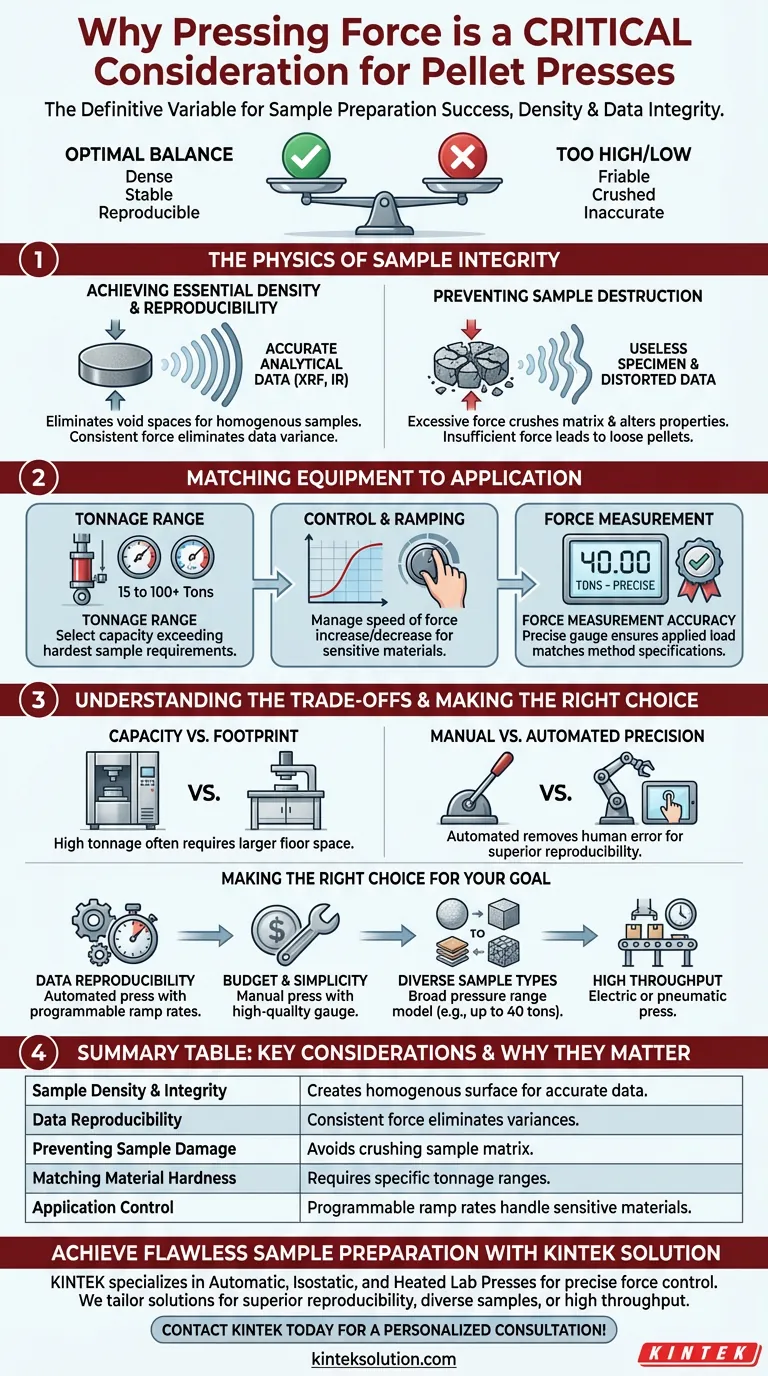
Pressing force is the definitive variable in the success or failure of sample preparation. It is the critical consideration because it directly dictates the density and structural integrity of your pellet, which serves as the foundation for accurate, reproducible analytical data.
The optimal pressing force must strike a precise balance: high enough to bind the sample into a dense, stable form for reproducibility, yet low enough to preserve the sample’s chemical and physical properties without causing damage.
The Physics of Sample Integrity
Achieving Essential Density
For analytical methods like XRF or IR spectroscopy, the sample must be homogenous and dense. Adequate pressing force eliminates void spaces between particles, creating a solid surface that yields consistent results.
Ensuring Reproducibility
If the force is insufficient, the resulting pellet will be loose or friable. A loose pellet leads to significant variances in data, making it impossible to validate your results across multiple test runs.
Preventing Sample Destruction
Conversely, applying excessive force is detrimental. Over-pressurizing can crush the sample matrix or distort the material properties, rendering the specimen useless for accurate analysis.
Matching Equipment to Application
The Tonnage Range
Different materials require vastly different loads to bind effectively. Presses typically offer ranges from 15 to over 100 tons; you must select a unit with a capacity ceiling that exceeds your hardest sample requirements.
Control and Ramping
It is not just about the maximum force, but how that force is applied. For sensitive materials, you must consider presses that control the "ramp" rate—the speed at which the clamp force increases and decreases.
Force Measurement Accuracy
A press is only as good as its gauge. To maintain quality control, the selected unit must feature a precise force gauge or digital sensor to ensure the applied load matches your method's specifications every time.
Understanding the Trade-offs
Capacity vs. Footprint
High-force capabilities often require larger hydraulic systems. You must balance the need for high tonnage (e.g., 40+ tons) with the physical space constraints of your laboratory, as high-capacity units often require floor space rather than a benchtop.
Manual vs. Automated Precision
Manual presses are cost-effective but rely on operator skill for consistency. Automated presses offer superior reproducibility by removing human error from the force application, but they come at a significantly higher financial cost and complexity level.
Making the Right Choice for Your Goal
To select the correct pellet press, you must map your specific analytical needs to the machine's force capabilities.
- If your primary focus is Data Reproducibility: Prioritize an automated press with programmable ramp rates to ensure identical force application for every cycle.
- If your primary focus is Budget and Simplicity: Select a manual hydraulic press, but ensure it includes a high-quality, easy-to-read force gauge for monitoring.
- If your primary focus is Diverse Sample Types: Choose a model with a broad pressure range (e.g., up to 40 tons) to handle both soft binders and hard, refractory materials.
- If your primary focus is High Throughput: Avoid manual systems and invest in an electric or pneumatic press to reduce operator fatigue and cycle time.
Select the press that provides the control necessary to treat your most fragile sample with care, while delivering the power required to densify your toughest material.
Summary Table:
| Key Consideration | Why It Matters |
|---|---|
| Sample Density & Integrity | Creates a homogenous, solid surface for accurate analytical data (XRF, IR). |
| Data Reproducibility | Consistent force application eliminates variances between test runs. |
| Preventing Sample Damage | Excessive force can crush the sample matrix or alter material properties. |
| Matching Material Hardness | Different materials (from soft binders to hard refractories) require specific tonnage ranges (e.g., 15-100+ tons). |
| Application Control | Programmable ramp rates in automated presses ensure gentle handling of sensitive materials. |
Achieve flawless sample preparation with the right press.
The correct pressing force is the foundation of reliable analysis. KINTEK specializes in lab press machines, including automatic lab presses, isostatic presses, and heated lab presses, designed to deliver the precise force control your application demands.
Whether you need superior reproducibility for quality control, the power to handle diverse sample types, or high-throughput automation, we have a solution tailored to your laboratory's needs.
Let our experts help you select the perfect press to ensure your sample integrity and data accuracy. Contact KINTEK today for a personalized consultation!
Visual Guide
Related Products
- Laboratory Hydraulic Split Electric Lab Pellet Press
- Manual Laboratory Hydraulic Pellet Press Lab Hydraulic Press
- Laboratory Hydraulic Pellet Press for XRF KBR FTIR Lab Press
- Automatic Laboratory Hydraulic Press Lab Pellet Press Machine
- Automatic Laboratory Hydraulic Press for XRF and KBR Pellet Pressing
People Also Ask
- What are the emerging trends in the design and materials of lab pellet presses? Modernize Your Lab Efficiency
- How do lab pellet presses support customization and flexibility? Optimize Your Sample Prep for Any Material
- What are common lab pellet press issues? Expert Troubleshooting Guide for Reliable Material Research
- What are the common operational types of lab pellet presses? Choosing the Right Manual, Automatic, or Hydraulic System
- Why use a laboratory pellet press for solid-state battery evaluation? Ensure Accuracy in Interface Stability Testing



















