
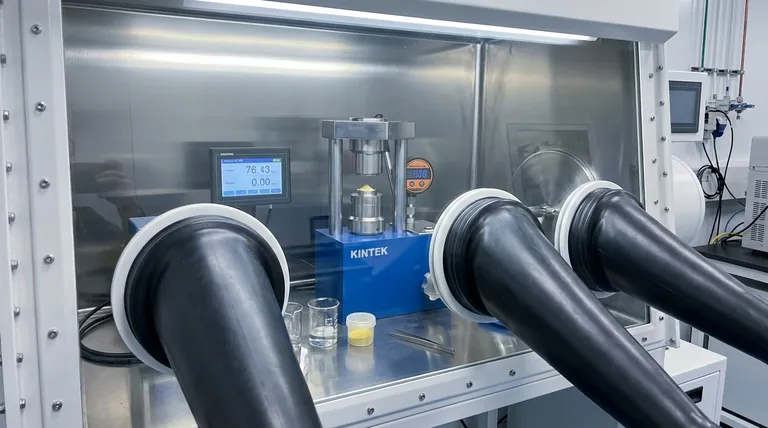
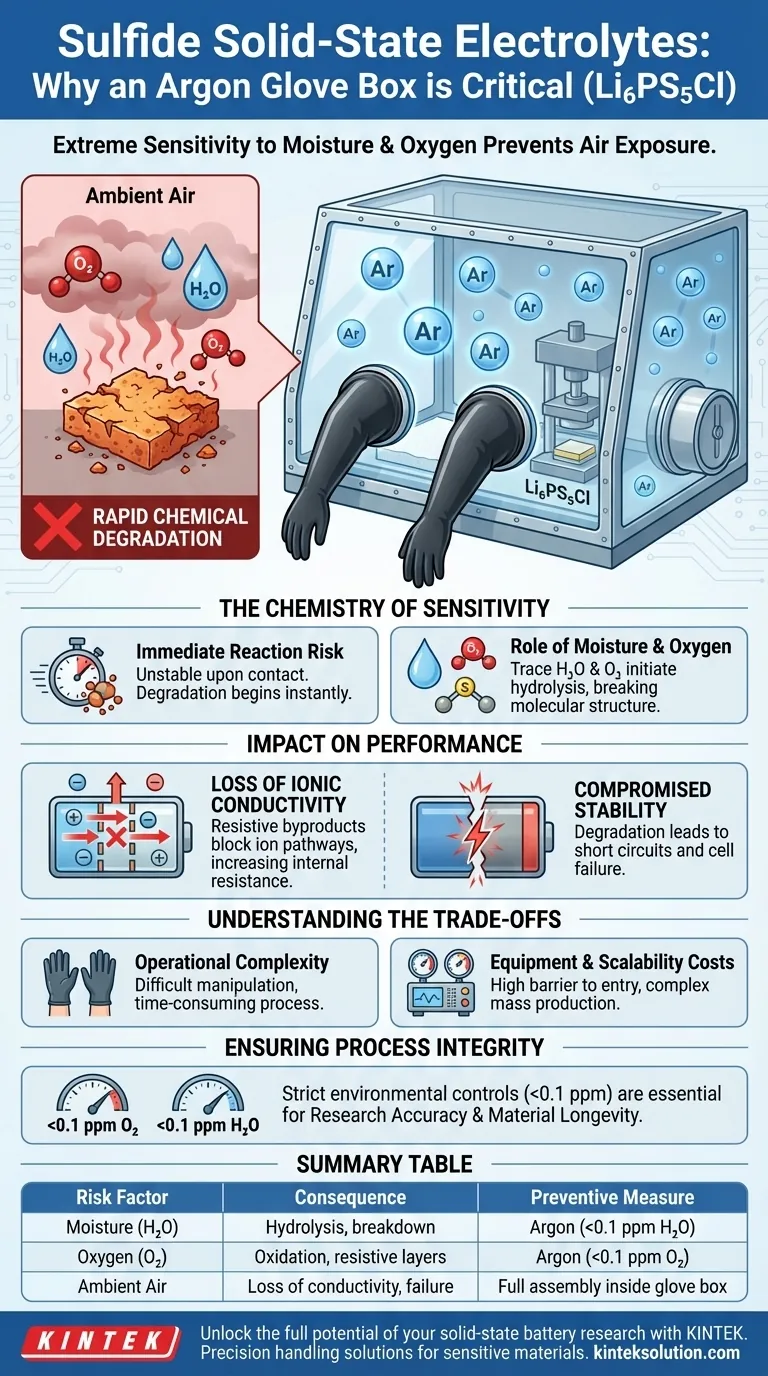
The pressing and assembly of sulfide solid-state electrolytes like Li6PS5Cl require an argon-filled glove box primarily due to their extreme sensitivity to moisture and oxygen found in ambient air. Exposure triggers rapid chemical reactions that degrade the material, rendering it useless for high-performance battery applications.
Sulfide electrolytes offer exceptional ionic conductivity but possess zero tolerance for atmospheric exposure. An inert argon environment is the only way to prevent immediate chemical degradation and preserve the material's electrochemical stability.
The Chemistry of Sensitivity
The Immediate Reaction Risk
Sulfide materials such as Li6PS5Cl are chemically unstable when removed from an inert environment. Upon contact with the ambient atmosphere, they undergo rapid chemical reactions.
This is not a slow decay; the degradation begins the moment the material is exposed to air.
The Role of Moisture and Oxygen
The primary culprits in this degradation are moisture (humidity) and oxygen. Even trace amounts of water vapor in the air can initiate hydrolysis.
This reaction breaks down the molecular structure of the sulfide, altering its fundamental composition.
Impact on Material Performance
Loss of Ionic Conductivity
The defining advantage of Li6PS5Cl is its high ionic conductivity, which allows lithium ions to move freely.
Atmospheric exposure creates resistive byproducts that block these ion pathways. A compromised electrolyte will exhibit significantly higher internal resistance, drastically reducing battery efficiency.
Compromised Electrochemical Stability
For a solid-state battery to function, the electrolyte must remain stable against the anode and cathode.
Degradation caused by air exposure destroys this stability. If used in a battery assembly, a degraded electrolyte will likely lead to short circuits or immediate cell failure.
Understanding the Trade-offs
Operational Complexity
While an argon glove box ensures chemical stability, it introduces significant logistical friction.
Manipulating precise equipment and small battery components through thick gloves is difficult and time-consuming. This slows down the assembly process compared to open-air manufacturing methods.
Equipment and Scalability Costs
Maintaining a strictly inert environment requires expensive hardware and constant monitoring of oxygen and moisture levels.
This requirement increases the barrier to entry for research and complicates the transition from lab-scale synthesis to mass production.
Ensuring Process Integrity
To maximize the performance of Li6PS5Cl, you must adhere to strict environmental controls.
- If your primary focus is Research Accuracy: Maintain glove box levels at less than 0.1 ppm for both oxygen and moisture to ensure data validity.
- If your primary focus is Material Longevity: Store all precursor materials and finished assemblies in sealed vessels within the glove box to prevent accidental exposure during maintenance cycles.
Strict environmental control is not merely a safety precaution; it is a fundamental prerequisite for unlocking the high-performance potential of sulfide solid-state batteries.
Summary Table:
| Risk Factor | Consequence for Li6PS5Cl | Preventive Measure |
|---|---|---|
| Moisture (H₂O) | Hydrolysis, structural breakdown | Argon atmosphere (<0.1 ppm H₂O) |
| Oxygen (O₂) | Chemical oxidation, formation of resistive layers | Argon atmosphere (<0.1 ppm O₂) |
| Ambient Air Exposure | Loss of ionic conductivity, cell failure | Full assembly inside glove box |
Unlock the full potential of your solid-state battery research with KINTEK.
Precision handling of sensitive materials like Li6PS5Cl is critical for achieving reliable results. KINTEK specializes in advanced laboratory equipment, including solutions designed for controlled environments. Our expertise supports researchers in developing next-generation batteries by ensuring material integrity from pressing to assembly.
Let KINTEK be your partner in innovation. Contact us today to discuss how our specialized lab press machines and technical support can enhance your solid-state electrolyte research and development.
Visual Guide
Related Products
People Also Ask
- How does a laboratory hydraulic press contribute to the preparation of Li3-3xScxSb samples? Optimize Ionic Conductivity
- What is the function of a laboratory hydraulic press in FT-IR of curcumin-coated MWCNTs? Achieve Optical Clarity.
- Why is a laboratory hydraulic press required for compression molding boron-siloxane? Solve High-Loading Density Challenges
- What role does a laboratory hydraulic press play in reaction pellets? Optimizing Lunar Soil and Metal Fuel Density
- What role does a laboratory hydraulic press play in the preparation of piezoelectric ceramic discs for DC-PG? | KINTEK
