The Invisible Barrier in the Powder
In battery research, we often obsess over the chemistry of the cathode—the precise ratio of lithium, nickel, and cobalt. Yet, a brilliant chemical formula can be rendered invisible by a simple physical failure: the gap between particles.
Loose powder is an archipelago of potential. Each grain holds energy, but if they do not touch, they cannot communicate. Air, the most common insulator, sits in the "interstitial voids," acting as a wall that blocks the flow of ions and electrons.
To measure the truth of a material’s conductivity, we must first destroy the air.
The Physics of Intimacy
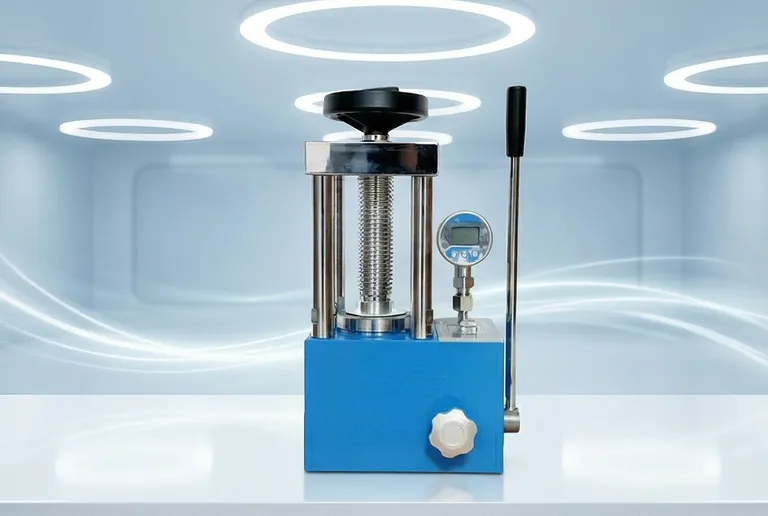
High-pressure molding is the process of forcing a material to transcend its granular nature. When a laboratory hydraulic press applies forces reaching 8 tons—or pressures up to 360 MPa—it performs a series of mechanical miracles.
The Collapse of Voids
Under uniaxial pressure, the "fluff" of the powder vanishes. The press collapses the air pockets, bringing the surface area of one particle into direct, uncompromising contact with the next.
Plastic Deformation
Beyond mere touching, high pressure induces plastic deformation. At the molecular level, the particles don't just lean against each other; they mold into one another. This physical bonding constructs a continuous highway for charge transport, reducing interface impedance to its absolute minimum.
The Eradication of Resistance
Conductivity testing is a search for "intrinsic" properties. Without high-pressure molding, you aren't measuring the material; you are measuring the resistance of the air gaps. Consolidation ensures that the data reflects the cathode’s potential, not the sample's flaws.
The Geometry of Measurement
In the world of Electrochemical Impedance Spectroscopy (EIS), precision is not a luxury—it is the denominator.
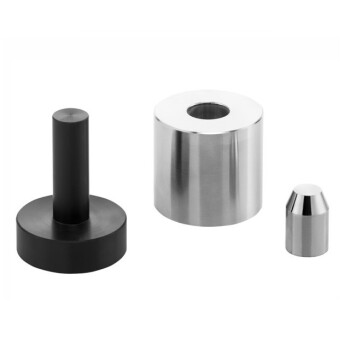
To calculate conductivity, you need the exact thickness and surface area of the sample. A precision mold and a controlled press produce a "green pellet" with standardized dimensions (typically 12 mm).
| Feature | Technical Requirement | Research Impact |
|---|---|---|
| Density | Uniform Distribution | Eliminates "porosity gradients" for reliable data |
| Dimensions | Standardized 12mm Diameter | Allows for accurate mathematical modeling in EIS |
| Integrity | Structural Soundness | Prepares the "green pellet" for high-temperature sintering |
| Pressure | Up to 360 MPa | Ensures maximum particle-to-particle connectivity |
The Paradox of Pressure
There is a psychological trap in pressing: the belief that more is always better.
However, every material has a breaking point. Exceeding the structural limits can lead to "capping"—a phenomenon where the pellet delaminates and cracks like a dry biscuit upon release.
The goal of a sophisticated lab setup isn't just raw power; it is reproducible control. Whether you are using a manual press for quick trials or an automatic system for high-throughput consistency, the ability to dial in a specific MPa is what separates a successful experiment from a pile of broken ceramic.
Systemic Solutions for the Lab
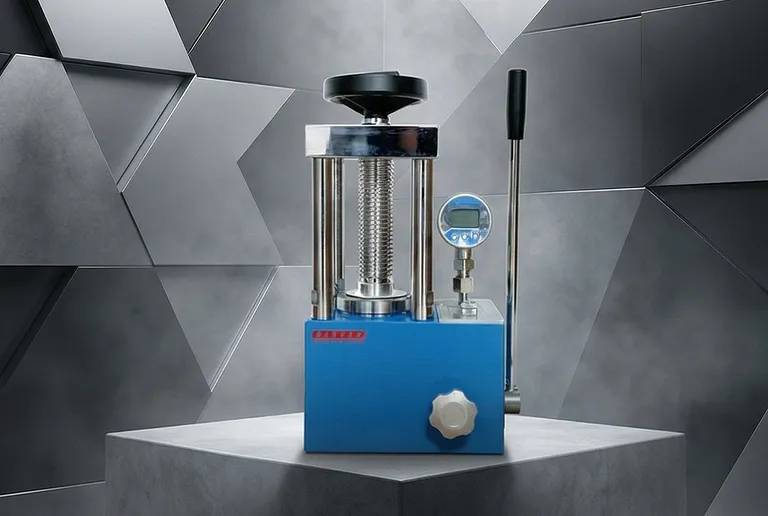
At KINTEK, we view the laboratory press not as a simple tool, but as the gateway to accurate data. If the pellet is flawed, the entire downstream analysis—no matter how expensive the equipment—is compromised.
Our engineering philosophy focuses on the specific constraints of battery research:
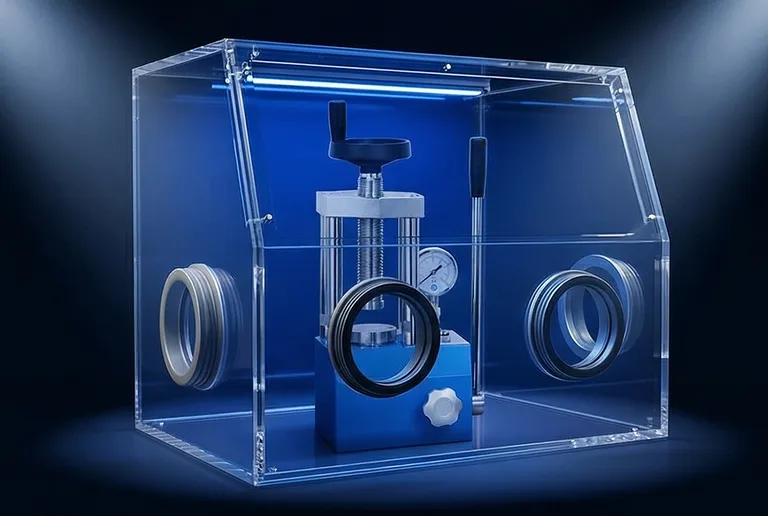
- Glovebox Compatibility: Because the most innovative chemistries are often the most sensitive to air.
- Isostatic Pressing (CIP/WIP): For when uniaxial pressure isn't enough, and you need perfectly uniform density from every angle.
- Precision Control: Gauges and systems designed to hit that 360 MPa sweet spot without overshooting.
In the quest for the next generation of energy storage, the journey begins with the architecture of contact. We provide the tools to build that foundation.
To find the pressing solution that fits your specific research goals, Contact Our Experts
Related Products
- Carbide Lab Press Mold for Laboratory Sample Preparation
- Lab Infrared Press Mold for Laboratory Applications
- Lab Button Battery Tablet Press Sealing Mold
- Lab Cylindrical Press Mold for Laboratory Use
- Lab Button Battery Disassembly and Sealing Mold
Related Articles
- The Anatomy of Repeatability: Deconstructing the Modern Laboratory Press
- The Physics of Trust: A Disciplined Approach to Laboratory Press Safety and Reliability
- The Precision Paradox: Why Time-Based Maintenance Fails Your Laboratory Press
- The Architecture of Density: Why Precision Pressing is the Bridge Between Simulation and Reality
- From Raw Material to Reliable Data: The Physics and Psychology of the Laboratory Press