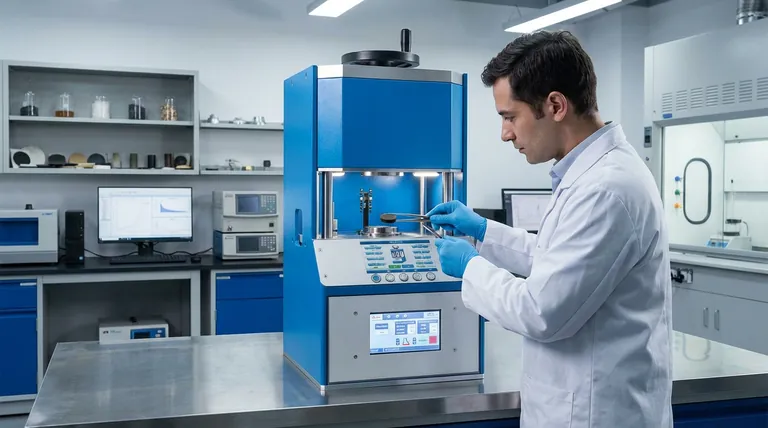
The High-Stakes World of a Ten-Gram Sample
Imagine a polymer engineer overseeing the production of a million automotive seals. A new, cheaper raw material supplier has been approved. On paper, the specs match. But deep within the compound's chemistry, a subtle variance lurks—one that will cause the seals to become brittle at low temperatures.
This single error could lead to a multi-million dollar recall.
The only thing standing between the engineer's decision and this potential catastrophe is a small, ten-gram puck of the new material, sitting inside the polished steel plates of a laboratory press. Under precisely controlled heat and pressure, this miniature sample will tell the story of the entire production batch.
This isn't just about testing; it's about foresight. The laboratory press is a crystal ball for material science.
The Power of the Small-Scale Replica
The most powerful psychological bias in manufacturing is the focus on the macro. We see the giant mixing vats, the sprawling assembly lines, and the finished products. We forget that the integrity of the entire system rests on the predictable, repeatable behavior of the material at a molecular level.
A laboratory press elegantly inverts this perspective. It functions as a miniature production simulator, replicating the intense conditions of a large industrial press on a tiny, manageable scale.
This function serves two fundamental human and engineering drives: the need for certainty and the desire for discovery.
The Pursuit of Certainty: Quality Control as a Guardrail
In a manufacturing environment, variance is the enemy. The goal is to produce the millionth part with the exact same properties as the first. A quality control technician's job is to enforce this consistency.
A lab press is their primary tool.
- Standardization: They take a small sample from a bulk batch of raw material—a rubber compound, a plastic resin.
- Molding: The press applies precise heat and pressure to mold this sample into a standard shape, like a small disc or bar.
- Verification: This standardized sample is then subjected to tests for hardness, tensile strength, or flow characteristics.
The result is a simple binary: does this batch meet the specification, or not? This process prevents a defective batch from ever entering the production line, saving enormous costs and protecting brand reputation. It transforms a subjective "it looks okay" into objective, defensible data.
The Freedom to Fail: R&D as a Sandbox
Innovation is the opposite of quality control. It is a process built on trial, error, and iteration. The goal is not to repeat the past but to invent a better future.
For an R&D scientist, the lab press is a sandbox. It creates a low-cost, low-risk environment to ask "what if?"
- What if we add this new filler to a polymer blend?
- Can we create a stronger, lighter ceramic by adjusting the heat and pressure profile?
- How does this new drug formulation compress into a stable tablet?
The ability to create and test dozens of variations quickly is the engine of material development. The lab press allows scientists to fail cheaply and learn quickly, accelerating the path from a theoretical idea to a viable new product.
A Universal Language for Material Behavior
While the core principles are simple—applying heat and pressure—the applications are as diverse as the materials themselves. The lab press provides a common platform to understand how different substances will behave under stress.
| Industry | Core Problem Solved by the Lab Press | KINTEK Solution Example |
|---|---|---|
| Polymers & Elastomers | Validating the cure (vulcanization) of rubber or forming plastic plaques for strength testing. | Standard Automatic Lab Press |
| Pharmaceuticals | Forming sample tablets to study hardness, dissolution rates, and drug delivery profiles. | Precision Automatic Lab Press |
| Composites & Aerospace | Consolidating powders or laminates into dense, defect-free solids for high-strength parts. | High-Temperature Heated Lab Press |
| Electronics | Bonding flexible circuits or components using heat-activated adhesives for reliable connections. | Heated Lab Press with precise temperature control |
| Metallurgy | Mounting small metal specimens in a polymer puck for easy handling during microscopic analysis. | Isostatic or Mounting Lab Press |
The Honest Trade-Offs of a Precision Tool
A laboratory press is a specialized instrument, and its power comes from understanding its purpose-built limitations.
- Scale is a Feature, Not a Bug: It is explicitly designed to generate data, not finished goods. Its small scale is what makes it fast, affordable, and perfect for testing.
- Expertise is the True Input: A press provides repeatable conditions. It does not interpret the results. The value lies in the operator's ability to connect the data from a small sample to the performance of a large-scale process. This is where engineering skill and material science knowledge become critical.
- Cost is an Investment in Foresight: The price of a precision machine like a KINTEK Automatic Lab Press is not an expense; it is an investment. It is the cost of avoiding a catastrophic production failure, reducing material waste, and accelerating the launch of innovative new products.
Ultimately, a lab press provides the data needed to make confident, informed decisions. For labs focused on quality, development, or fundamental research, having a reliable press isn't a luxury—it's the foundation of their work. From robust automatic lab presses for routine QC to advanced heated lab presses for complex composite R&D, the right tool empowers better science and safer products.
To find the optimal solution for your material validation and development needs, Contact Our Experts.
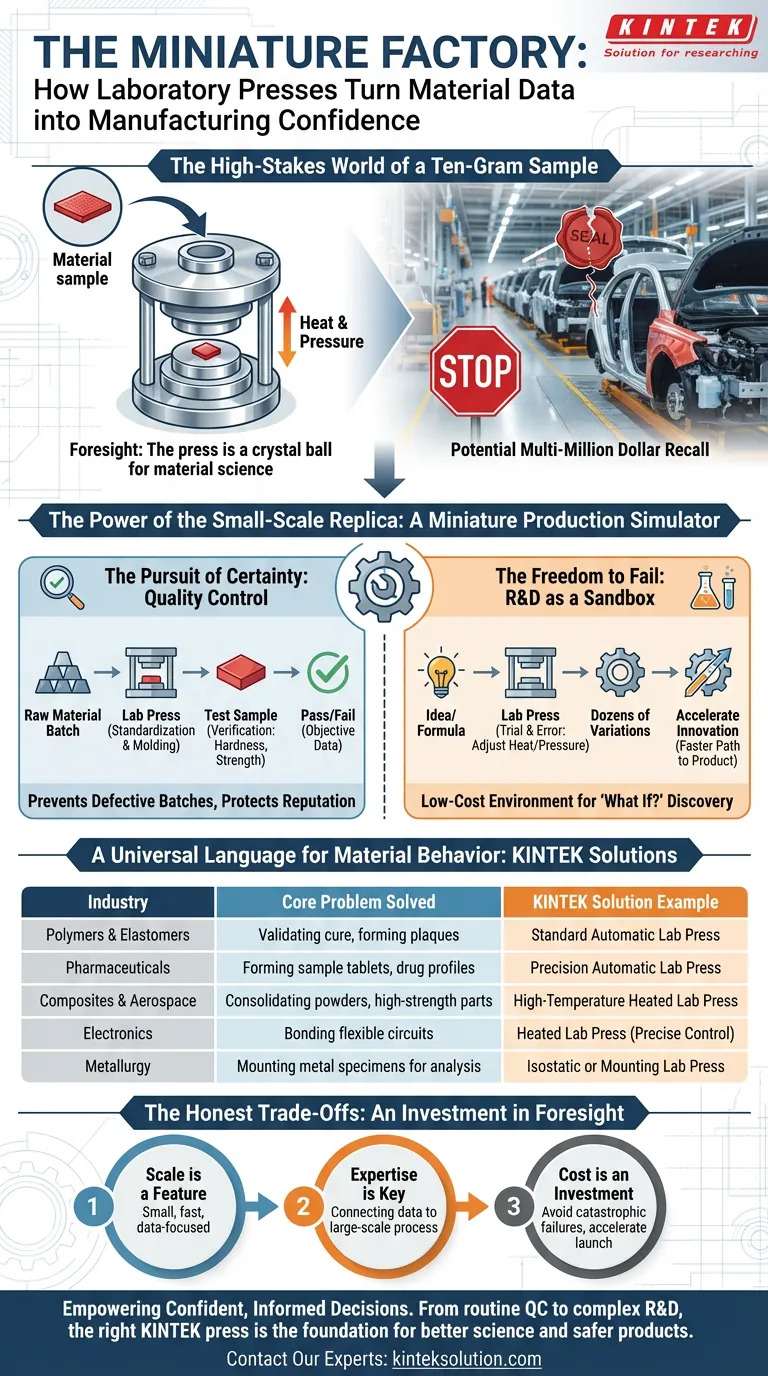
Visual Guide
Related Products
- Laboratory Hydraulic Press Lab Pellet Press Button Battery Press
- Laboratory Hydraulic Press 2T Lab Pellet Press for KBR FTIR
- Laboratory Hydraulic Press Lab Pellet Press Machine for Glove Box
- Laboratory Split Manual Heated Hydraulic Press Machine with Hot Plates
- Laboratory Hydraulic Pellet Press for XRF KBR FTIR Lab Press
Related Articles
- The Architecture of Density: Why Pressure is the Silent Architect of Solid-State Batteries
- The Physics of Transparency: Why Pressure is the Silent Architect of Spectroscopic Clarity
- The Architecture of Heat: Why Sample Density Dictates the Truth in Metal Hydride Research
- The Geometry of Ionic Flow: Why Precision Pressing Dictates Material Truth
- The Geometry of Electrons: Why Surface Precision is the Silent Partner in SECM Research



















