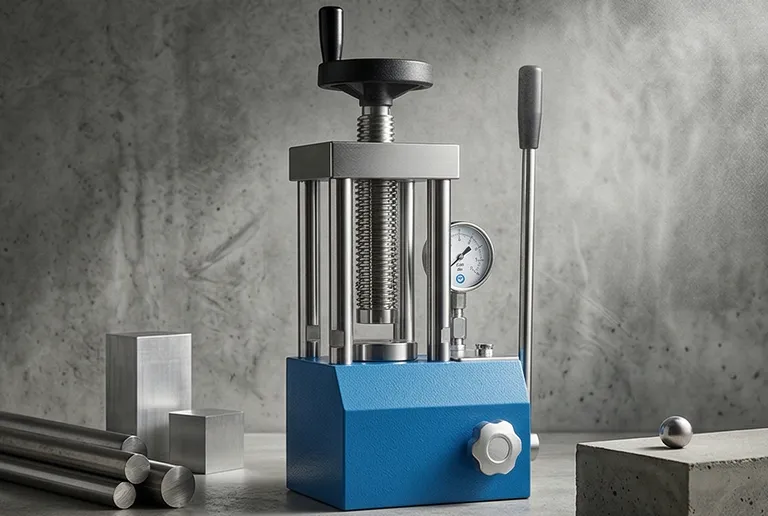
The Gap Between Math and Matter
In the quiet elegance of computational materials science, atoms behave. First-principles calculations and AI simulations predict the existence of miraculous materials—compounds like Al3NiP4 or specialized MAX phases—with precise lattice parameters and theoretical hardness that could redefine industry.
But a simulation is a map, not the territory.
The transition from a mathematical prediction to a physical specimen is where most research falters. Powdered synthesized materials are chaotic; they contain air, moisture, and inconsistent grain boundaries. To prove a simulation right, you must first turn chaos into a standardized physical model: the "green body."
The Engineering of a Baseline
A laboratory pellet press is not merely a tool for compaction; it is a system for noise reduction. In the world of high-precision materials, "noise" takes the form of internal density gradients and microscopic voids.
Standardizing the Physical Medium
To validate a material’s intrinsic properties—such as the bulk modulus or Vickers hardness—the specimen must be uniform. If the density varies across the pellet, the resulting data reflects the flaws of the preparation, not the genius of the material.
- Uniformity: Ensures that X-ray diffraction (XRD) captures true lattice constants.
- Density: Reaches the theoretical limits required to match "infinite" crystal models.
- Geometry: Provides the flat, level surfaces necessary for indentation testing.
The Mechanical Discipline of Validation
Precision control in a press acts as the arbiter between a successful validation and a failed experiment. It requires a level of mechanical romanticism—an obsession with the perfect level and the steady hold.
Eliminating Internal Gradients
High-precision presses utilize threaded rods and digital monitoring to ensure platens remain perfectly parallel. This prevents the "wedging" effect, where one side of a pellet is denser than the other, which would otherwise skew ultrasonic velocity measurements or stress-state simulations.
The Variable of Temperature
Materials change under heat. By integrating heated platens, researchers can stabilize the phase of a material during the pressing cycle. This prevents thermal shock and ensures that the physical specimen remains structurally identical to the "idealized" version living in the computer’s memory.
The Psychology of Material Failure
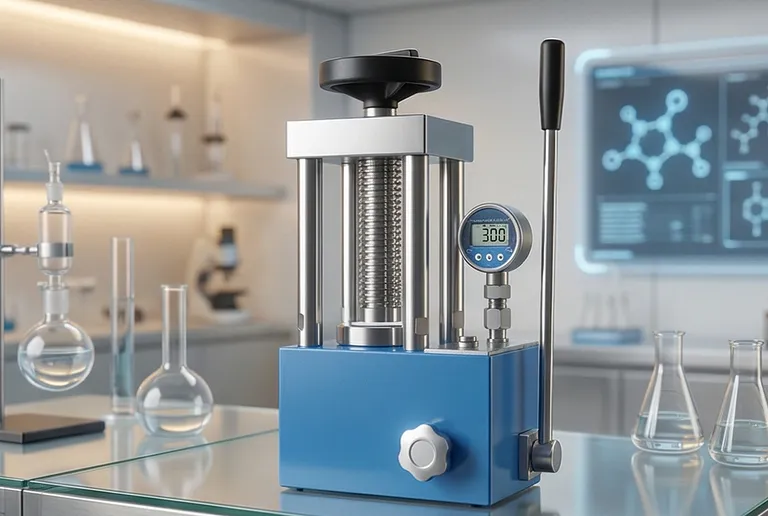
In materials science, as in finance, the most significant risks are often hidden in the "tails" of the process. Pushing a material too hard, or too fast, creates artificial history.
| Risk Factor | Physical Outcome | Scientific Impact |
|---|---|---|
| Rapid Decompression | Capping or Lamination | Creates structural flaws not present in the theoretical model. |
| Edge Effects | Wall Friction Gradients | Leads to non-uniform density at the pellet periphery. |
| Elastic Recovery | "Material Memory" | Causes the final density to drift away from the simulation's target. |
Understanding these limitations is what separates a technician from a researcher. A high-quality press allows for the "dwell time"—the patient holding of pressure—that permits the material to settle into its new reality.
The Interface: Where Performance is Won
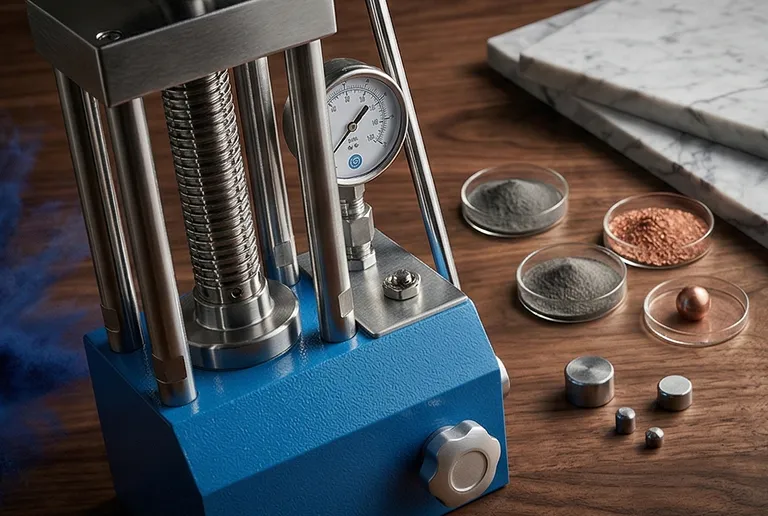
In the burgeoning field of solid-state battery research, the press serves a different, more intimate role: managing the interface.
Validation of electrochemical models depends entirely on how well an electrolyte touches an electrode. By precisely controlling the compaction of layers, a press minimizes interfacial impedance. You are quite literally pressing the components into a conversation, ensuring ion transport efficiency that matches the theoretical maximums.
Engineering the Truth with KINTEK
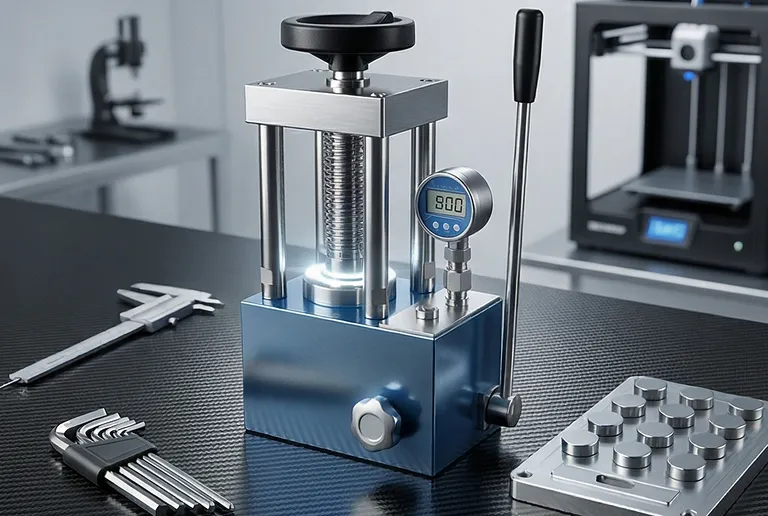
If the goal of research is to validate the simulated with the physical, the equipment must be beyond reproach. Precision is the only way to ensure that your results are a reflection of the material, not the machine.
KINTEK provides the mechanical infrastructure for this validation, offering a spectrum of solutions tailored to the rigors of modern material physics:
- Isostatic Solutions: Cold and Warm Isostatic Presses (CIP/WIP) for uniform 360-degree density.
- Controlled Environments: Glovebox-compatible models for air-sensitive battery chemistries.
- Automation: High-throughput automatic presses that eliminate human variability from the pressing cycle.
The journey from a digital lattice prediction to a physical breakthrough requires a bridge built on pressure, heat, and precision.
Ensure your physical results live up to your theoretical potential. Contact Our Experts
Related Products
- Laboratory Hydraulic Press 2T Lab Pellet Press for KBR FTIR
- Laboratory Hydraulic Press Lab Pellet Press Button Battery Press
- Laboratory Hydraulic Press Lab Pellet Press Machine for Glove Box
- Laboratory Split Manual Heated Hydraulic Press Machine with Hot Plates
- Laboratory Hydraulic Pellet Press for XRF KBR FTIR Lab Press
Related Articles
- The Physics of Transparency: Why Pressure is the Silent Architect of Spectroscopic Clarity
- The Architecture of Density: Why Pressure is the Silent Architect of Solid-State Batteries
- The Architecture of Heat: Why Sample Density Dictates the Truth in Metal Hydride Research
- The Geometry of Electrons: Why Surface Precision is the Silent Partner in SECM Research
- The Geometry of Ionic Flow: Why Precision Pressing Dictates Material Truth



















