
The Moment the Power Fails
Imagine a technician carefully placing a meticulously prepared sample into a laboratory press. The machine hums to life, pressure building. Then, unexpectedly, the building's power cuts out. The lights flicker off, and the hum dies.
In this moment, one silent, ever-present force takes over: gravity.
What happens next is not a matter of chance; it's a matter of design. This single scenario reveals the most critical, yet often overlooked, distinction in laboratory press technology: the difference between an up-stroking and a down-stroking mechanism. It’s a choice that reflects a fundamental philosophy about safety, reliability, and human interaction.
The Physics of Trust
At its core, the debate between up-stroking and down-stroking presses is a conversation about our relationship with gravity. Do we design our systems to work with it as an ally, or do we engineer complex countermeasures to fight against its inevitable pull?
Up-Stroking: Designing with Gravity as an Ally
An up-stroking press, the standard for most laboratory applications, uses hydraulic force to lift the bottom platen against a fixed top platen. It works against gravity to apply pressure.
This orientation creates an inherently fail-safe system. If hydraulic power is lost, gravity simply and gently lowers the bottom platen, opening the press and releasing the sample. The machine naturally returns to its safest state. This isn't just a feature; it's a design that builds trust between the operator and the equipment.
Because gravity assists the return stroke, the hydraulic system is elegantly simple, reducing potential points of failure and simplifying maintenance.
Down-Stroking: Engineering Against Gravity's Pull
A down-stroking press moves the top platen downwards. Here, hydraulic pressure and gravity work in the same direction to close the press.
The critical flaw lies in its failure mode. Upon power loss, the weight of the platen and tooling can cause it to drift downward, creating a significant hazard. The machine's natural tendency is to become less safe.
To counteract this, down-stroking systems require more complex engineering—counterbalance valves and pilot-operated check valves that must actively fight gravity to hold the platen open. These are essential safety features, but they add layers of complexity, cost, and maintenance requirements.
The Human Factor: Simplicity and Peace of Mind
The choice of stroking mechanism directly impacts the user's experience, from ergonomics to the cognitive load required for operation and maintenance.
-
Ergonomic Stability: Loading a sample onto a fixed, stationary bottom platen (as in an up-stroking press) is intuitively safer and more stable. It provides a solid foundation for precise work.
-
Reduced Cognitive Load: A simpler hydraulic circuit means easier troubleshooting and more reliable operation. This simplicity reduces the mental energy an operator or maintenance technician must expend worrying about hidden failure modes.
The elegance of an up-stroking design is that its safety isn't dependent on an additional, complex system that could itself fail. Its safety is baked into its physics.
A Philosophy of Inherent Safety
For specialized, high-speed automated lines, a down-stroking press may be a necessary choice. But in a laboratory, where precision, reliability, and operator safety are paramount, the decision becomes clear. You aren't just buying a machine; you're adopting a safety philosophy.
This philosophy of inherent safety is why the vast majority of high-quality laboratory presses, including KINTEK's range of automatic, isostatic, and heated lab presses, are built on the superior up-stroking principle. They are engineered not just for accurate results, but for the operator's peace of mind.
Here is a summary of the core differences:
| Feature | Up-Stroking Press (Works Against Gravity) | Down-Stroking Press (Works With Gravity) |
|---|---|---|
| Failure Mode | Inherently Safe: Opens on power loss. | Potentially Hazardous: Can drift shut. |
| Hydraulic System | Simple, reliable, fewer components. | Complex, requires extra safety valves. |
| Operator Safety | Superior due to fail-safe design. | Requires vigilant safety protocols. |
| Best Application | Standard laboratories, R&D, QC. | Specialized, high-speed automation. |
Ultimately, great engineering doesn't just solve a problem; it does so with an elegance that respects fundamental forces. The design of a lab press is a perfect testament to this principle.
To ensure your laboratory is equipped with a press that prioritizes both performance and inherent safety, Contact Our Experts.
Visual Guide
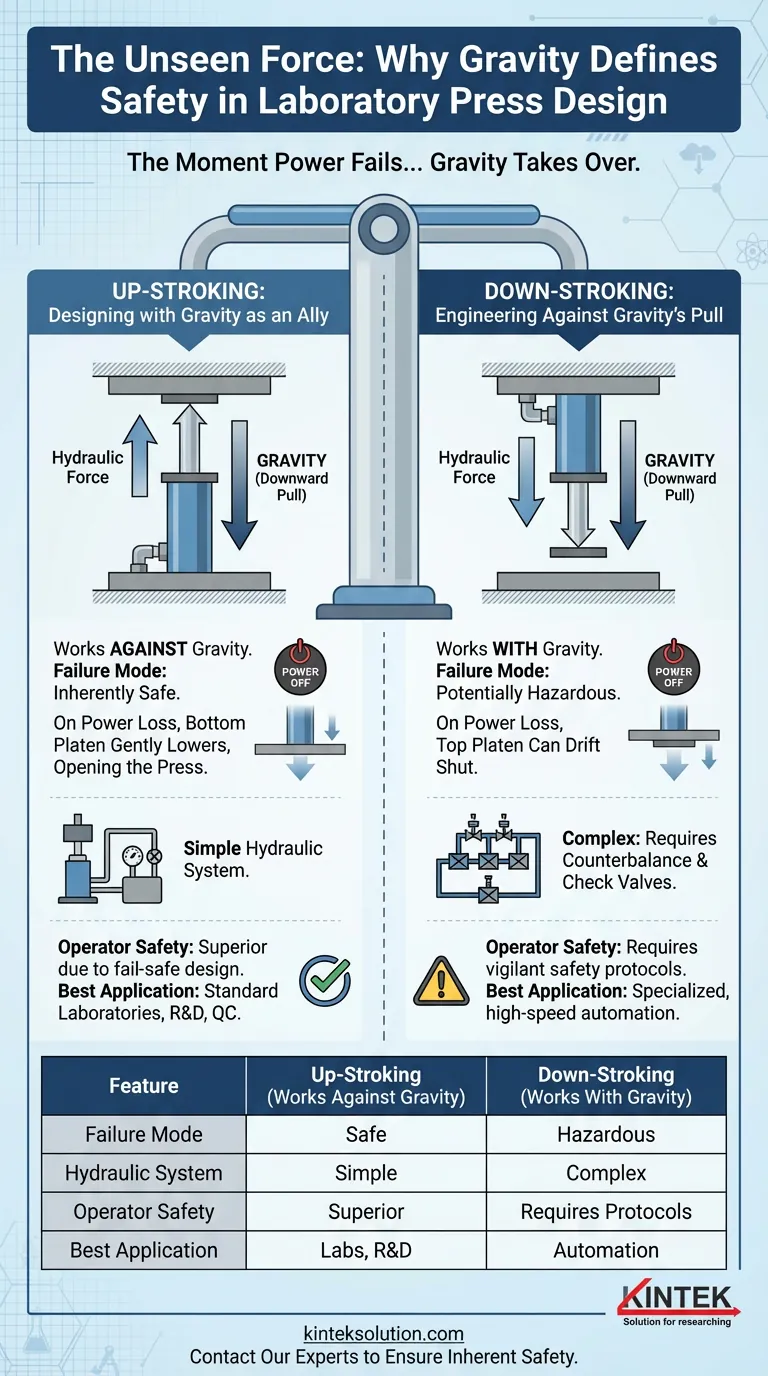
Related Products
- Laboratory Hydraulic Press 2T Lab Pellet Press for KBR FTIR
- Laboratory Hydraulic Press Lab Pellet Press Button Battery Press
- Laboratory Hydraulic Press Lab Pellet Press Machine for Glove Box
- Laboratory Split Manual Heated Hydraulic Press Machine with Hot Plates
- Laboratory Hydraulic Pellet Press for XRF KBR FTIR Lab Press
Related Articles
- The Physics of Transparency: Why Pressure is the Silent Architect of Spectroscopic Clarity
- The Architecture of Density: Why Pressure is the Silent Architect of Solid-State Batteries
- The Architecture of Heat: Why Sample Density Dictates the Truth in Metal Hydride Research
- The Geometry of Electrons: Why Surface Precision is the Silent Partner in SECM Research
- The Geometry of Ionic Flow: Why Precision Pressing Dictates Material Truth



















