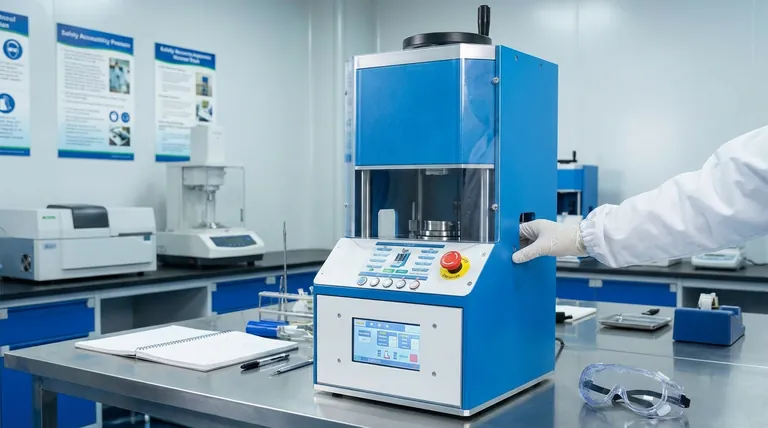
The Moment of Inattention
A lab is a symphony of controlled variables. But the one variable that can never be fully controlled is human attention.
Imagine a technician, running a compaction test on a new material. They're focused, but also juggling a deadline, a blinking notification on their monitor, and a question from a colleague. For just a fraction of a second, their mind is elsewhere as they reach toward the press.
In that fraction of a second, a catastrophic injury could occur. Or, nothing happens. The difference between those two outcomes is not luck. It is engineering. It is a philosophy of safety built into the machine, one that anticipates human fallibility.
A Language of Predictability: Decoding CE and OSHA
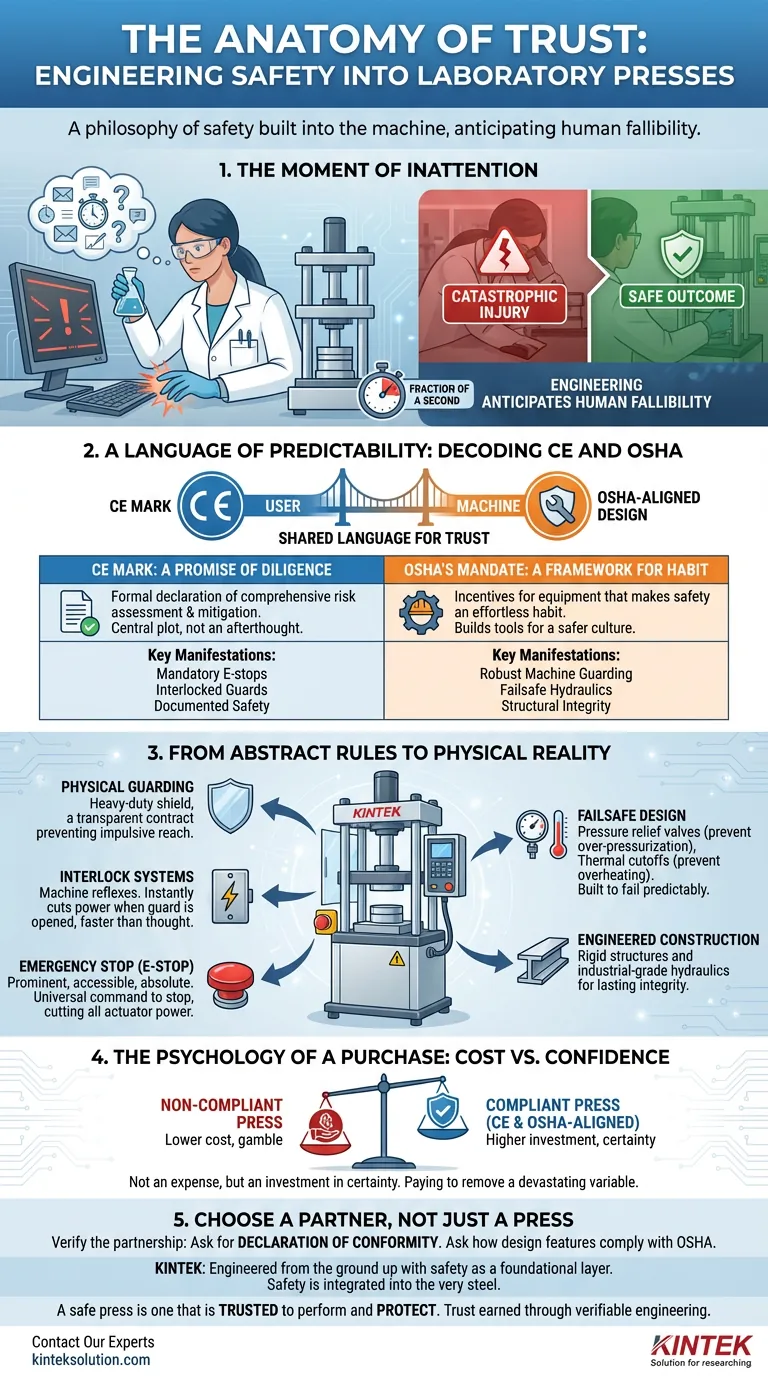
Safety standards are often seen as bureaucratic hurdles. In reality, they are a shared language for building trust between the user and the machine. For laboratory presses, two dialects are dominant: the CE mark and OSHA-aligned design principles.
They are not just stickers or lines in a manual; they are the grammar of a system designed to be predictable and safe, even when its operator is not.
The CE Mark: A Promise of Diligence
The CE mark on a laboratory press is the final sentence in a long, detailed story of risk assessment. It signifies that the manufacturer has systematically identified every potential hazard—from electrical shock to crushing force—and engineered a specific mitigation for it.
It is a formal declaration that the machine’s design was not an afterthought, but the central plot.
OSHA's Mandate: A Framework for Habit
The Occupational Safety and Health Administration (OSHA) focuses on the workplace environment. It doesn't certify machines, but it creates powerful incentives for labs to use equipment that makes safety an effortless habit.
Manufacturers who design in alignment with OSHA standards, such as 29 CFR 1910.212 for machine guarding, are essentially building the tools for a safer culture. They create a press that doesn't just allow for safe work, but actively encourages it.
From Abstract Rules to Physical Reality
This philosophy of safety translates into tangible, life-saving features. Each component is part of a dialogue between the machine and the operator, designed to keep them safe.
- Physical Guarding: A heavy-duty polycarbonate safety shield isn't just a barrier. It’s a transparent contract. It allows you to observe the high-pressure process while physically preventing the impulsive reach that can lead to injury.
- Interlock Systems: These are the machine's reflexes. The moment a safety shield is opened during a cycle, the interlock switch instantly cuts power. It acts faster than human thought, enforcing the safety contract without hesitation.
- Emergency Stop (E-Stop): The E-stop button is the ultimate expression of operator authority. It is prominent, accessible, and absolute. Pressing it is a universal command for "stop," cutting all actuator power and providing a final, foolproof safeguard.
- Failsafe Design: A well-engineered press is designed with humility. Hydraulic systems have pressure relief valves to prevent over-pressurization. Heated platens have thermal cutoffs to prevent overheating. The entire system is built to fail predictably and safely, not catastrophically.
This level of engineering is evident in the fundamental construction of presses from manufacturers like KINTEK. Their use of rigid, pillar-type structures and industrial-grade hydraulics is not just for performance—it’s a foundational layer of safety, ensuring the machine can withstand years of intense use without material fatigue or failure.
The Psychology of a Purchase: Cost vs. Confidence
Choosing a lab press often involves a psychological trade-off. A cheaper, non-compliant machine offers an immediate, tangible saving. A compliant machine, built to CE and OSHA-aligned standards, costs more.
This isn't an expense; it's an investment in certainty.
Opting for the non-compliant press is a bet against human error. It's a gamble that no one in your lab will ever be distracted, tired, or rushed. The higher upfront cost of a certified press buys you out of that gamble. You are paying to remove a devastating variable from your laboratory's future.
| Standard | Core Philosophy | Key Manifestations in Design |
|---|---|---|
| CE Marking | A formal promise of comprehensive risk mitigation. | Mandatory E-stops, interlocked guards, documented safety. |
| OSHA Alignment | A framework for building a safe workplace culture. | Robust machine guarding, failsafe hydraulics, structural integrity. |
Choose a Partner, Not Just a Press
When selecting a press, you are choosing a partner in your laboratory's safety culture. The best way to verify this partnership is to ask for proof. Request the manufacturer's Declaration of Conformity for the CE mark. Ask how their design features specifically help you comply with OSHA regulations.
A manufacturer committed to safety, like KINTEK, will welcome these questions. Their range of automatic lab presses, isostatic presses, and heated lab presses is engineered from the ground up with these principles in mind. The safety isn't an add-on; it's integrated into the very steel of the machine.
Ultimately, a safe press is one that is trusted—not just to perform its function, but to protect its user. This trust is earned through thoughtful, deliberate, and verifiable engineering.
If you are looking to build a safer, more reliable laboratory environment, Contact Our Experts
Visual Guide
Related Products
- Laboratory Hydraulic Press 2T Lab Pellet Press for KBR FTIR
- Laboratory Hydraulic Press Lab Pellet Press Button Battery Press
- Laboratory Hydraulic Press Lab Pellet Press Machine for Glove Box
- Laboratory Split Manual Heated Hydraulic Press Machine with Hot Plates
- Laboratory Hydraulic Pellet Press for XRF KBR FTIR Lab Press
Related Articles
- The Physics of Transparency: Why Pressure is the Silent Architect of Spectroscopic Clarity
- The Architecture of Density: Why Pressure is the Silent Architect of Solid-State Batteries
- The Architecture of Heat: Why Sample Density Dictates the Truth in Metal Hydride Research
- The Geometry of Electrons: Why Surface Precision is the Silent Partner in SECM Research
- The Geometry of Ionic Flow: Why Precision Pressing Dictates Material Truth



















