
The Invisible Bridge Between Powder and Data
In the world of high-resolution spectroscopy, we often obsess over the detector. We spend millions on X-ray Photoelectron Spectrometers (XPS) that can resolve the chemical states of atoms.
Yet, the integrity of that data is decided long before the X-ray hits the sample. It is decided at the workbench, under the piston of a laboratory press.
A raw coal sample is a landscape of chaos. It is porous, irregular, and physically unstable. To extract a signal from this chaos, we must transform it into a "green body"—a perfectly flat, dense pellet.
Without this transition, the spectrometer does not see the chemistry of the coal; it only sees the noise of the preparation.
The Surface Sensitivity Paradox
XPS is a surface-sensitive technique. It interrogates only the top few nanometers of a material.
If the surface is rough, the emitted photoelectrons encounter "shadowing." They scatter off microscopic peaks and valleys. This is not just a loss of signal; it is a distortion of reality.
A high-precision press is the tool that enforces order. By applying specific pressures—typically 8 t/cm²—it creates a mirror-like flatness.
This ensures:
- Uniform Illumination: The X-ray beam hits the entire surface at a consistent angle.
- Geometric Consistency: Every sample sits at the exact focal point of the detector, preventing artificial energy shifts.
The High-Vacuum Threshold
The interior of an XPS chamber is a violent transition for a powder. As vacuum pumps engage, loose particles can "fluidize," flying into the expensive machinery and contaminating the detector.
Beyond physical dispersion, there is the problem of the "void."
Internal air pockets in poorly pressed samples lead to slow outgassing. This delays the testing process and compromises the high-vacuum environment required for photoelectrons to reach the sensor.
High-pressure pelletization collapses these voids, creating a structurally sound specimen that respects the vacuum's requirements.
Managing the Electric Field
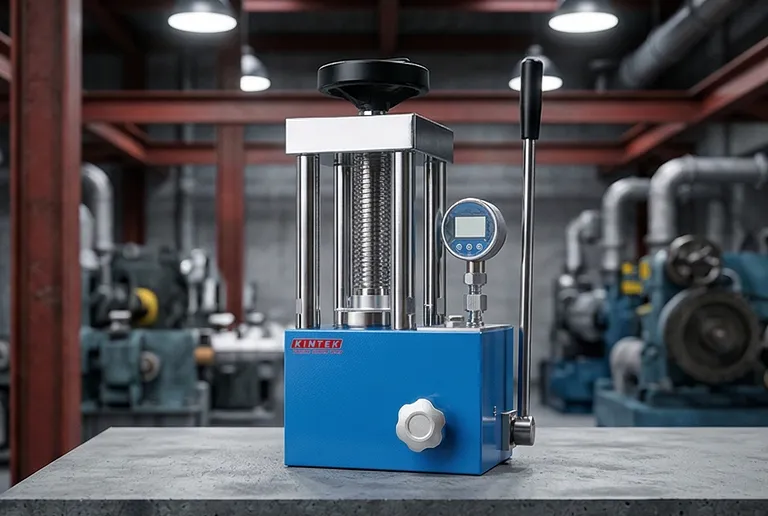
Coal is a poor conductor. When hit by X-rays, it tends to develop a surface charge.
If the pellet is porous or unevenly packed, this charge becomes localized—a phenomenon known as differential charging. This "electric noise" blurs the very peaks researchers are looking for.
Precision pressing establishes a tightly packed particle network. This network allows charge neutralizers to work effectively, stabilizing the electric field.
This stability is the only way to resolve sensitive chemical species, such as N-5 and N-6 nitrogen peaks. Without a uniform surface, these peaks merge into a meaningless smudge.
The Margin of Error: Finding the "Goldilocks" Pressure
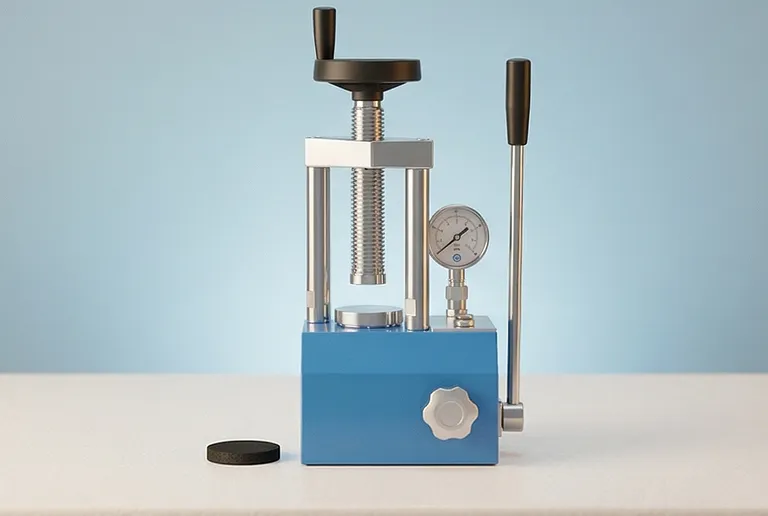
In engineering, more is not always better. The pressure applied to a sample follows a curve of diminishing returns.
| Pressure Level | Physical Result | Analytical Consequence |
|---|---|---|
| Too Low | "Soft" pellets, high porosity | Signal loss, vacuum contamination, poor resolution |
| Optimal (8 t/cm²) | Dense, mirror-flat "green body" | High signal-to-noise ratio, stable binding energy |
| Too High | Mechanical deformation, cracking | Brittle samples, surface contamination from the mold |
The goal is repeatability. A laboratory press must deliver the exact same force, every single time, to ensure that the only variable in the data is the chemistry of the sample itself.
Systems Over Luck: The KINTEK Standard
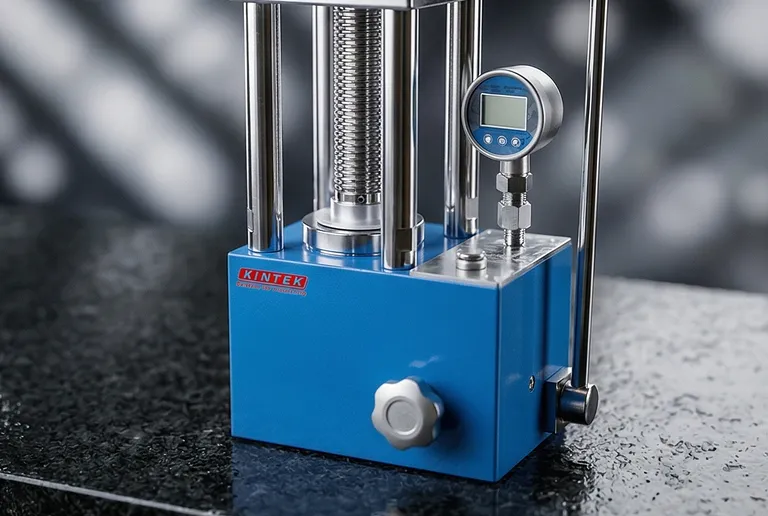
Reliable science is not the result of a lucky measurement; it is the result of a rigorous system.
At KINTEK, we provide the hardware for that rigor. We understand that the path to a breakthrough in battery research or coal chemistry begins with a perfectly prepared pellet.
Our suite of laboratory pressing solutions is designed for the engineer who views sample preparation as a critical phase of analysis:
- Manual & Automatic Presses: For standardized pelletization at specific loads.
- Heated & Multifunctional Models: For complex material behaviors.
- Glovebox-Compatible & Isostatic Presses: For sensitive materials requiring uniform 360-degree density.
The press is the quiet architect of your data integrity. It transforms the physical irregularities of the world into the digital certainties of the laboratory.
To ensure your research is built on a foundation of precision, Contact Our Experts today.
Related Products
- Lab Round Bidirectional Press Mold
- XRF KBR Plastic Ring Lab Powder Pellet Pressing Mold for FTIR
- Carbide Lab Press Mold for Laboratory Sample Preparation
- Lab XRF Boric Acid Powder Pellet Pressing Mold for Laboratory Use
- Lab Polygon Press Mold
Related Articles
- The Physics of Trust: A Disciplined Approach to Laboratory Press Safety and Reliability
- The Anatomy of Repeatability: Deconstructing the Modern Laboratory Press
- The Unseen Variable: Why Your Lab Press Dictates Your Data's Integrity
- The First Principle: Why Lab Press Installation Governs a Decade of Data
- From Powder to Proof: The Unseen Force in Material Science



















