The Ghost in the Membrane
In laboratory research, what you see is rarely what you get. A solid polymer electrolyte (SPE) film, fresh from the solvent-casting tray, looks uniform to the naked eye. To an engineer, however, it is a landscape of microscopic imperfections—trapped gas, loose molecular chains, and internal voids.
If left unaddressed, these "ghosts" become the failure points of the next generation of solid-state batteries. They are the paths where lithium dendrites grow and the gaps where internal resistance thrives.
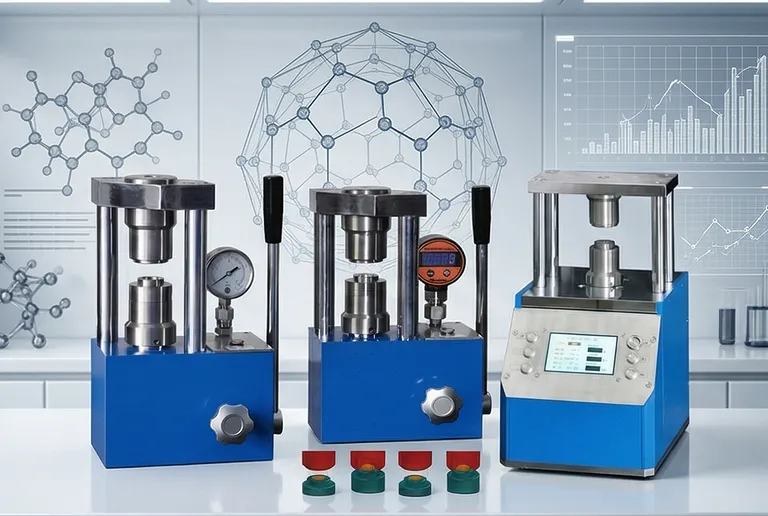
The laboratory hot press is not merely a tool for shaping; it is the final act of structural discipline. It is where raw materials are forced into their most efficient physical state.
The Engineering of Density
Eliminating the Invisible
During solvent evaporation, micro-bubbles are inevitable. They are the structural equivalent of structural cracks in a foundation. A hot press applies controlled, simultaneous heat and pressure to collapse these voids. This secondary densification transforms a porous film into a homogenous barrier.
Molecular Rearrangement
At the glass transition temperature ($T_g$), a polymer matrix is neither liquid nor strictly solid. It is navigable. Under pressure, molecular chains are forced to rearrange, filling gaps and increasing the compactness of the material. This is "engineer’s romance"—the moment where chaotic strands become a high-integrity lattice.
The Precision of Limits
In the world of high-performance batteries, thickness is not a preference; it is a critical variable.
- Uniformity: Variations in thickness create "hotspots" where current distribution becomes uneven.
- Impedance: Every extra micrometer of thickness adds internal resistance, stealing energy from the system.
- Dimensional Integrity: A hot press allows a researcher to move from a "rough" cast of 250 micrometers to a precise, calibrated 120 micrometers with 99% surface uniformity.
Comparison of Processing Outcomes
| Feature | Raw Solvent-Casted Film | Hot-Pressed SPE Film |
|---|---|---|
| Internal Structure | Porosity and micro-bubbles | High-density homogenous matrix |
| Interface | Low surface contact | Superior "wetted" contact |
| Dendrite Safety | Vulnerable to penetration | Robust physical barrier |
| Dimensionality | Variable thickness | Micron-level precision |
The Battle at the Interface
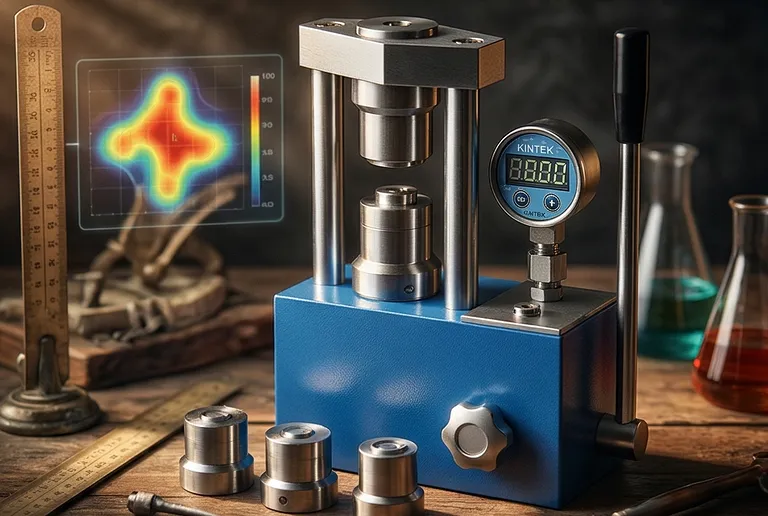
The failure of most solid-state systems happens at the "handshake"—the point where the electrolyte meets the metal anode.
If the contact is poor, the resistance is insurmountable. By reducing the polymer's viscosity during the pressing stage, the hot press allows the electrolyte to "wet" the electrode surface. This creates an intimate mechanical bond that reduces interfacial resistance and stabilizes the battery under thermal stress.
The Psychology of the "Sweet Spot"
Engineering is the management of trade-offs. More heat isn't always better; more pressure isn't always safer.
- Thermal Integrity: Exceeding the thermal window can degrade the lithium salts or the polymer backbone itself.
- Pressure Limits: Excessive force (beyond 20 MPa) risks dielectric breakdown—thinning the film to the point of mechanical failure.
- Viscosity Leaks: If the temperature is too high, the material may flow out from the plates entirely, losing the target geometry.
The goal is a "free-standing" membrane: a material strong enough to be handled, thin enough to be efficient, and dense enough to be safe.
Orchestrating the Result
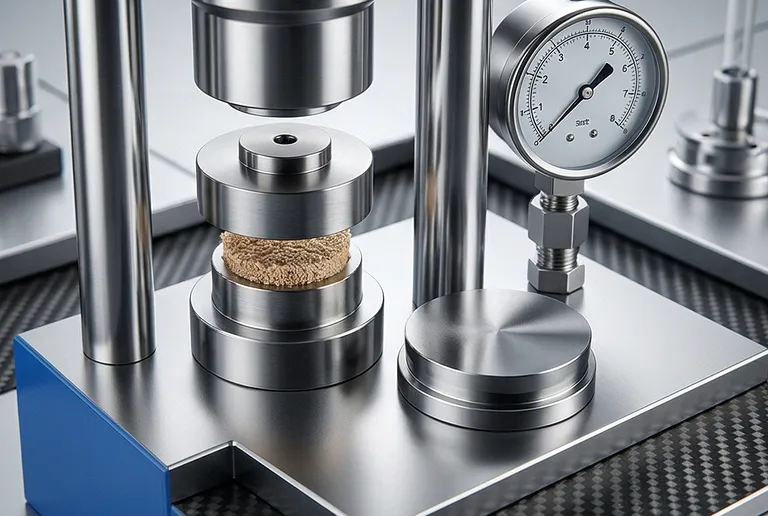
At KINTEK, we understand that a press is only as good as its control. Whether it is a manual unit for quick prototyping or an automatic, glovebox-compatible system for air-sensitive samples, the goal remains the same: the elimination of uncertainty.
Our pressing solutions provide the thermal stability and pressure precision required to bridge the gap between a promising material and a functional battery cell.
Related Products
- Automatic High Temperature Heated Hydraulic Press Machine with Heated Plates for Lab
- Heated Hydraulic Press Machine with Heated Plates for Vacuum Box Laboratory Hot Press
- Automatic Heated Hydraulic Press Machine with Hot Plates for Laboratory
- Heated Hydraulic Press Machine With Heated Plates For Vacuum Box Laboratory Hot Press
- Laboratory Manual Heated Hydraulic Press Machine with Hot Plates
Related Articles
- The Architecture of Slow: Why Physical Precision Dictates Chemical Destiny
- The Architecture of Certainty: Why the Laboratory Press is the Anchor of Material Science
- The Vanishing Boundary: The Hidden Thermodynamics of LTCC Lamination
- The Alchemy of 160°C: Why Precision Pressing is the Silent Backbone of Rubber Science
- The Invisible Forge: Why the Laboratory Press is the Soul of Nano-Composites



















