The Paradox of Soft Timber
Poplar is a biological masterpiece—lightweight, fast-growing, and sustainable. Yet, in the eyes of an engineer, its internal architecture is a liability. It is too porous, too soft, and lacks the mechanical resilience required for high-stress applications.
To transform this "soft" timber into something rivaling the density of hardwoods, we do not add material. We rearrange it. This is the essence of Thermo-Hydro-Mechanical (THM) treatment: a systemic intervention into the wood’s molecular structure through a calculated application of heat and pressure.
The Molecular Lock
Wood is fundamentally a composite of natural polymers. Its rigidity comes from lignin and hemicellulose, which act as the glue holding the cellulose fibers together. In its natural state, this glue is "vitrified"—a glassy, brittle state that resists change.
If you apply pressure to wood at room temperature, it fractures. The cell walls splinter because they cannot bend. To rewrite the material’s destiny, we must first "unlock" the molecules.
Breaking the Glass Transition ($T_g$)
The heated platen is the key to this lock. By transferring thermal energy via conduction, the platens raise the temperature of the wood's surface polymers past their Glass Transition Temperature ($T_g$).
- The State Change: At this threshold (typically 120°C to 160°C), the brittle lignin shifts into a "rubbery," viscoelastic state.
- The Window of Opportunity: In this pliable condition, the wood no longer resists force with brittleness. It yields with plasticity.
The Targeted Collapse: Mechanics of Density

Once the surface has been "plasticized," the second phase of the system begins: mechanical compression. This is where the physical architecture of the wood is permanently altered.
Folding the Lumens
Poplar is full of air—hollow centers within the cells called lumens. By pressing the softened surface layer, we force these lumens to fold and collapse.
This is not a chaotic crushing. It is a controlled reduction of porosity. By packing the same amount of cell wall substance into a fraction of the space, we create a densified "shell" that exponentially increases surface hardness.
Precision of Depth
Wood is a poor thermal conductor, a property we use to our advantage. By using precisely heated platens, we ensure the heat—and thus the densification—remains localized.
- The Shell: Only the outer few millimeters soften and densify.
- The Core: The interior remains unchanged, preserving the light weight and natural flexibility of the board.
The Engineering of Uniformity
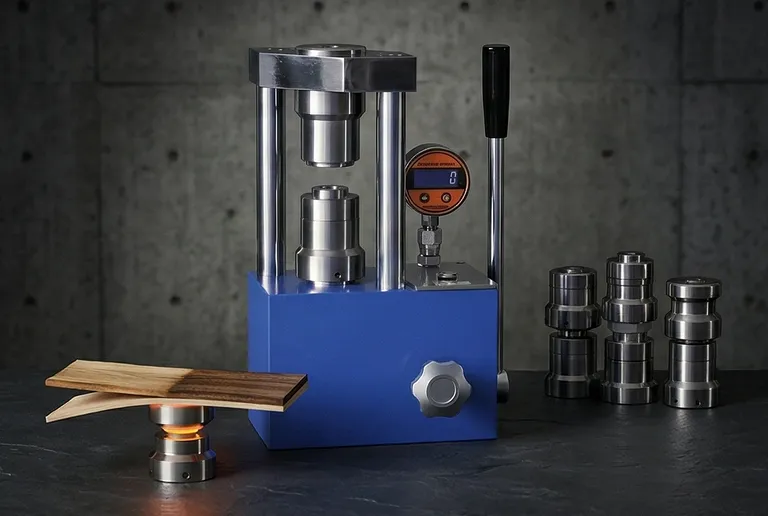
In the pursuit of densification, the margin for error is razor-thin. If the system drifts, the material fails.
The Risk of Thermal Decay
Heat is a catalyst, but in excess, it becomes a poison. If platen temperatures exceed 200°C for too long, the hemicellulose begins to degrade. The wood loses mass, turns an unwanted charred color, and becomes "over-cooked"—brittle rather than strong.
The Problem of "Spring-back"
Wood has a memory. If the internal stresses are not neutralized during the heating and pressing phase, the material will eventually attempt to return to its original shape—a phenomenon known as "set-recovery." Achieving a permanent state requires an absolute balance of temperature uniformity and prolonged contact.
| Parameter | Function in THM Treatment | Technical Outcome |
|---|---|---|
| Platen Temperature | Reaches Glass Transition ($T_g$) | Converts lignin from brittle to pliable |
| Hydraulic Pressure | Forces cell lumen collapse | Increases material density and hardness |
| Duration of Press | Neutralizes internal stresses | Prevents "spring-back" or recovery |
| Surface Precision | Ensures localized conduction | Maintains core integrity while hardening surface |
Systems That Govern Performance
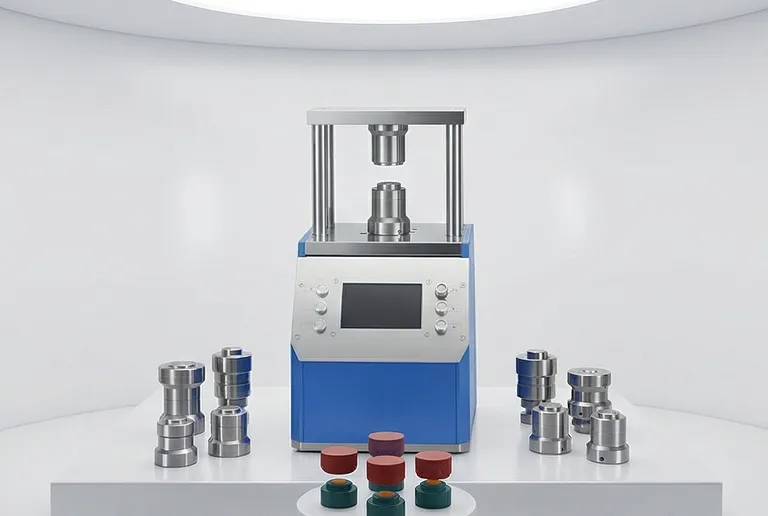
In laboratory and industrial research, the result is only as good as the control over these variables. A fluctuating platen temperature or uneven pressure distribution doesn't just create a bad sample; it creates a flawed data set.
At KINTEK, we understand that material science is a game of precision. Our laboratory pressing solutions are designed for the "Engineer’s Romance"—where the machinery disappears, leaving only the perfect execution of physics.
Whether you are exploring the limits of THM wood treatment or pushing boundaries in battery research, KINTEK offers a comprehensive suite of manual, automatic, and heated presses. Our systems deliver the thermal uniformity and structural stability required to turn soft timber into high-performance material.
Contact Our Experts to discover how our heated pressing solutions can refine your material research.
Related Products
- Automatic High Temperature Heated Hydraulic Press Machine with Heated Plates for Lab
- Heated Hydraulic Press Machine With Heated Plates For Vacuum Box Laboratory Hot Press
- Infrared Heating Quantitative Flat Plate Mold for Precise Temperature Control
- Split Automatic Heated Hydraulic Press Machine with Heated Plates
- Laboratory Split Manual Heated Hydraulic Press Machine with Hot Plates
Related Articles
- The Architecture of Slow: Why Physical Precision Dictates Chemical Destiny
- The Architecture of Certainty: Why the Laboratory Press is the Anchor of Material Science
- The Vanishing Boundary: The Hidden Thermodynamics of LTCC Lamination
- The Alchemy of 160°C: Why Precision Pressing is the Silent Backbone of Rubber Science
- The Invisible Forge: Why the Laboratory Press is the Soul of Nano-Composites














