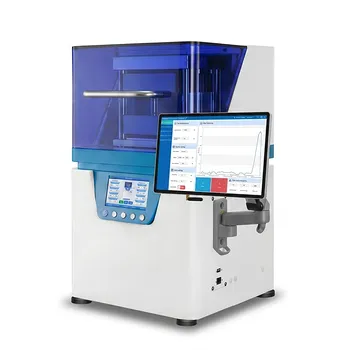
Warm Isostatic Pressing (WIP) is specifically engineered for materials that require elevated temperatures to form correctly but do not necessitate the extreme heat of sintering. It is most commonly used for powders, binders, plastics, and laminates that cannot be successfully molded at room temperature.
Core Takeaway WIP occupies a critical middle ground between cold and hot isostatic pressing. It is the ideal solution for materials that resist compaction at room temperature, using heated liquid to soften binders or polymers to achieve uniform density without the high energy costs of full thermal sintering.
Primary Material Applications
Powders and Binders
The primary application for WIP involves powdered materials mixed with binders.
At room temperature, certain binders may remain too rigid to allow for proper particle rearrangement. WIP applies heat to soften these binders, facilitating higher density and better cohesion during the pressing cycle.
Plastics and Laminates
WIP is highly effective for processing plastics and laminated materials.
Specific liquid warm isostatic presses can reach temperatures up to 250°C, making them ideal for molding polymers that require malleability to take complex shapes without degrading.
Temperature-Sensitive Compounds
This method is essential for materials with special temperature requirements for forming.
If a material is prone to cracking or poor density when pressed cold, but cannot withstand the high temperatures of Hot Isostatic Pressing (HIP), WIP provides the necessary thermal "nudge" to ensure structural integrity.
The Mechanism of Action
The Role of the Liquid Medium
Unlike gas-based high-temperature processes, WIP uses a liquid medium (such as water or oil) to transmit pressure.
The process functions isostatically, applying uniform pressure from all directions. The liquid is heated to a specific point below its boiling typically around 100°C for water-based systems, though specialized fluids allow for higher ranges.
Enhancing Formability
The combination of hydraulic pressure and heat allows the material to flow into the flexible envelope die more effectively.
By introducing heat, the yield strength of the material or binder is temporarily reduced. This allows the powder to pack more tightly, potentially eliminating the need for post-sintering steps in specific applications.
Understanding the Trade-offs
Temperature Limitations
WIP is strictly limited by the boiling point of the liquid medium used.
You cannot achieve the metallurgical bonding temperatures seen in Hot Isostatic Pressing (HIP). If your material requires diffusion bonding or full sintering, WIP will not be sufficient.
Application Specificity
WIP is considered a niche variant of Cold Isostatic Pressing (CIP).
It is not a universal replacement for CIP; it is only suitable for specific applications where the addition of a heating element is necessary to overcome the physical limitations of the material at room temperature.
Making the Right Choice for Your Goal
To determine if Warm Isostatic Pressing is the correct approach for your project, consider the following:
- If your primary focus is Consolidating Powders with Binders: WIP is the superior choice if your binder requires softening to achieve high green density.
- If your primary focus is Processing Plastics: WIP is ideal for laminates and polymers that need temperatures up to 250°C to mold effectively.
- If your primary focus is Cost-Efficiency: WIP may offer a faster cycle time (3-5 minutes) and lower energy costs than HIP, provided the material does not require diffusion bonding.
WIP is the definitive tool when room temperature is too cold for forming, but extreme heat is unnecessary or damaging.
Summary Table:
| Material Category | Common Examples | Temperature Benefit |
|---|---|---|
| Powders & Binders | Metal/ceramic powders with rigid binders | Softens binders for higher green density |
| Plastics & Laminates | Specialty polymers and composite sheets | Enhances malleability for complex molding |
| Temperature-Sensitive | Compounds prone to cracking at room temp | Reduces yield strength to prevent defects |
| Forming Media | Water or specialized oils | Provides uniform isostatic pressure up to 250°C |
Maximize Material Density with KINTEK’s Precision Pressing Solutions
Are you struggling with material cracking or poor density in your battery research or material science projects? KINTEK specializes in comprehensive laboratory pressing solutions tailored to your specific thermal and pressure requirements.
Whether you need Warm Isostatic Presses (WIP) for sensitive laminates, or our advanced manual, automatic, and glovebox-compatible models, we provide the uniform pressure technology essential for high-performance results. Our range also includes Cold and Hot Isostatic Presses to cover every stage of your R&D and production workflow.
Ready to elevate your lab's efficiency? Contact KINTEK today to find the perfect pressing system for your materials!
Related Products
- Warm Isostatic Press for Solid State Battery Research Warm Isostatic Press
- Split Warm Isostatic Lab Press 200 Ton Powder Compaction Chamber for Battery Research and Material Science
- Split Hot Isostatic Pressing Machine 150 Ton Laboratory Heated Isostatic Press
- Electric Isostatic Pressing Machine 40 Tons Automatic Laboratory Powder Compacting Press
- Lab Isostatic Pressing Molds for Isostatic Molding
People Also Ask
- Why must composite cathodes be sealed in vacuum lamination bags for WIP? Ensure Battery Stability and Density
- What is the function of elastic molds in warm isostatic pressing? Achieve Uniform Density in Composite Particles
- How do sacrificial volume materials (SVM) maintain microchannels in isostatic pressing? Ensure Structural Integrity
- What is the role of the flexible material in warm isostatic pressing? Key to Uniform Density & Precision
- What is the mechanism of a Warm Isostatic Press (WIP) on cheese? Master Cold Pasteurization for Superior Safety