
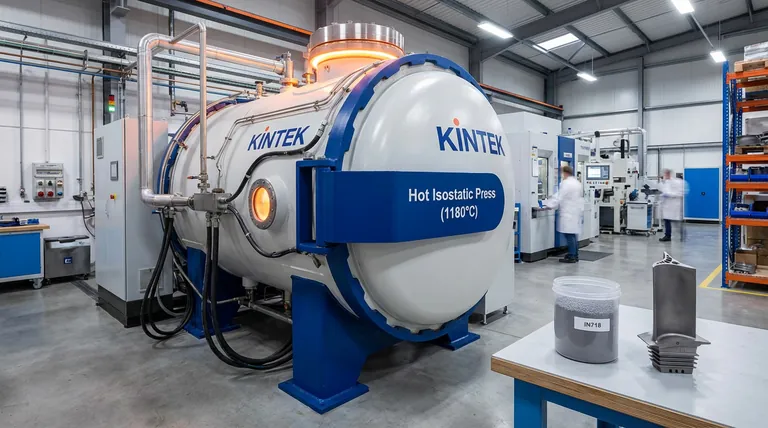
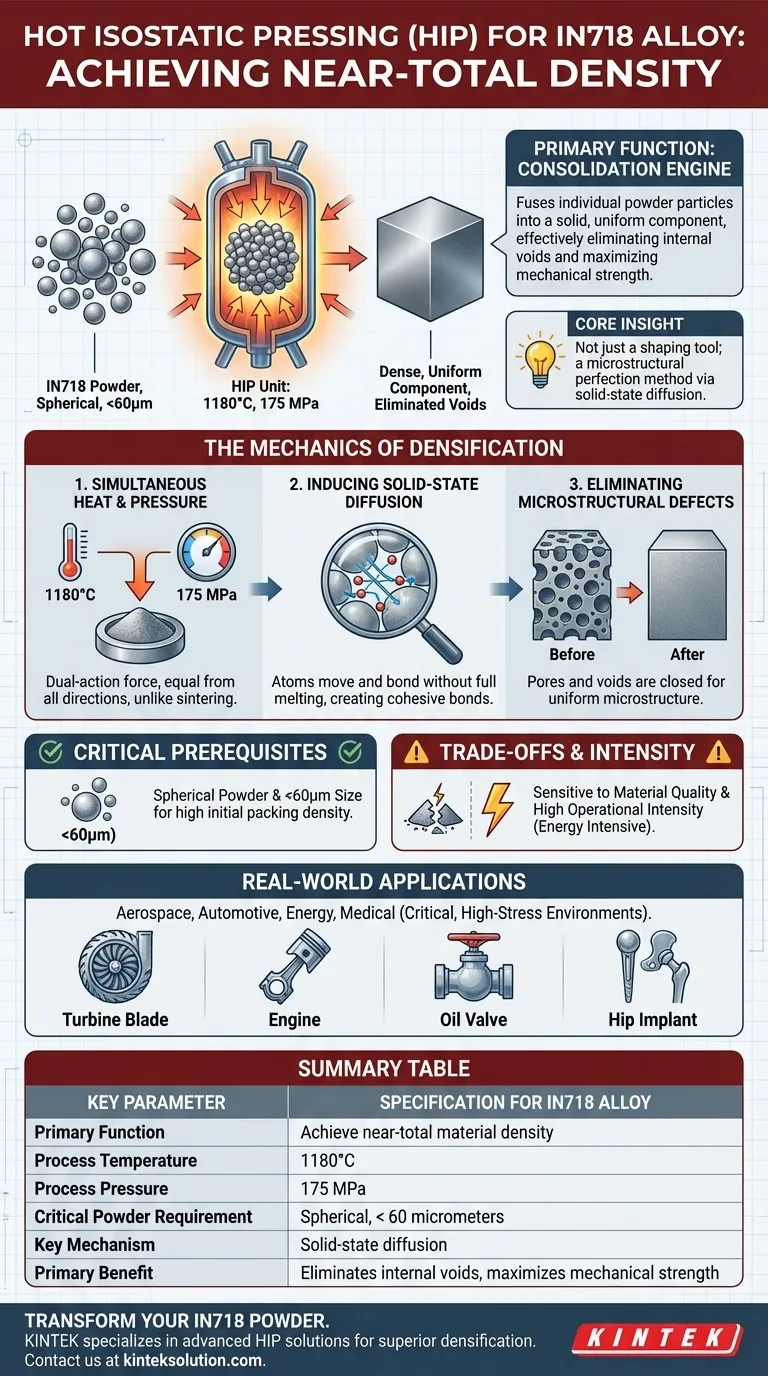
The primary function of a Hot Isostatic Press (HIP) is to achieve near-total material density. In the powder metallurgy of IN718 alloy, the HIP unit acts as a consolidation engine, simultaneously applying extreme temperature (1180°C) and pressure (175 MPa). This process fuses individual powder particles into a solid, uniform component, effectively eliminating internal voids and maximizing mechanical strength.
Core Insight: HIP is not merely a shaping tool; it is a microstructural perfection method. By forcing solid-state diffusion, it resolves the inherent porosity of powder metallurgy, ensuring the final IN718 component delivers the reliability required for critical, high-stress environments.
The Mechanics of Densification
Simultaneous Heat and Pressure
The HIP process subjects the IN718 alloy to a specific environment of 1180°C and 175 MPa.
Unlike standard sintering, which uses heat alone, the addition of isostatic pressure ensures force is applied equally from all directions. This dual-action approach is critical for processing superalloys that are difficult to densify using conventional methods.
Inducing Solid-State Diffusion
The combination of heat and pressure triggers solid-state diffusion.
Atoms move across particle boundaries, bonding the material without necessarily melting it completely. This mechanism fuses the powder particles at the atomic level, creating strong cohesive bonds throughout the component.
Eliminating Microstructural Defects
The primary goal of this diffusion is the removal of original particle boundaries.
As the process continues, internal pores and voids are closed. The result is a uniform microstructure that exhibits significantly improved mechanical properties compared to non-HIPed components.
Critical Prerequisites for Success
The Necessity of Spherical Powder
To achieve high-quality results, the input material must be highly spherical IN718 alloy powder.
Spherical morphology allows the particles to arrange themselves efficiently. This ensures a high initial packing density, which reduces the volume of voids that the HIP process must close.
Particle Size Constraints
References indicate that a particle size under 60 micrometers is crucial.
Smaller, uniform particles minimize the space between granules. This high initial density is a non-negotiable prerequisite for producing a final component with maximum compaction.
Understanding the Trade-offs
Sensitivity to Material Quality
The HIP process is highly dependent on the quality of the feedstock.
If the powder lacks sphericity or exceeds the 60-micrometer size limit, the initial packing density will be insufficient. This can lead to residual porosity, negating the benefits of the expensive high-pressure treatment.
High Operational Intensity
HIP is an energy-intensive process due to the extreme conditions required.
Maintaining 1180°C and 175 MPa requires specialized, robust equipment capable of handling these forces safely. It is generally reserved for components where failure is not an option, such as in aerospace or medical applications.
Real-World Applications
Aerospace and Automotive
The resulting density makes HIP ideal for turbine blades and engine parts.
These components demand superior mechanical properties and dimensional stability to survive high-velocity and high-temperature operations.
Energy and Medical Sectors
In the oil and gas industry, HIP produces parts like valves and seals that endure extreme pressures and corrosive environments.
Similarly, in the medical field, the process enhances the fatigue strength and biocompatibility of surgical implants.
Making the Right Choice for Your Goal
When integrating HIP into your manufacturing workflow, consider your specific performance targets:
- If your primary focus is maximum mechanical strength: Prioritize the precise control of the 1180°C temperature and 175 MPa pressure variables to ensure complete diffusion.
- If your primary focus is process efficiency: Invest heavily in pre-processing quality control to ensure your powder is spherical and under 60 micrometers before it ever enters the press.
By strictly adhering to these material and processing standards, you transform loose powder into a component capable of withstanding the world's most demanding environments.
Summary Table:
| Key Parameter | Specification for IN718 Alloy |
|---|---|
| Primary Function | Achieve near-total material density |
| Process Temperature | 1180°C |
| Process Pressure | 175 MPa |
| Critical Powder Requirement | Spherical particles, < 60 micrometers |
| Key Mechanism | Solid-state diffusion |
| Primary Benefit | Eliminates internal voids, maximizes mechanical strength |
Transform Your IN718 Powder into High-Performance Components
Are you manufacturing critical parts for aerospace, medical, or energy sectors where failure is not an option? The superior densification achieved with Hot Isostatic Pressing is essential for maximizing the fatigue strength and reliability of your IN718 alloy components.
KINTEK specializes in advanced lab press machines, including isostatic presses, designed to meet the rigorous demands of modern powder metallurgy. Our expertise ensures your materials meet the highest standards of density and performance.
Contact KINTALK today to discuss how our HIP solutions can enhance your manufacturing process and deliver the material integrity your applications demand.
Visual Guide
Related Products
- Warm Isostatic Press for Solid State Battery Research Warm Isostatic Press
- Electric Lab Cold Isostatic Press CIP Machine
- Electric Split Lab Cold Isostatic Pressing CIP Machine
- Lab Isostatic Pressing Molds for Isostatic Molding
- Manual Cold Isostatic Pressing CIP Machine Pellet Press
People Also Ask
- Why must composite cathodes be sealed in vacuum lamination bags for WIP? Ensure Battery Stability and Density
- How do sacrificial volume materials (SVM) maintain microchannels in isostatic pressing? Ensure Structural Integrity
- What is the function of elastic molds in warm isostatic pressing? Achieve Uniform Density in Composite Particles
- What is the role of the flexible material in warm isostatic pressing? Key to Uniform Density & Precision
- What are the advantages of using a Warm Isostatic Press (WIP) for batteries? Achieve Superior Interface Contact



















