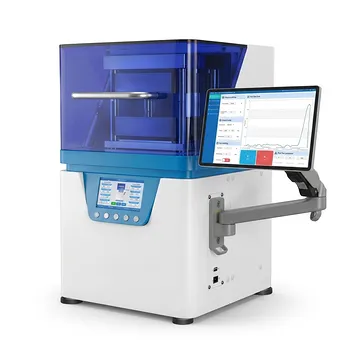
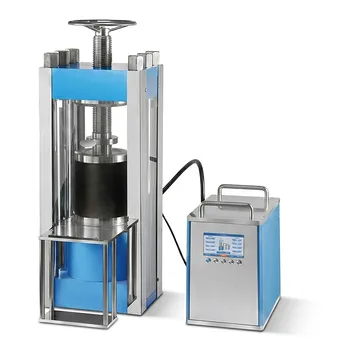
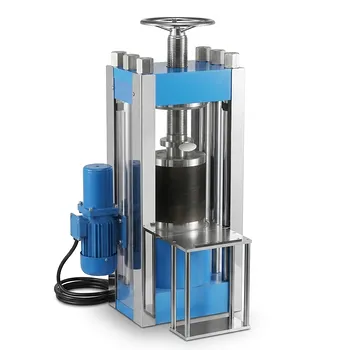
Heated laboratory presses are the standard instrument for converting raw polymer materials into the thin, uniform films required for precise analytical testing. By simultaneously applying controlled thermal energy and mechanical pressure, these devices consolidate polymer samples to achieve specific targets regarding thickness, density, and crystallinity.
The heated press functions not just as a molding tool, but as a critical standardization device. It eliminates structural defects and ensures geometric uniformity, transforming variable raw materials into consistent substrates necessary for reliable spectroscopic and mechanical analysis.
The Mechanics of Film Consolidation
Achieving Structural Uniformity
The primary function of the press is to consolidate loose polymer materials—whether pellets, powders, or solvent-cast fragments—into a single continuous phase. Heat reduces the polymer's viscosity, while pressure forces the material to flow and fuse. This process creates a dense, homogeneous film suitable for detailed study.
Controlling Thickness and Density
Precision is paramount for quantitative analysis. Laboratory presses often utilize metal spacers to define the exact thickness of the film (e.g., 150 μm). This control allows researchers to normalize data, such as photoluminescence intensity or cross-sectional area, which is required to calculate accurate stress-strain curves.
Modulating Crystallinity
The application of heat and pressure directly influences the crystallinity of the final film. By controlling the temperature program and cooling rate, researchers can manipulate the polymer's internal structure. This is essential for understanding how structural changes impact physical properties and behavior under stress.
Enhancing Material Integrity
Defect Elimination and Densification
For advanced applications, such as solid-state electrolytes (e.g., PEO matrices), the press is used to eliminate micropores and voids. This densification is critical for enhancing mechanical strength. In battery research, for example, a defect-free film is necessary to prevent lithium dendrite penetration.
Homogenous Distribution of Additives
When preparing composite films, the press ensures that additives—such as inorganic fillers or mechanochromic agents—are distributed evenly throughout the matrix. This re-melting and integration process prevents localized clumping. A uniform distribution is vital for consistent optical monitoring and mechanical performance.
Critical Applications in Research
Spectroscopic Analysis
Thin, uniform films are a prerequisite for transmission techniques like IR spectroscopy and XRF analysis. The press creates samples that are thin enough to allow light transmission but robust enough to handle. This facilitates the identification of chemical bonds and elemental composition.
Standardized Mechanical Testing
To determine physical properties like tensile strength, flexure, and impact resistance, samples must adhere to international standards. Heated presses allow users to mold common polymers (PE, PP, PS, ABS) into standardized geometries. This ensures that test results are reproducible and comparable across different laboratories.
Understanding Operational Trade-offs
Thermal Degradation vs. Fusion
While high heat is necessary for fusion, excessive temperatures can cause thermal degradation of the polymer chains. Operators must carefully balance the temperature profile to ensure flow without breaking down the material's molecular weight.
Demolding Challenges
Molten polymers have a high tendency to adhere to metal press platens, which can ruin the sample upon removal. To mitigate this, PTFE sheets are frequently used as a non-stick interface. This ensures the film can be demolded intact without inducing surface defects or stress.
Making the Right Choice for Your Goal
When utilizing a heated press for polymer films, your specific analytical goal dictates your processing parameters.
- If your primary focus is Infrared (IR) Spectroscopy: Prioritize achieving the minimum possible thickness to ensure sufficient light transmission and minimize signal saturation.
- If your primary focus is Mechanical Testing: Focus on using precise metal spacers and controlled cooling rates to ensure uniform density and standardized dimensions for stress-strain calculations.
- If your primary focus is Composite Development: Ensure the temperature and pressure are sufficient to fully densify the matrix and eliminate voids around inorganic fillers.
Success in polymer film preparation relies on treating the press not as a simple heater, but as a precision instrument for structural standardization.
Summary Table:
| Feature | Function in Film Preparation | Research Benefit |
|---|---|---|
| Thermal Energy | Reduces polymer viscosity and enables fusion | Modulates crystallinity and eliminates voids |
| Mechanical Pressure | Forces material flow into continuous phases | Ensures high density and structural homogeneity |
| Metal Spacers | Defines specific film thickness (e.g., 150 μm) | Standardizes samples for quantitative analysis |
| PTFE Sheets | Provides a non-stick interface during cooling | Prevents surface defects and ensures easy demolding |
| Temperature Control | Manages heating and cooling rates | Prevents thermal degradation of polymer chains |
Elevate Your Polymer Research with KINTEK Precision
Ready to achieve flawless film uniformity and density? KINTEK specializes in comprehensive laboratory pressing solutions tailored for high-stakes research. Whether you are developing solid-state electrolytes for battery research or performing advanced IR spectroscopy, our range of manual, automatic, heated, multifunctional, and glovebox-compatible models—including specialized cold and warm isostatic presses—provides the control you need.
Why choose KINTEK?
- Precision Engineering: Achieve exact thickness and crystallinity for standardized testing.
- Versatile Solutions: From PE and PP to complex composite matrices.
- Expert Support: We help you balance thermal profiles to prevent material degradation.
Contact KINTEK Today to Find Your Perfect Pressing Solution
Related Products
- 24T 30T 60T Heated Hydraulic Lab Press Machine with Hot Plates for Laboratory
- Automatic Heated Hydraulic Lab Press 120x120mm Plate Fully Automated Material Research Press
- Automatic Heated Hydraulic Lab Press with Programmable Touch Screen Controls and Precision Temperature Regulation
- Automatic Heated Hydraulic Lab Press Machine 200x200 Plate Size for Battery Research and Materials Science
- Manual Heated Hydraulic Lab Press with Integrated Hot Plates Hydraulic Press Machine
People Also Ask
- Function of a Laboratory Hydraulic Press with Heated Platens in SSE? Enhance Battery Density & Conductivity
- Why is a laboratory hydraulic press with heating plates required for PLA/TEC films? Achieve Precise Sample Integrity
- What role does a laboratory heated hydraulic press play in LTCC? Essential for High-Density Ceramic Lamination
- Why reduce load when applying composite strengthening tabs? Protect Specimen Integrity and Data Accuracy
- Why is a laboratory heated hydraulic press utilized during the lamination stage of NASICON green tapes?