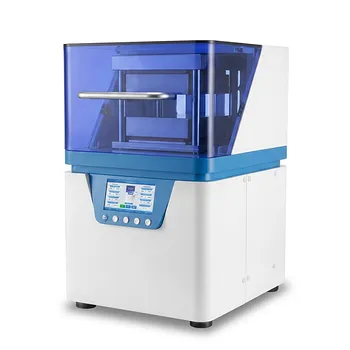
Hydraulic presses are fundamental instruments in laboratory environments, primarily utilized for precise sample preparation and material testing. They function by applying immense, controlled pressure to compress materials into uniform pellets or thin films essential for spectroscopic analysis, while also providing the force necessary to evaluate material strength and durability.
Core Takeaway: Beyond simple compression, the laboratory hydraulic press is a tool for consistency. Its primary value lies in creating perfectly homogeneous samples for analytical chemistry and simulating extreme stress conditions for material science, all within a compact and cost-effective footprint.
The Primary Application: Sample Preparation
Enabling Accurate Spectroscopy
The most frequent use of hydraulic presses in the lab is preparing samples for analytical techniques. Methods like FTIR (Fourier Transform Infrared Spectroscopy) and XRF (X-ray Fluorescence) require samples to be optically transparent or uniformly dense to yield accurate data.
Creating Homogeneous Pellets and Films
To achieve this uniformity, technicians use hydraulic presses to compress powder mixtures. For example, KBr (Potassium Bromide) is mixed with a sample and pressed into a solid pellet for FTIR analysis. The press ensures the material is compacted evenly, eliminating voids that could distort analytical results.
Material Characterization and Testing
Evaluating Strength and Durability
Hydraulic presses are not limited to making pellets; they are also rigorous testing machines. They are widely used for tension testing, a process where materials are pulled apart under controlled force to measure their tensile strength and overall durability.
Investigating High-Pressure Effects
Research laboratories use these presses to study how substances behave under extreme conditions. By applying specific pressures—often exceeding 10,000 psi—scientists can investigate phase changes and physical alterations in materials that would not occur under normal atmospheric conditions.
Why Laboratories Choose Hydraulic Systems
Superior Force Generation
Compared to pneumatic systems, which generally top out around 100 psi, hydraulic systems can efficiently transmit power to generate significantly higher pressures. This capability is essential for compressing hard materials or conducting failure analysis on robust composites.
Compact and Economical Design
Despite their power, laboratory hydraulic presses—particularly "hot press" models—are valued for their compact footprint. They are space-efficient, cost-effective, and require less physical effort to operate than mechanical alternatives, making them ideal for pharmaceutical, polymer, and undergraduate chemistry labs.
Understanding the Trade-offs
Process Speed vs. Control
While hydraulic presses offer immense force, they are generally slower than mechanical stamping presses. This slower actuation is an advantage in a lab setting, allowing for the precise application of pressure, but it makes them less suitable for high-speed, high-volume production tasks.
Sample Limitations
Not all materials respond well to hydraulic compression. While excellent for powders and malleable solids, certain brittle materials may shatter rather than compress if the pressure ramp-up is not carefully controlled.
Making the Right Choice for Your Research
To determine the best application for your specific needs, consider your primary scientific goal:
- If your primary focus is Analytical Chemistry (FTIR/XRF): Prioritize a press designed for sample preparation, specifically one capable of creating consistent, high-density KBr pellets or thin films.
- If your primary focus is Material Science: Look for a press configured for tension and compression testing, ensuring it can generate sufficient force to test the failure points of your specific materials.
Success in the laboratory depends on reproducible results; the hydraulic press is the standard for ensuring your physical samples match the precision of your analytical instruments.
Summary Table:
| Application Category | Primary Laboratory Use | Key Benefits for Research |
|---|---|---|
| Analytical Chemistry | Creating KBr pellets for FTIR & XRF samples | Ensures homogeneity and optical transparency for accurate data. |
| Material Science | Tension, compression, and durability testing | Evaluates material strength and behavior under extreme stress. |
| High-Pressure Research | Investigating phase changes & physical alterations | Reaches pressures >10,000 psi to simulate extreme environments. |
| Sample Preparation | Compressing powders into uniform thin films | Eliminates voids and inconsistencies in sample density. |
Elevate Your Research Precision with KINTEK
Consistency is the foundation of scientific discovery. KINTEK specializes in comprehensive laboratory pressing solutions designed to meet the rigorous demands of modern research. Whether you are conducting cutting-edge battery research or performing routine spectroscopic analysis, our diverse range of equipment—including manual, automatic, heated, multifunctional, and glovebox-compatible models, as well as cold and warm isostatic presses—provides the controlled force you need.
Don't let sample inconsistency compromise your results. Partner with KINTEK for durable, space-efficient, and high-performance hydraulic systems tailored to your specific lab requirements.
Ready to optimize your sample preparation? Contact KINTEK today to find the perfect press for your application!
Related Products
- Automatic Hydraulic Hot Press with Large Plate and Precision Temperature Control for Advanced Material Sample Preparation and Industrial Research
- Automatic Hydraulic Heat Press Machine with Multi Stage Programmable Control and Integrated Water Cooling Plate Size 180x180mm
- Automatic High Temperature Heated Hydraulic Press Machine with Heated Plates for Lab
- Automatic Heated Hydraulic Lab Press with Programmable Touch Screen Controls and Precision Temperature Regulation
- Manual Heated Hydraulic Lab Press with Integrated Hot Plates Hydraulic Press Machine
People Also Ask
- What are the specific features and applications of hydraulic hot press machines? Precision Solutions for Modern Labs
- How does an automatic hydraulic press operate? Achieve Precision and Consistency in Lab Pelleting
- What are the advantages and common applications of an automatic hydraulic press? Elevate Your Lab's Precision
- What is the technical significance of setting a precise dwell time? Achieve Peak Material Density and Stability
- When is an automatic hydraulic press more suitable than a manual press? Scale Your Lab with Precision & Speed