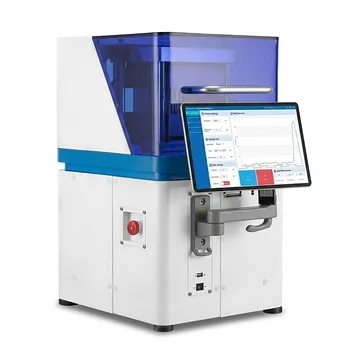
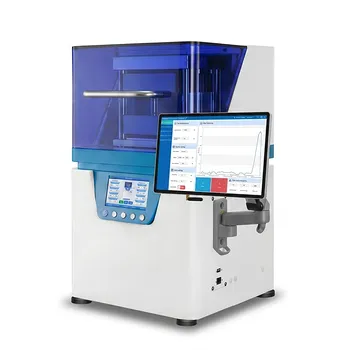
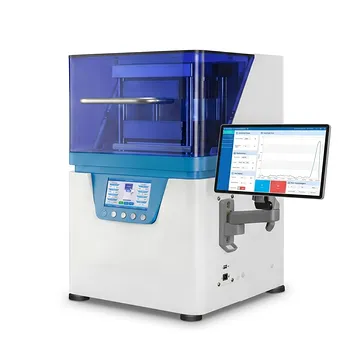
Laboratory presses are utilized in X-ray fluorescence (XRF) spectroscopy to transform loose sample materials into solid, stable pellets. By applying high hydraulic pressure, the press squeezes the sample between two plates, ensuring complete compaction and creating a dense disc that is ready for analysis.
The primary goal of using a laboratory press in XRF is not just to flatten the sample, but to standardize it. By creating a uniform, high-density pellet, you minimize variables like particle scattering, ensuring that the analytical data reflects the true elemental composition of the material rather than physical irregularities.
The Mechanics of Sample Integrity
Achieving Complete Compaction
The most immediate function of the laboratory press is to force loose powders into a solid state. The press applies high pressure to the material, removing void spaces and forcing particles to bond mechanically. This ensures the sample maintains its physical integrity and does not crumble during the handling or analysis process.
Creating a Uniform Surface
XRF analysis relies on the interaction between X-rays and the sample surface. A laboratory press creates a perfectly flat, uniform surface on the pellet or briquette. This smoothness is critical because surface irregularities can alter how X-rays are absorbed or fluoresced, leading to erratic data.
Enhancing Homogeneity via Heat
While standard hydraulic presses use pressure alone, heated lab presses are often employed for higher precision. Applying heat alongside pressure promotes better homogeneity within the sample matrix. This is particularly useful for materials that resist compaction at room temperature, ensuring a consistent internal structure.
The Impact on Analytical Performance
Reducing Particle Scattering
One of the main enemies of accurate spectroscopy is particle scattering. If a sample is loose or uneven, X-rays scatter unpredictably. By pressing the sample into a dense pellet, the laboratory press reduces particle scattering, allowing for a direct and clear measurement of the elemental signal.
Improving Sensitivity and Accuracy
The quality of the sample preparation directly dictates the quality of the results. A well-pressed pellet ensures that the elemental composition is presented to the detector in a reproducible way. This consistency enhances both the accuracy (closeness to the true value) and sensitivity (ability to detect trace elements) of the measurement.
Understanding the Trade-offs
Consistency is Critical
A laboratory press is only as effective as its operator's consistency. If pressure levels or dwell times vary between samples, the density of the resulting pellets will fluctuate. These variations in density can be misinterpreted by the XRF instrument as differences in elemental concentration, introducing systematic errors into your dataset.
Thermal Considerations
While heated presses improve homogeneity, they introduce a variable that must be controlled. Excessive heat can alter the chemical structure of volatile components in certain samples. It is vital to balance the need for plastic flow and binding against the thermal stability of the material you are analyzing.
Making the Right Choice for Your Goal
Whether you are conducting routine quality control or high-precision research, the way you utilize the press matters.
- If your primary focus is Routine Elemental Analysis: Use a standard hydraulic press to create general sample pellets, prioritizing consistent pressure settings to ensure reproducibility across batches.
- If your primary focus is High-Sensitivity/Trace Analysis: Utilize a heated laboratory press to maximize homogeneity and minimize surface irregularities that could mask trace signals.
Ultimately, the laboratory press bridges the gap between a raw, messy sample and a precise, scientific measurement.
Summary Table:
| Feature | Function in XRF Sample Preparation | Benefit to Analytical Results |
|---|---|---|
| High Pressure | Removes void spaces & bonds particles | Ensures physical integrity & durability |
| Flat Surfaces | Creates a smooth, uniform interface | Minimizes X-ray absorption errors |
| Compaction | Increases sample density | Reduces particle scattering for clear signals |
| Heat (Optional) | Enhances matrix homogeneity | Improves sensitivity for trace element detection |
Elevate Your Analytical Precision with KINTEK
Maximize the accuracy of your XRF spectroscopy with KINTEK’s premium laboratory pressing solutions. Whether you are performing routine quality control or advanced battery research, our comprehensive range of manual, automatic, heated, and multifunctional presses—including glovebox-compatible and isostatic models—ensures perfectly standardized pellets every time.
Why choose KINTEK?
- Unmatched Versatility: From standard hydraulic compaction to heated homogeneity.
- Precision Control: Eliminate systematic errors with consistent pressure and dwell times.
- Expert Support: Solutions tailored to your specific material science needs.
Contact KINTEK today to find the perfect press for your lab and transform your raw samples into precise scientific measurements!
Related Products
- Laboratory Hydraulic Press Lab Pellet Press Button Battery Press
- Laboratory Hydraulic Press Lab Pellet Press Machine for Glove Box
- Laboratory Split Manual Heated Hydraulic Press Machine with Hot Plates
- Laboratory Hydraulic Pellet Press for XRF KBR FTIR Lab Press
- Laboratory Hydraulic Split Electric Lab Pellet Press
People Also Ask
- How is a laboratory hydraulic press used for HAP composite gels? Master Mineral Substrate Standardization
- What role does a laboratory hydraulic press play in the preparation of piezoelectric ceramic discs for DC-PG? | KINTEK
- What role does a laboratory hydraulic press play in reaction pellets? Optimizing Lunar Soil and Metal Fuel Density
- Why is a laboratory hydraulic press required for PBAT and PLA sample preparation? Achieve Flawless Characterization
- What role does a laboratory hydraulic press play in the assembly of all-solid-state battery test cells? Expert Guide