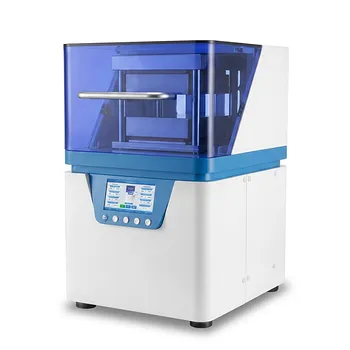
The primary advantages of a hydraulic mini press over a full-sized unit are its compact footprint and improved ergonomics. By significantly reducing the physical effort required for operation and occupying far less surface area, these units allow for convenient placement on a laboratory countertop rather than a dedicated floor space.
Core Takeaway The hydraulic mini press is an ergonomic solution designed to bring industrial-grade compression to space-constrained environments. It prioritizes technician comfort and ease of access without the physical strain or storage demands associated with standard, floor-standing manual presses.
Maximizing Laboratory Space
Countertop Accessibility
Unlike full-sized presses that often dominate floor space, a mini press is engineered for a compact footprint.
This allows the unit to be placed directly on a lab bench or countertop. Technicians can integrate the press into their immediate workflow rather than traveling to a separate area of the facility.
Efficient Storage
The reduced physical dimensions of a mini press extend beyond just its operational footprint.
When not in active use, these units require minimal storage space. This makes them ideal for smaller laboratories or multi-purpose rooms where equipment density is a concern.
Improving Ergonomics and Usability
Reduced Physical Effort
One of the most critical benefits of the mini press is the reduction in operator fatigue.
Compared to standard-sized, manually hand-pumped hydraulic presses, the mini press requires less physical force to operate. This allows for repeated use without the strain typically associated with larger manual systems.
Enhanced Technician Comfort
The ability to place the unit on a benchtop creates a more natural working height.
This setup significantly enhances technician comfort by allowing the operator to work in a stable, ergonomic position. This contrasts with floor-standing models that may require awkward bending or reaching during operation.
Understanding the Trade-offs
Capacity Limitations
While mini presses excel in portability and ease of use, they naturally have physical limitations compared to full-sized counterparts.
Users requiring extreme tonnage or the ability to process very large samples may find the force capacity or platen size of a mini press insufficient.
Throughput Considerations
Mini presses are often optimized for individual sample preparation rather than mass industrial production.
For high-volume manufacturing where automation and speed are the primary drivers, a larger, fully automated industrial press might be necessary despite the space requirements.
Making the Right Choice for Your Goal
Selecting the correct press depends on balancing your available space against your force requirements.
- If your primary focus is Space Efficiency: Choose a hydraulic mini press to maintain a clear floor plan and utilize existing bench space effectively.
- If your primary focus is Operator Comfort: Opt for the mini press to minimize the physical exertion required for routine sample preparation.
- If your primary focus is Maximum Force: Stick to a full-sized press, accepting the trade-off of a larger footprint for higher tonnage capabilities.
The hydraulic mini press offers a smart compromise, delivering essential hydraulic power in a package that respects both the user's energy and the laboratory's limited space.
Summary Table:
| Feature | Hydraulic Mini Press | Full-Sized Press |
|---|---|---|
| Footprint | Compact (Benchtop/Countertop) | Large (Floor-Standing) |
| Operator Effort | Low (Reduced physical force) | High (Manual hand-pumping) |
| Space Demand | Minimal storage & work area | Requires dedicated floor space |
| Ergonomics | High (Natural working height) | Variable (Potential for strain) |
| Best Use Case | Lab research & space-constrained R&D | High tonnage & mass production |
Upgrade Your Lab with KINTEK Precision Pressing Solutions
Don't let limited space compromise your research quality. KINTEK specializes in comprehensive laboratory pressing solutions, offering a versatile range of manual, automatic, heated, and multifunctional models. Whether you need the compact ergonomics of our mini presses or the robust power of our cold and warm isostatic presses, we provide the tools essential for advanced battery research and material science.
Ready to enhance your lab's efficiency and technician comfort?
Contact KINTEK Today for a Specialized Consultation
Related Products
- Automatic Hydraulic Hot Press with Large Plate and Precision Temperature Control for Advanced Material Sample Preparation and Industrial Research
- Automatic Laboratory Hydraulic Press Lab Pellet Press Machine
- Laboratory Hydraulic Press Lab Pellet Press Machine for Glove Box
- Automatic Hydraulic Heat Press Machine with Multi Stage Programmable Control and Integrated Water Cooling Plate Size 180x180mm
- Laboratory Hydraulic Press Lab Pellet Press Button Battery Press
People Also Ask
- What are the specific features and applications of hydraulic hot press machines? Precision Solutions for Modern Labs
- How does an automatic hydraulic press operate? Achieve Precision and Consistency in Lab Pelleting
- What are the advantages and common applications of an automatic hydraulic press? Elevate Your Lab's Precision
- What is the technical significance of setting a precise dwell time? Achieve Peak Material Density and Stability
- When is an automatic hydraulic press more suitable than a manual press? Scale Your Lab with Precision & Speed