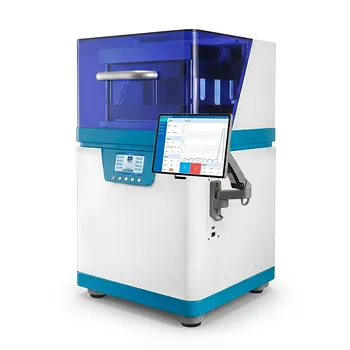
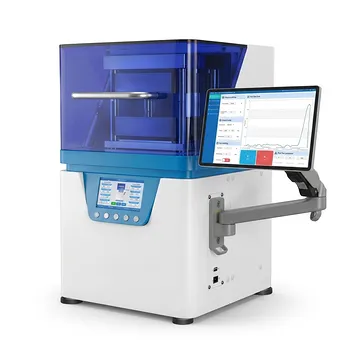
Precise mechanical force is the key lever. You can directly control the magnetic field of a ferromagnetic material by modulating the physical pressure applied via a hydraulic press. By increasing or decreasing this applied force, you effectively tune the material's magnetic strength up or down.
The hydraulic press acts as a mechanical interface for magnetic control. By compressing the material, you force an internal realignment of electron spins, allowing you to translate mechanical pressure into magnetic polarization.
The Mechanics of Magnetic Control
Direct Correlation of Force and Field
The primary mechanism at play is a direct relationship between physical stress and magnetic response. As you increase the force exerted by the hydraulic press, the magnetic field of the material strengthens.
Tuning the Field Strength
This process is bidirectional. Just as increasing pressure amplifies the field, decreasing the force weakens it. This allows for dynamic adjustments rather than a static magnetic state.
The Underlying Physics
Deformation and Shape Change
The hydraulic press does not simply squeeze the object; it alters its physical shape. This mechanical deformation is the catalyst that triggers the change in magnetic properties.
Aligning Electron Spins
The force applied generates an internal magnetic environment. This influence causes the spins of the electrons within the material's atoms to align in a uniform direction.
Increased Polarization
As these electron spins align, the material becomes more magnetically polarized. This heightened polarization results in a stronger physical attraction to other magnetic components in the vicinity.
Understanding the Trade-offs
Material Limits
While increasing force yields a stronger magnetic field, there is a physical limit. Excessive pressure can lead to permanent structural deformation or fracture, destroying the component you are trying to magnetize.
Precision vs. Power
Achieving the maximum possible magnetic field requires high force, but this reduces the granularity of your control. Fine-tuning the magnetic field requires a hydraulic system capable of applying subtle, incremental pressure changes.
Making the Right Choice for Your Goal
To effectively use a hydraulic press for magnetic control, consider your specific objective:
- If your primary focus is Maximum Field Strength: Apply the highest force possible that remains within the material's structural yield limits to maximize electron spin alignment.
- If your primary focus is Dynamic Control: Utilize a press with variable pressure settings to incrementally adjust the force, allowing you to modulate the field strength in real-time.
By viewing mechanical force as a variable input, you can manipulate magnetism with the same precision as a dial on a control panel.
Summary Table:
| Mechanism | Action | Magnetic Effect |
|---|---|---|
| Increased Pressure | Mechanical Compression | Strengthens magnetic field/polarization |
| Decreased Pressure | Reduced Physical Stress | Weakens magnetic field strength |
| Electron Spin Alignment | Force-induced Realignment | Uniform direction creates higher attraction |
| Structural Limit | Excessive Force | Risk of permanent deformation or fracture |
Unlock Precision in Material Science with KINTEK
Take control of your research with KINTEK’s comprehensive laboratory pressing solutions. Whether you are exploring magnetic polarization in battery research or conducting high-pressure material synthesis, our range of manual, automatic, heated, and glovebox-compatible models provides the exact force control you need.
From fine-tuned dynamic adjustments to high-capacity isostatic presses, we deliver the reliability required for groundbreaking results. Contact us today to find the perfect hydraulic solution for your laboratory and enhance your material performance.
Related Products
- Automatic Hydraulic Hot Press with Large Plate and Precision Temperature Control for Advanced Material Sample Preparation and Industrial Research
- Automatic Hydraulic Heat Press Machine with Multi Stage Programmable Control and Integrated Water Cooling Plate Size 180x180mm
- Automatic High Temperature Heated Hydraulic Press Machine with Heated Plates for Lab
- Automatic Heated Hydraulic Lab Press with Programmable Touch Screen Controls and Precision Temperature Regulation
- Manual Heated Hydraulic Lab Press with Integrated Hot Plates Hydraulic Press Machine
People Also Ask
- What are the specific features and applications of hydraulic hot press machines? Precision Solutions for Modern Labs
- How does an automatic hydraulic press operate? Achieve Precision and Consistency in Lab Pelleting
- What are the advantages and common applications of an automatic hydraulic press? Elevate Your Lab's Precision
- What is the technical significance of setting a precise dwell time? Achieve Peak Material Density and Stability
- When is an automatic hydraulic press more suitable than a manual press? Scale Your Lab with Precision & Speed