
Cloudy KBr pellets are almost invariably caused by moisture contamination or an incomplete physical press. To resolve this immediately, you must ensure your KBr powder is thoroughly desiccated and that your anvils and die set are heated to remove residual humidity. Critically, ensure all components—powder and tools—are at the same temperature before pressing to prevent condensation from forming inside the die.
The clarity of a KBr pellet is a direct indicator of spectral quality; cloudiness signifies light scattering or water absorption that will obscure your sample's true infrared signature.
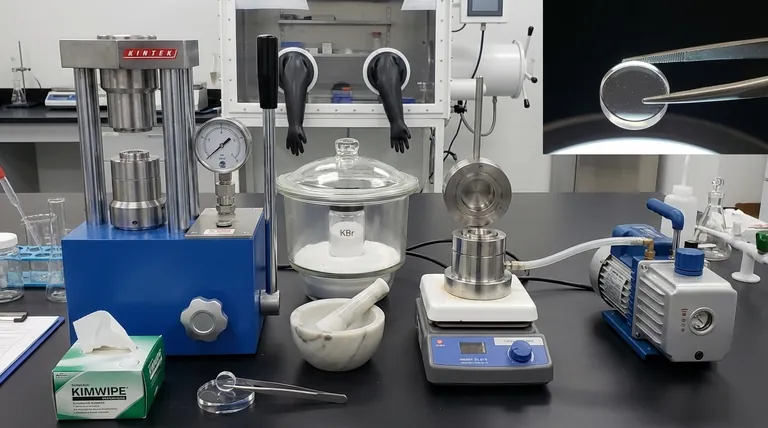
Mastering Moisture Control
The primary adversary in KBr pellet preparation is atmospheric water. Since KBr is hygroscopic, it aggressively absorbs moisture, leading to opaque pellets and significant background interference in the 3400 cm⁻¹ and 1640 cm⁻¹ regions.
Proper Powder Storage
You must treat KBr powder as a moisture magnet. Always store high-quality powder in a heated case or a desiccator to maintain dryness. Using powder that has been left exposed to ambient air will guarantee a cloudy result.
Thermal Equilibrium
A common error is introducing temperature differentials during the setup. If you place room-temperature powder into hot anvils (or vice-versa), condensation will occur immediately. Ensure the anvils, die body, and powder have equalized at the same temperature before applying pressure.
Controlled Atmospheres
Speed is essential when working in open air. However, if your lab is humid or the sample is particularly sensitive, speed is not enough. The most effective troubleshooting step for persistent moisture issues is to perform the grinding and pressing inside a glovebox to eliminate atmospheric interference entirely.
Mechanical and Compositional Factors
If moisture has been ruled out, the cloudiness or "white spots" in your pellet likely stem from physical errors in the ratio of materials or the compression technique.
Optimizing Powder Volume
Using too much KBr powder is a frequent cause of pellet failure. A thick layer of powder requires significantly more force to fuse into a transparent disc. If the force is insufficient for the volume of powder, the pellet will contain white spots or remain opaque due to an incomplete press.
The Sample-to-Matrix Ratio
A noisy spectrum often correlates with incorrect sample concentration. The ideal mixture contains only 0.2% to 1% sample relative to the KBr. Exceeding this range leads to over-absorption and light scattering, which ruins the spectral resolution.
Applying Correct Pressure
Standard compression usually requires a load of approximately 10 tonnes for a 13 mm diameter die. If you have used the correct amount of powder, this force should be adequate to fuse the material. If the pellet remains cloudy at this pressure, check the dryness of the material rather than simply increasing the force.
Common Pitfalls to Avoid
Troubleshooting often requires understanding the limitations of your tools. Relying on shortcuts can lead to deceptive results.
The Vacuum Die Fallacy
While evacuating the die set is standard practice to remove trapped air, it is not a substitute for a dry atmosphere. References indicate that using a vacuum die alone is less effective than preparing the sample in a glovebox when dealing with significant humidity or hygroscopic materials.
The Cost of Rushing
Skipping the heating step for the anvils is a false economy of time. Cold or damp metal surfaces are a primary source of contamination. It is better to wait for the die set to heat and dry thoroughly than to waste time pressing a pellet that will ultimately be unusable.
Making the Right Choice for Your Goal
Achieving a clear pellet is about balancing environmental control with mechanical precision.
- If your primary focus is eliminating persistent cloudiness: Move your entire preparation process (grinding and loading) into a glovebox to isolate the hygroscopic KBr from lab humidity.
- If your primary focus is removing "white spots" or uneven texture: Reduce the total amount of KBr powder used to ensure the applied force (10 tonnes) is sufficient to fully fuse the disc.
- If your primary focus is reducing spectral noise: Verify that your sample concentration is strictly between 0.2% and 1% to prevent scattering effects.
Treat the preparation phase with the same rigor as the analysis itself, as a flawless spectrum is impossible without a flawless pellet.
Summary Table:
| Common Issue | Primary Cause | Quick Solution |
|---|---|---|
| General Cloudiness | Moisture contamination from powder, tools, or atmosphere | Dry KBr powder and heat anvils/die to the same temperature |
| White Spots/Texture | Too much KBr powder for the applied pressure | Reduce powder volume; ensure 10-tonne force for a 13mm die |
| Noisy Spectrum | Incorrect sample concentration (>1%) | Use sample-to-KBr ratio of 0.2% to 1% |
| Persistent Humidity Issues | Hygroscopic KBr exposed to lab air | Perform grinding and pressing in a glovebox |
Achieve flawless KBr pellets and pristine FTIR spectra with KINTEK.
Struggling with cloudy pellets or inconsistent results? Our specialized lab presses, including automatic and heated models, are engineered to provide the precise pressure and temperature control essential for perfect pellet preparation. KINTEK serves laboratories that demand reliability and accuracy in sample preparation.
Let our expertise solve your pressing challenges. Contact our team today to find the ideal press for your application!
Visual Guide
Related Products
- Laboratory Hydraulic Press 2T Lab Pellet Press for KBR FTIR
- XRF KBR Plastic Ring Lab Powder Pellet Pressing Mold for FTIR
- XRF KBR Steel Ring Lab Powder Pellet Pressing Mold for FTIR
- Laboratory Hydraulic Pellet Press for XRF KBR FTIR Lab Press
- Automatic Laboratory Hydraulic Press for XRF and KBR Pellet Pressing
People Also Ask
- What is the role of a laboratory pressure machine and KBr in FTIR? Master Sample Preparation for Flame Retardants
- What is the role of a laboratory hydraulic press in high-loading NCM811 cathode prep for solid-state batteries?
- Why is a laboratory hydraulic press necessary for sample preparation? Precise Pelleting for Spiro Heterocyclic Analysis
- What role does a laboratory hydraulic press play in reaction pellets? Optimizing Lunar Soil and Metal Fuel Density
- Why is the regulation of compression speed in a laboratory hydraulic press essential for oil extraction? Optimize Yield



















