
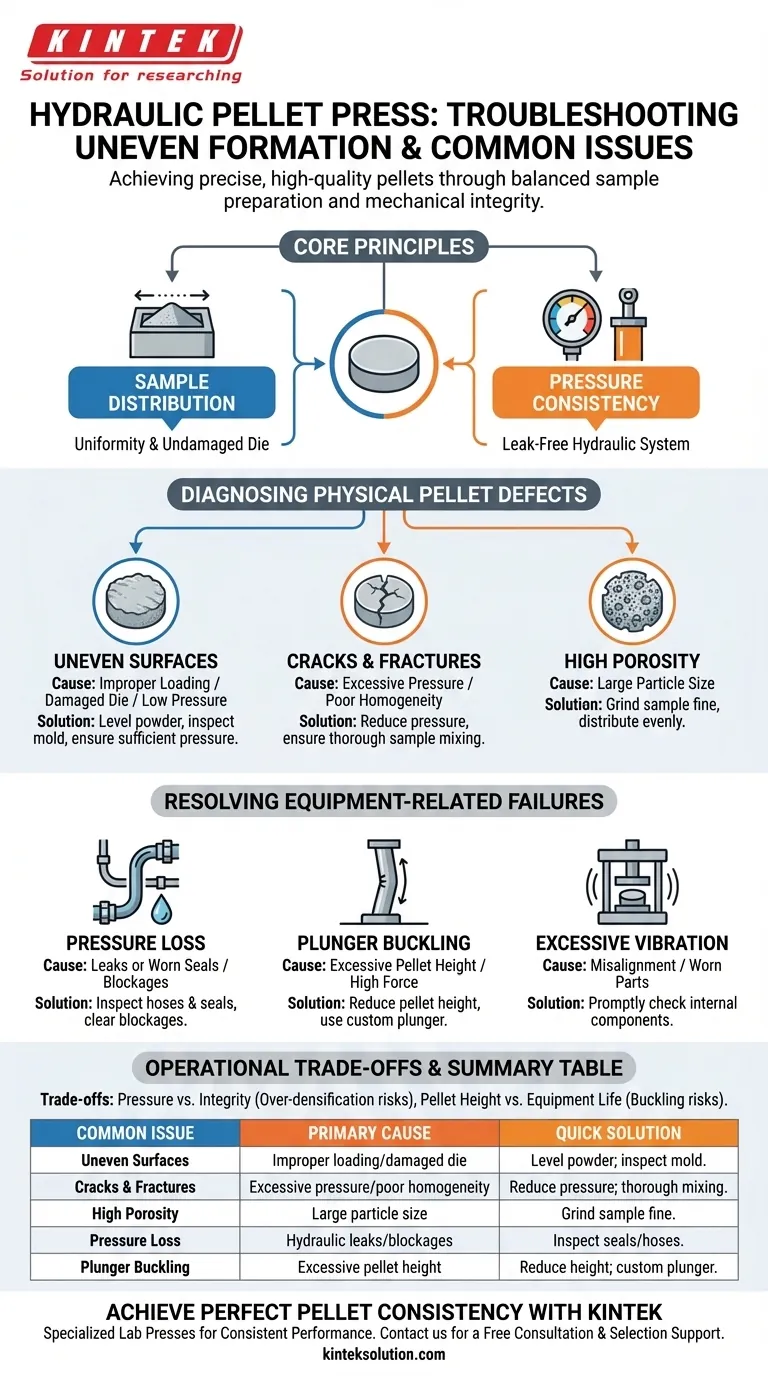
Troubleshooting uneven pellet formation starts with two fundamental variables: sample distribution and pressure consistency. If your pellets are forming irregularly, you must first verify that the raw material is distributed completely uniformly within the die and that the mold faces are undamaged; if the sample load is correct, the fault often lies in the hydraulic system’s inability to maintain the necessary force due to leaks or internal blockages.
Achieving distinct, high-quality pellets is rarely just about applying force; it requires balancing precise sample preparation—specifically homogeneity and particle size—with the mechanical integrity of the press to ensure pressure is applied evenly and held constant.

Diagnosing Physical Pellet Defects
Addressing Uneven Surfaces and Compaction
The most common cause of uneven pellets is improper loading of the raw material. If the powder is not leveled inside the die before pressing, the resulting density will vary across the pellet.
Check the condition of the mold and die. A damaged or scored mold will inevitably lead to uneven compaction regardless of how well you load the sample.
Verify that the applied pressure is sufficient. If the pressure is too low, the particles will not bond effectively, leaving surfaces rough and irregular.
Preventing Cracks and Fractures
Cracking typically indicates the application of excessive pressure. While high force is needed for binding, pushing beyond the material's limit introduces internal stresses that shatter the pellet upon release.
Sample homogeneity is also critical here. If the sample is not well-mixed, regions of different density will form, creating weak points that lead to fractures.
Reducing High Porosity
If pellets appear too porous or "loose," the particle size may be too large. Large particles leave significant void spaces that pressure alone cannot close.
To resolve this, grind the sample to a finer powder before pressing. Ensure this fine powder is evenly distributed in the die to maximize particle-to-particle contact.
Resolving Equipment-Related Failures
Troubleshooting Hydraulic Pressure Loss
If the press cannot reach or maintain the desired pressure, you likely have a compromised hydraulic system.
Inspect the unit for leaks or worn-out seals. Even a minor leak in a hose or seal will prevent the system from holding the static load required for pellet formation.
Check for blockages in the hydraulic lines. These can restrict fluid movement, leading to erratic pressure readings or an inability to generate force.
Mitigating Plunger Buckling
Buckling stresses occur when the plunger is subjected to high force while extended too far. This is a common risk when pressing pellets with a significant height.
To prevent damage, reduce the pellet height or lower the applied force. If you need taller pellets, consider using a shorter, custom-made plunger to reduce the leverage and stress on the component.
Fixing Excessive Vibration
Vibration during operation is a warning sign of internal mechanical issues. It usually suggests misalignment of the press components or worn-out moving parts.
Address this promptly. Continued operation with excessive vibration will accelerate wear on the die and may permanently damage the hydraulic mechanism.
Understanding the Operational Trade-offs
Pressure vs. Integrity
There is a critical balance between density and structural integrity. Applying maximum pressure is not always better. While higher pressure reduces porosity, it dramatically increases the risk of cracking (over-densification) and can damage the die. You must find the specific "sweet spot" range for your specific material.
Pellet Height vs. Equipment Life
Producing taller pellets allows for more sample analysis but introduces buckling risks to the plunger. Pushing the equipment to accommodate larger samples increases mechanical stress. It is often safer and more consistent to press multiple thinner pellets than one tall one.
Making the Right Choice for Your Goal
Troubleshooting is an iterative process of adjusting variables until the output stabilizes. Use the following guide to prioritize your adjustments.
- If your primary focus is Surface Uniformity: Prioritize meticulous sample loading and inspect the die faces for any scratches or damage that could transfer to the pellet.
- If your primary focus is Structural Strength (No Cracking): Lower the applied pressure immediately and ensure the raw sample is perfectly homogenized before loading.
- If your primary focus is Equipment Longevity: Reduce pellet height to minimize plunger stress and perform regular inspections on hoses and seals to catch leaks early.
Consistency in your sample preparation is just as vital as the mechanical condition of your press.
Summary Table:
| Common Issue | Primary Cause | Quick Solution |
|---|---|---|
| Uneven Surfaces | Improper sample loading or damaged die | Level powder in die; inspect mold faces |
| Cracks & Fractures | Excessive pressure or poor sample homogeneity | Reduce pressure; ensure thorough mixing |
| High Porosity | Large particle size | Grind sample to a finer powder |
| Pressure Loss | Hydraulic leaks or blockages | Inspect seals and hoses for damage |
| Plunger Buckling | Excessive pellet height | Reduce pellet height or use custom plunger |
Achieve Perfect Pellet Consistency with KINTEK
Struggling with unreliable results? Your research deserves precision. KINTEK specializes in robust and reliable laboratory press machines, including automatic lab presses, isostatic presses, and heated lab presses, designed to deliver the consistent pressure and performance your work demands.
Our experts can help you select the right press for your specific materials and application, ensuring you eliminate common issues like uneven formation and cracking.
Contact us today to discuss your lab's needs and discover how our solutions can enhance your productivity and data integrity.
Visual Guide
Related Products
- Laboratory Hydraulic Pellet Press for XRF KBR FTIR Lab Press
- Automatic Laboratory Hydraulic Press Lab Pellet Press Machine
- Laboratory Hydraulic Press Lab Pellet Press Machine for Glove Box
- Manual Laboratory Hydraulic Pellet Press Lab Hydraulic Press
- Automatic Laboratory Hydraulic Press for XRF and KBR Pellet Pressing
People Also Ask
- Laboratory Pellet Press for Solar PV Recycling: Ensuring High-Precision Material Analysis and Purity
- Why is a professional laboratory pellet press required for XRF of silica sand? Achieve +/- 0.10% Precision
- Why is precise pressure-holding control critical for biomass pellets? Master Your Densification Results
- What is the necessity of a laboratory pellet press for alcohol by-product fuels? Maximize Energy Density & Consistency
- What are the different types of pellet-making tools available for labs? Choose the Right Press for Your Sample



















