
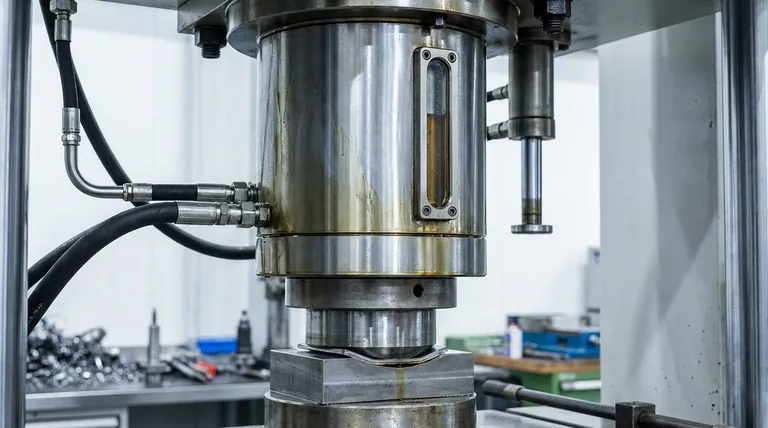
Cylinders serve as the primary actuators within a hydraulic press, functioning as the "muscle" that converts pressurized fluid energy into linear mechanical force. By housing a piston that moves under the influence of hydraulic oil, the cylinder drives the press's ram and die to shape, compress, or cut materials with significant tonnage.
The Core Mechanism The hydraulic cylinder operates on the principle of force amplification defined by Pascal's Law. By applying pressure to a fluid within a sealed system, the cylinder transforms a relatively small input force into a massive output force capable of deforming heavy industrial materials.
The Mechanics of Force Generation
Pascal’s Law Application
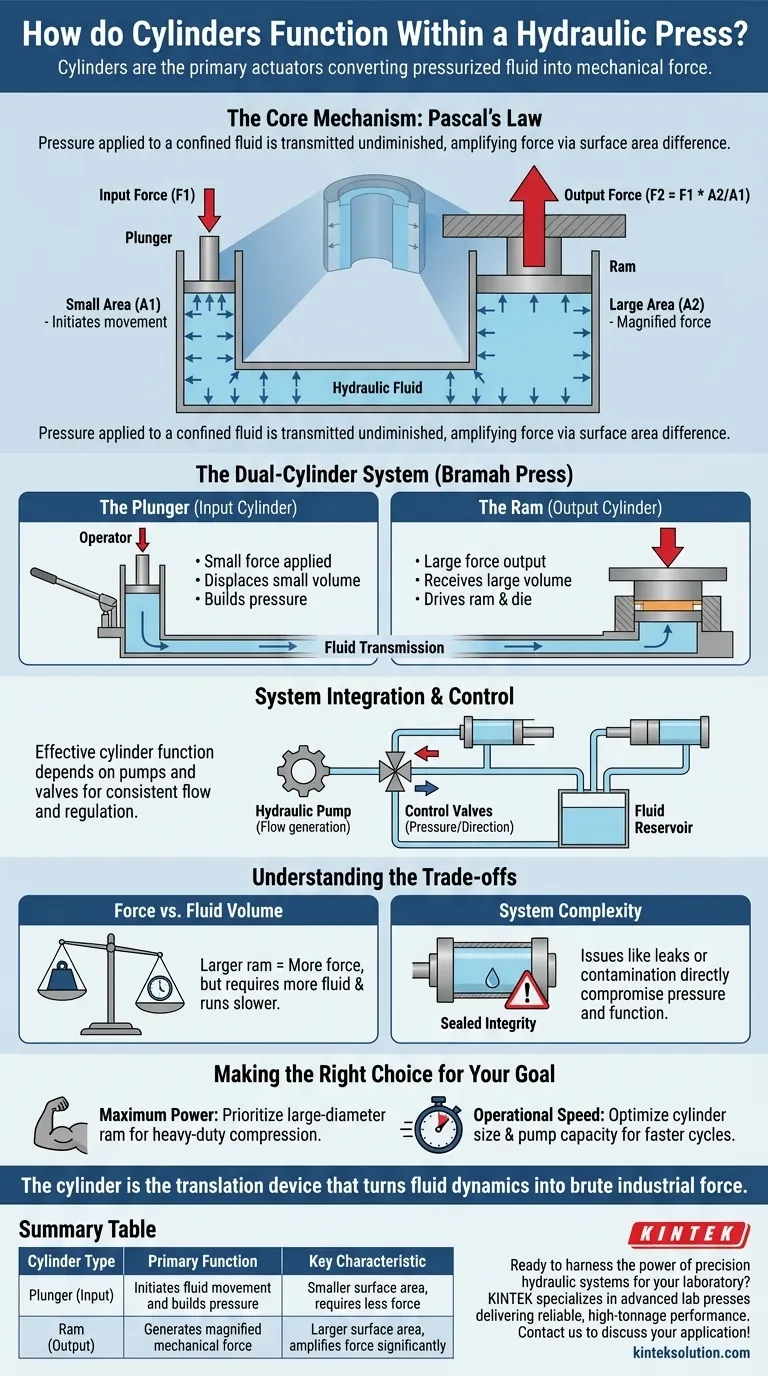
The fundamental function of the cylinder relies on the physical law that pressure applied to a confined fluid is transmitted undiminished in all directions.
In a hydraulic press, the cylinder acts as the vessel where this pressure is applied to a moveable surface area (the piston).
Surface Area Amplification
The magnitude of the force generated is directly dictated by the surface area of the cylinder's piston.
Because pressure is constant throughout the system, a cylinder with a larger diameter (and thus larger surface area) will generate significantly more force than a smaller one, even if the fluid pressure remains the same.
The Dual-Cylinder System
Most hydraulic presses (often called Bramah presses) utilize a specific interplay between two distinct types of cylinders to achieve their function.
The Plunger (Input Cylinder)
This is the smaller of the two cylinders. Its primary function is to initiate fluid movement and build system pressure.
When an operator applies a small force to the plunger, it displaces hydraulic fluid into the system. Due to its small size, it requires less force to operate but moves a smaller volume of fluid per stroke.
The Ram (Output Cylinder)
This is the larger, main cylinder responsible for the heavy lifting.
The fluid displaced by the plunger enters this larger cavity. Because the ram has a much larger surface area, the pressure transmitted from the plunger results in a magnified mechanical force that drives the anvil or die against the workpiece.
System Integration and Control
Fluid Transmission
The cylinders do not operate in isolation; they are connected by pipes that facilitate the transfer of hydraulic fluid (typically oil).
As the larger ram piston moves, it eventually forces fluid back into the reservoir or smaller piston during the retraction phase, creating a continuous cycle of exchange.
Component Dependency
The cylinder functions effectively only because of supporting components like the hydraulic pump, which generates the initial flow, and control valves, which regulate the pressure and direction of the fluid.
Without these regulating components, the cylinder would not be able to provide the consistent, dynamic motion required for precision tasks.
Understanding the Trade-offs
Force vs. Fluid Volume
While a larger ram cylinder generates more force, it requires a larger volume of fluid to move the piston a specific distance.
This means that to achieve high tonnage, the system must either have a high-capacity pump or the press will operate at a slower speed compared to a lower-tonnage machine.
System Complexity
The cylinder is a sealed component that relies heavily on the integrity of the hydraulic fluid.
Issues such as fluid contamination or seal degradation can lead to pressure loss. Because the force generation is entirely dependent on maintaining pressure, any leak directly compromises the press's ability to function.
Making the Right Choice for Your Goal
When evaluating hydraulic press cylinders for specific applications, consider how the design parameters influence performance.
- If your primary focus is Maximum Power: Prioritize a press with a large-diameter ram cylinder, as the increased surface area acts as a force multiplier for heavy-duty compression.
- If your primary focus is Operational Speed: Look for systems where the cylinder size is optimized for fluid displacement volume, or ensures the pump capacity matches the cylinder's volume requirements.
Ultimately, the cylinder is the translation device that turns fluid dynamics into the brute force required for industrial manufacturing.
Summary Table:
| Cylinder Type | Primary Function | Key Characteristic |
|---|---|---|
| Plunger (Input) | Initiates fluid movement and builds pressure | Smaller surface area, requires less force |
| Ram (Output) | Generates magnified mechanical force for pressing | Larger surface area, amplifies force significantly |
Ready to harness the power of precision hydraulic systems for your laboratory? KINTEK specializes in advanced lab press machines, including automatic lab presses, isostatic presses, and heated lab presses, designed to deliver reliable, high-tonnage performance for your specific material processing needs. Let our experts help you select the ideal press with the right cylinder configuration to maximize efficiency and achieve superior results. Contact us today to discuss your application and discover the KINTEK advantage!
Visual Guide
Related Products
- Automatic High Temperature Heated Hydraulic Press Machine with Heated Plates for Lab
- Heated Hydraulic Press Machine with Heated Plates for Vacuum Box Laboratory Hot Press
- Manual Heated Hydraulic Lab Press with Integrated Hot Plates Hydraulic Press Machine
- Laboratory Hydraulic Press 2T Lab Pellet Press for KBR FTIR
- Laboratory Hydraulic Press Lab Pellet Press Machine for Glove Box
People Also Ask
- Function of a Laboratory Hydraulic Press with Heated Platens in SSE? Enhance Battery Density & Conductivity
- What are the requirements for electrode pressing with high-viscosity ionic liquids like EMIM TFSI? Optimize Performance
- How does a laboratory heated hydraulic press facilitate PBN sample prep for WAXS? Achieve Precise X-Ray Scattering
- What are the industrial applications of heated hydraulic presses? Master Heat & Force for Precision Manufacturing
- Why is a laboratory hydraulic press with heating plates required for PLA/TEC films? Achieve Precise Sample Integrity



















