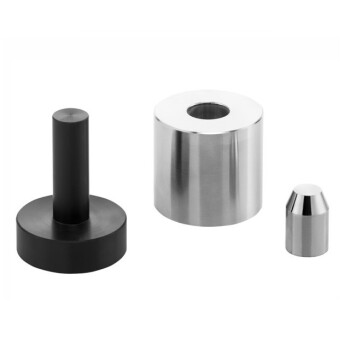
The combination of floating dies and wall lubrication plays a pivotal role in optimizing both the structural density and chemical purity of PM Ti-3Al-2.5V alloys. Together, these techniques minimize friction at the die interface, ensuring uniform pressure transmission and facilitating part ejection without introducing contaminants.
By isolating lubrication to the die walls and utilizing a floating die system, manufacturers can achieve superior density uniformity in titanium components while eliminating the carbon and oxygen impurities typically introduced by internal lubricants.
Optimizing Density and Pressure
The Role of Floating Dies
A floating die system is essential for counteracting the natural decrease in pressure that occurs as depth increases during pressing.
Unlike a stationary die, a floating die moves relative to the punches during the compaction cycle. This movement allows for a "double-action" effect, where pressure is applied more symmetrically from both the top and bottom of the powder column.
Mitigating Density Gradients
Friction between the metal powder and the die wall typically resists the compaction force. This resistance creates density gradients, where the ends of the part are dense, but the center remains porous.
The floating die system significantly reduces these gradients. By enabling the die to move with the powder, the system ensures that the pressure is transmitted more uniformly throughout the entire geometry of the component.
Preserving Alloy Purity
The Contamination Challenge
In traditional powder metallurgy, lubricants are often mixed directly into the metal powder to facilitate pressing.
However, titanium alloys like Ti-3Al-2.5V are highly sensitive to interstitial impurities. Admixed lubricants often leave behind residue, specifically carbon and oxygen, which can severely compromise the mechanical properties of the final alloy.
The Advantage of Wall Lubrication
Wall lubrication addresses this contamination issue by changing where the lubricant is applied. Instead of being mixed into the bulk powder, the lubricant is applied exclusively to the die walls.
This creates the necessary slip layer to reduce friction and allow for smooth part ejection. Crucially, because the lubricant is not inside the part, the chemical purity of the titanium alloy is maintained.
Understanding the Trade-offs
Purity vs. Process Control
While wall lubrication is superior for material properties, it shifts the processing burden. You are trading the convenience of pre-mixed powder for the necessity of precise die maintenance.
Ejection Mechanics
Without internal lubricant, the friction reduction relies entirely on the external coating and the floating die mechanics.
If the wall lubrication coverage is inconsistent, or if the floating action binds, ejection forces can spike. This risks damaging the "green" (unsintered) part or causing die wear, making process consistency paramount.
Making the Right Choice for Your Goal
To maximize the quality of your PM Ti-3Al-2.5V components, consider your specific performance requirements:
- If your primary focus is Mechanical Uniformity: Prioritize the floating die system to ensure pressure reaches the center of the part, eliminating weak, low-density zones.
- If your primary focus is Material Purity: Rely strictly on wall lubrication to prevent carbon and oxygen uptake, which is critical for maintaining ductility and fatigue strength.
Mastering these two variables is the key to producing titanium parts that are both geometrically precise and chemically clean.
Summary Table:
| Feature | Function in Ti-3Al-2.5V Pressing | Key Benefit |
|---|---|---|
| Floating Die | Enables double-action symmetrical pressing | Eliminates density gradients & porous centers |
| Wall Lubrication | Lubricant applied only to die interfaces | Prevents carbon/oxygen contamination |
| Pressure Control | Symmetrical transmission of force | Superior mechanical uniformity |
| Ejection Mechanics | Reduces friction during part removal | Protects 'green' part integrity |
Elevate Your Titanium Research with KINTEK Solutions
Precision in powder metallurgy requires more than just high pressure; it demands specialized control over friction and purity. KINTEK specializes in comprehensive laboratory pressing solutions, offering manual, automatic, heated, multifunctional, and glovebox-compatible models, as well as cold and warm isostatic presses designed for demanding applications like battery research and titanium alloy development.
Whether you are aiming to eliminate density gradients with advanced floating die systems or maintain absolute material purity through precise lubrication techniques, our team of experts is ready to help you find the perfect equipment for your workflow.
Contact KINTEK today to optimize your lab's pressing performance!
References
- L. Bolzoni, E. Gordo. Investigation of the factors influencing the tensile behaviour of PM Ti–3Al–2.5V alloy. DOI: 10.1016/j.msea.2014.05.017
This article is also based on technical information from Kintek Solution Knowledge Base .
Related Products
- Laboratory Hydraulic Split Electric Lab Pellet Press
- Lab Cylindrical Press Mold with Scale
- Lab Ring Press Mold for Sample Preparation
- Lab Infrared Press Mold for No Demolding
- XRF KBR Plastic Ring Lab Powder Pellet Pressing Mold for FTIR
People Also Ask
- What are the emerging trends in the design and materials of lab pellet presses? Modernize Your Lab Efficiency
- What are common lab pellet press issues? Expert Troubleshooting Guide for Reliable Material Research
- How do lab pellet presses support customization and flexibility? Optimize Your Sample Prep for Any Material
- What are the common operational types of lab pellet presses? Choosing the Right Manual, Automatic, or Hydraulic System
- Why use a laboratory pellet press for solid-state battery evaluation? Ensure Accuracy in Interface Stability Testing