
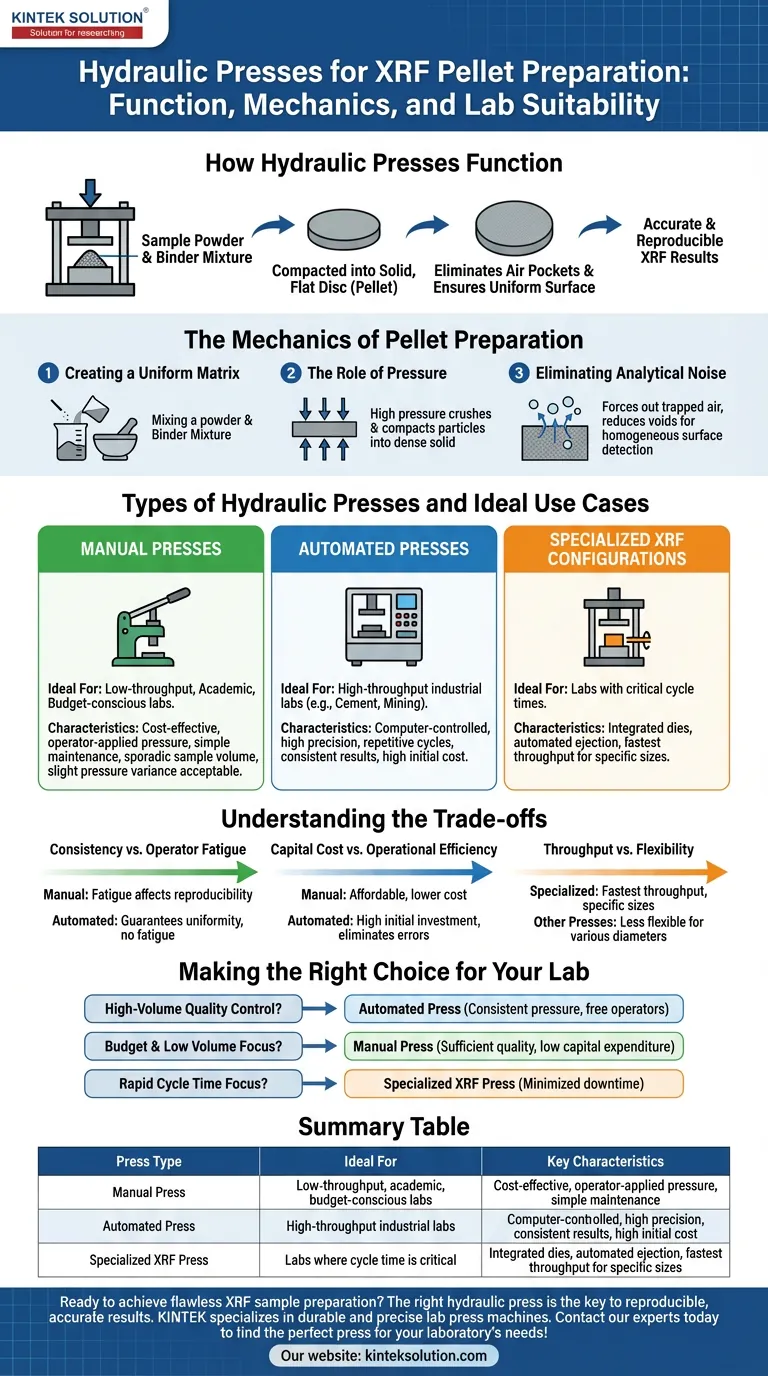
Hydraulic presses function by applying immense force to a mixture of sample powder and binder within a die, compacting it into a flat, solid disc known as a pellet. This process eliminates air pockets and ensures the sample surface is perfectly uniform, a prerequisite for accurate and reproducible X-ray Fluorescence (XRF) spectroscopy results.
In XRF analysis, the hydraulic press serves as the bridge between raw material and reliable data. By standardizing density and surface quality, it removes physical variations that could skew analytical results, making it essential for laboratories prioritizing precision over speed or cost.
The Mechanics of Pellet Preparation
Creating a Uniform Matrix
The process begins by mixing the sample powder with a binding or grinding aid. This mixture is loaded into a die, which acts as the mold for the pellet.
The Role of Pressure
The hydraulic system applies varying degrees of pressure to the die assembly. This is not merely about shaping the material; the pressure must be high enough to crush and compact the particles into a dense solid.
Eliminating Analytical Noise
By compacting the powder, the press forces out trapped air and reduces void spaces. This ensures the XRF spectrometer reads a solid, homogeneous surface rather than a loose, aerated powder, which is critical for accurate elemental detection.
Types of Hydraulic Presses and Ideal Use Cases
Manual Presses
Manual presses rely on the operator to generate pressure, usually via a hand lever. They are cost-effective and simple to maintain.
These units are ideal for low-throughput laboratories or academic settings with budget constraints. They fit well where sample volume is sporadic and the slight variance in operator-applied pressure is acceptable.
Automated Presses
Automated systems are computer-operated, controlling pressure application and dwell time with high precision. They allow for repetitive cycles without physical exertion from the technician.
These are ideal for high-throughput industrial labs (such as cement or mining) requiring constant, round-the-clock testing. They excel where data consistency and speed are paramount.
Specialized XRF Configurations
Some hydraulic presses are built specifically for XRF workflows. These often feature integrated dies and automated ejection mechanisms to speed up the retrieval of the finished pellet.
These systems are designed for environments where cycle time is a critical performance metric, allowing the machine to be ready for the next sample almost immediately.
Understanding the Trade-offs
Consistency vs. Operator Fatigue
While manual presses are affordable, they introduce the variable of human fatigue. As an operator tires, the pressure applied to samples later in the day may differ from those prepared in the morning, potentially affecting data reproducibility.
Capital Cost vs. Operational Efficiency
Automated presses eliminate operator error and guarantee uniformity across thousands of samples. However, this comes with a significantly higher initial capital investment compared to manual alternatives.
Throughput vs. Flexibility
Presses with integrated dies offer the fastest throughput for specific sample sizes. However, they may offer less flexibility if your laboratory needs to press pellets of drastically different diameters for various analytical techniques.
Making the Right Choice for Your Lab
To select the correct hydraulic press, you must weigh your daily sample volume against your requirements for precision.
- If your primary focus is high-volume quality control: Invest in an automated press to ensure consistent pressure and free up operators for other tasks.
- If your primary focus is budget management and low volume: A manual press provides sufficient pellet quality for occasional testing without a heavy capital expenditure.
- If your primary focus is rapid cycle times: Look for presses with integrated dies and automatic pellet ejection to minimize downtime between samples.
The best equipment choice creates a workflow where sample preparation is a reliable constant, not a variable.
Summary Table:
| Press Type | Ideal For | Key Characteristics |
|---|---|---|
| Manual Press | Low-throughput, academic, budget-conscious labs | Cost-effective, operator-applied pressure, simple maintenance |
| Automated Press | High-throughput industrial labs (e.g., cement, mining) | Computer-controlled, high precision, consistent results, high initial cost |
| Specialized XRF Press | Labs where cycle time is critical | Integrated dies, automated ejection, fastest throughput for specific sizes |
Ready to achieve flawless XRF sample preparation? The right hydraulic press is the key to reproducible, accurate results. KINTEK specializes in lab press machines, including automatic lab presses and specialized XRF pellet presses designed for durability and precision. Whether you're a high-volume industrial lab or a research-focused academic institution, we have a solution to streamline your workflow and enhance your data quality.
Contact our experts today to find the perfect press for your laboratory's needs!
Visual Guide
Related Products
- Automatic High Temperature Heated Hydraulic Press Machine with Heated Plates for Lab
- Manual Heated Hydraulic Lab Press with Integrated Hot Plates Hydraulic Press Machine
- Heated Hydraulic Press Machine with Heated Plates for Vacuum Box Laboratory Hot Press
- Laboratory Hydraulic Press 2T Lab Pellet Press for KBR FTIR
- Laboratory Hydraulic Press Lab Pellet Press Machine for Glove Box
People Also Ask
- Function of a Laboratory Hydraulic Press with Heated Platens in SSE? Enhance Battery Density & Conductivity
- What are the requirements for electrode pressing with high-viscosity ionic liquids like EMIM TFSI? Optimize Performance
- How does a laboratory heated hydraulic press facilitate PBN sample prep for WAXS? Achieve Precise X-Ray Scattering
- What are the industrial applications of heated hydraulic presses? Master Heat & Force for Precision Manufacturing
- Why is a laboratory hydraulic press with heating plates required for PLA/TEC films? Achieve Precise Sample Integrity



















