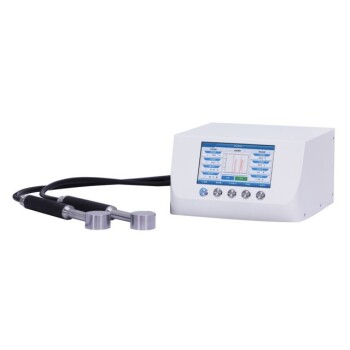
Precision temperature-controlled heating plates function as the stabilizing engine for long-term electrolyte experiments. By pairing a heat source with a thermocouple sensor, the system creates a closed feedback loop that maintains a constant temperature with minimal error. This setup allows researchers to subject electrolytes to sustained thermal stress, such as holding a sample at exactly 55°C for four weeks.
The core value of this system is its ability to replicate high-temperature storage conditions with high fidelity, enabling the precise calculation of decomposition kinetics based on strictly controlled thermal variables.
The Mechanics of Thermal Stability
Closed-Loop Feedback
The integration of a thermocouple is the critical component of this setup. It constantly monitors the temperature of the electrolyte environment and signals the heating plate to adjust its output. This minimizes error and prevents thermal drift.
Long-Duration Consistency
Battery degradation is rarely instantaneous; it requires time. These heating plates are designed to operate continuously for extended periods, such as a four-week cycle. Maintaining a fixed setpoint over this duration is essential for data integrity.
Simulating Real-World Conditions
The primary function of this equipment is to simulate high-temperature storage conditions. By creating a stable thermal environment, researchers can mimic the stress a battery endures during actual usage or storage in hot climates.
Analyzing the Results
Tracking Decomposition Kinetics
Once the thermal environment is established, the focus shifts to how the electrolyte additives react. The precise temperature control allows researchers to mathematically determine the decomposition kinetics—the rate at which the chemical breakdown occurs.
Identifying Degradation Products
The heat accelerates the breakdown of specific additives, resulting in measurable byproducts. Researchers analyze these products to understand the chemical pathways of failure within the battery cell.
Visual Indicators
Data collection often begins with simple observation. As the electrolyte degrades under heat, researchers monitor the samples for distinct color changes. This visual evidence serves as a primary indicator of additive instability.
Understanding the Trade-offs
The Requirement for Precision
The validity of this experiment relies entirely on "minimal error." Even slight fluctuations in temperature over a four-week period can skew the decomposition kinetics, leading to incorrect conclusions about an additive's stability.
Time Intensity
This method is inherently slow. Because it relies on long-duration simulation (e.g., four weeks), it creates a bottleneck in research throughput compared to rapid screening methods.
Making the Right Choice for Your Goal
To get the most out of precision heating plates in your research, consider the following:
- If your primary focus is determining shelf-life: Rely on the system's ability to hold stable temperatures (like 55°C) over multi-week periods to mimic long-term storage.
- If your primary focus is analyzing chemical breakdown: Use the precise thermal control to isolate temperature as a variable, ensuring that any color changes or degradation products are strictly a result of the additive's kinetics.
Precision temperature control transforms heat from a simple hazard into a measurable, analytical tool.
Summary Table:
| Feature | Function in Electrolyte Testing | Research Benefit |
|---|---|---|
| Thermocouple Integration | Real-time temperature monitoring & feedback loop | Minimizes thermal drift and experimental error |
| Sustained Heat Output | Continuous operation for 4+ week cycles | Simulates long-term shelf-life and storage stress |
| Precision Control | Maintains exact setpoints (e.g., 55°C) | Enables accurate calculation of decomposition kinetics |
| Visual Monitoring | Observation of sample color changes | Provides primary indicators of additive instability |
Elevate Your Battery Research with KINTEK
Precise thermal control is the backbone of reliable electrolyte stability data. KINTEK specializes in comprehensive laboratory pressing and heating solutions designed to meet the rigorous demands of battery material science. Whether you require manual, automatic, or multifunctional systems, our equipment ensures the long-term consistency necessary for identifying degradation pathways.
Our value to your lab:
- Unmatched Precision: Advanced thermocouple integration for minimal thermal error.
- Versatile Solutions: From heated plates to glovebox-compatible and isostatic presses.
- Reliability: Built for continuous, multi-week experimental cycles.
Ready to eliminate thermal drift in your experiments? Contact KINTEK today to find your solution!
References
- Jonas Welch, Reza Younesi. Effect of additives on the high-temperature performance of a sodium bis(oxalato)borate in triethyl phosphate electrolyte in sodium-ion batteries. DOI: 10.1038/s42004-025-01515-0
This article is also based on technical information from Kintek Solution Knowledge Base .
Related Products
- Infrared Heating Quantitative Flat Plate Mold for Precise Temperature Control
- Automatic High Temperature Heated Hydraulic Press Machine with Heated Plates for Lab
- Automatic Heated Hydraulic Press Machine with Heated Plates for Laboratory
- Lab Double Plate Heating Mold for Laboratory Use
- 24T 30T 60T Heated Hydraulic Lab Press Machine with Hot Plates for Laboratory
People Also Ask
- What is the importance of a precision temperature-controlled heating module? Ensure Aluminum-Cadmium Thermal Stability
- How does heating platen precision affect rubber specimens? Achieve uniform density and reliable testing results.
- How are thin polymer films produced for spectroscopic analysis? Expert Guide to Heat and Low-Pressure Methods
- What accessories and field services can be used to optimize the capabilities of presses? Maximize Your Lab Performance
- What role does a constant temperature chamber play in shielding interference during battery cycle aging? | KINTEK