
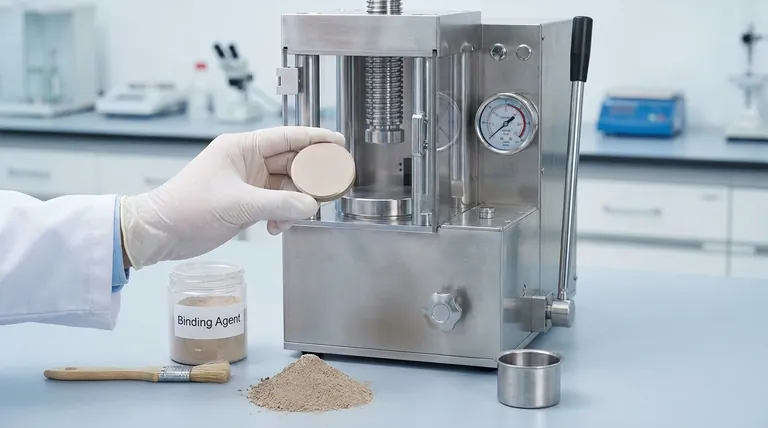
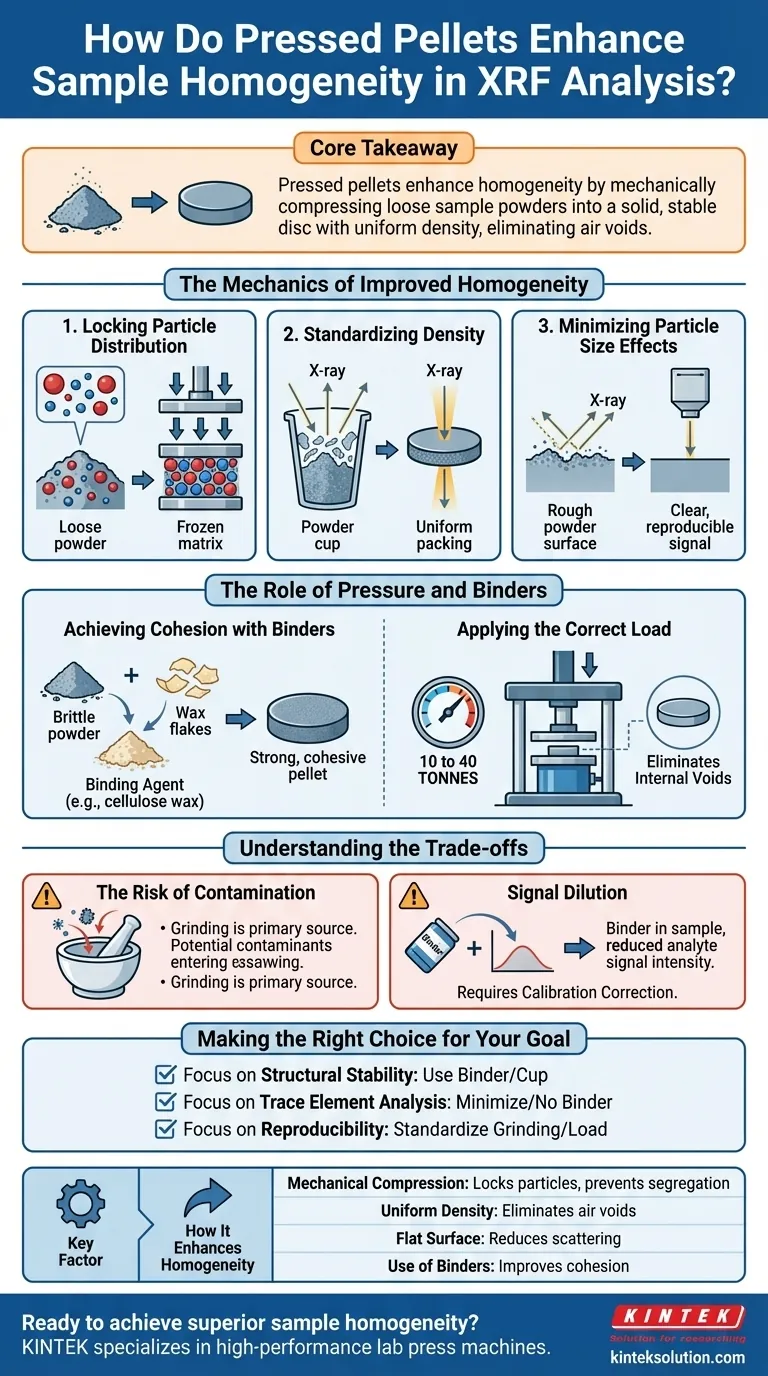
Pressed pellets enhance homogeneity by mechanically compressing loose sample powders into a solid, stable disc with uniform density. This high-pressure compaction eliminates the air voids and irregular spacing inherent in loose powders, locking particles into a fixed matrix to prevent the segregation of elements during analysis.
Core Takeaway By standardizing sample density and creating a perfectly flat surface, pressed pellets minimize particle size effects and signal scattering. This preparation method bridges the gap between the inconsistency of loose powders and the complexity of fused beads, offering a balance of high precision, reproducibility, and durability.
The Mechanics of Improved Homogeneity
Locking Particle Distribution
In loose powder samples, elements can segregate based on density or size—a phenomenon often triggered simply by moving the sample cup. Heavier elements may sink, while lighter ones rise.
Pressed pellets freeze the sample matrix. By applying extreme pressure, the particles are mechanically interlocked, ensuring that the distribution of elements remains constant throughout the analysis.
Standardizing Density
X-ray fluorescence (XRF) relies on the interaction between X-rays and the sample atoms; varying amounts of empty space (air) between particles can alter these interactions.
Pelletizing compresses the sample to a uniform density. This ensures the X-ray beam interacts with a consistent mass of material per unit area, directly translating to higher accuracy.
Minimizing Particle Size Effects
Irregularities in particle shape and size can cause "shadowing" or scattering effects that distort the analytical signal.
While fine grinding is the first step, pressing the pellet forces these particles into a flat, cohesive plane. This reduction in surface roughness ensures the detector receives a clear, reproducible signal unhindered by geometric surface errors.
The Role of Pressure and Binders
Achieving Cohesion with Binders
Not all materials adhere well under pressure; hard geological samples or brittle pharmaceutical compounds often crumble.
To maintain homogeneity, these powders are mixed with a binding agent, such as cellulose wax or boric acid. This improves particle flow during pressing and ensures the final pellet is robust enough to withstand handling without introducing cracks or voids.
Applying the Correct Load
Achieving a homogenous surface requires a hydraulic press capable of delivering significant force.
A load of 10 to 20 tonnes is standard for most samples in a 40 mm die. However, difficult materials may require loads up to 40 tonnes to eliminate internal voids and achieve the necessary surface flatness.
Understanding the Trade-offs
The Risk of Contamination
While pelletizing improves result quality, the mechanical preparation introduces a risk of contamination.
Grinding is the primary source of error here. Contaminants can enter from the grinding vessel materials (e.g., tungsten or iron) or via cross-contamination from previous samples if the equipment is not cleaned rigorously.
Signal Dilution
Using a binder improves structural integrity, but it also dilutes the sample.
Because you are adding a light-element matrix (the binder), the net intensity of the analytes is slightly reduced. This must be mathematically corrected during the calibration phase to prevent underreporting element concentrations.
Making the Right Choice for Your Goal
To maximize the benefits of pressed pellets, align your preparation method with your analytical priorities:
- If your primary focus is structural stability: Use a cellulose wax binder or an aluminum cup to support brittle samples and prevent pellet breakage inside the spectrometer.
- If your primary focus is trace element analysis: Minimize the ratio of binder to sample to avoid excessive signal dilution, or attempt pressing without a binder if the material allows.
- If your primary focus is reproducibility: Standardize the grinding time and pressing load (e.g., always 20 tonnes) to ensure every sample has identical physical characteristics.
Ultimately, pressed pellets transform a variable powder into a quantifiable solid, providing the consistency required for rigorous quantitative analysis.
Summary Table:
| Key Factor | How It Enhances Homogeneity |
|---|---|
| Mechanical Compression | Locks particles in place, preventing segregation based on density or size. |
| Uniform Density | Eliminates air voids, ensuring consistent X-ray interaction for accurate readings. |
| Flat Surface | Reduces signal scattering and geometric errors for clear, reproducible data. |
| Use of Binders | Improves cohesion for brittle samples, maintaining structural integrity. |
Ready to achieve superior sample homogeneity and precision in your lab?
KINTEK specializes in high-performance lab press machines, including automatic lab presses and heated lab presses, designed to create perfect pressed pellets for your XRF analysis. Our equipment ensures the consistent pressure and durability needed for reproducible results.
Contact us today to discuss how our solutions can enhance your analytical workflow. Let our experts help you select the ideal press for your specific materials and analytical goals.
Get in touch via our Contact Form
Visual Guide
Related Products
- Manual Laboratory Hydraulic Pellet Press Lab Hydraulic Press
- Laboratory Hydraulic Split Electric Lab Pellet Press
- Automatic Laboratory Hydraulic Press Lab Pellet Press Machine
- Laboratory Hydraulic Pellet Press for XRF KBR FTIR Lab Press
- XRF KBR Plastic Ring Lab Powder Pellet Pressing Mold for FTIR
People Also Ask
- What is the primary purpose of a manual lab hydraulic pellet press? Ensure Accurate Sample Prep for XRF and FTIR
- What is the primary purpose of manual lab hydraulic pellet presses? Achieve High-Precision Sample Preparation for Spectroscopy
- What is the primary function of a laboratory hydraulic press in evaluating the ionic conductivity of Li6PS5X (LMSX)?
- What role does a lab hydraulic press play in researching squishy granular matter? Expert Insights into Material Physics
- What is the purpose of initial axial molding using a lab hydraulic press? Optimizing Electrolyte Green Bodies



















