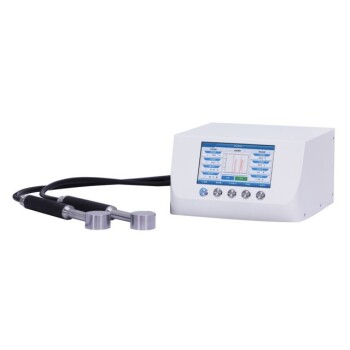
A constant temperature heating station facilitates optimal interfacial contact by maintaining the electrolyte in a low-viscosity, molten state. By holding the environment at 80°C, the station ensures the electrolyte remains liquid long enough to penetrate the complex pore structure of the cathode. This process utilizes capillary action to replace voids with active electrolyte, establishing a continuous ion-conducting path.
The core function of the heating station is to convert a static solid interface problem into a fluid dynamic solution. By sustaining a temperature of 80°C for 12 hours, it allows the electrolyte to fully permeate the porous cathode, thereby eliminating the high impedance caused by poor physical contact between particles.
Overcoming the Solid-Solid Interface Barrier
The Challenge of Physical Contact
In all-solid-state batteries, the primary performance bottleneck is often the high impedance found at the solid-solid interface.
Unlike liquid electrolytes that naturally wet surfaces, solid electrolytes often fail to touch the active material particles completely. This results in microscopic gaps that block ion movement.
Liquefaction as the Key Enabler
The heating station addresses this by maintaining the electrolyte at 80°C.
At this specific temperature, the electrolyte transitions into a molten liquid state. This phase change is critical because it temporarily removes the rigidity of the material, allowing it to flow rather than sit statically on the surface.
The Mechanics of Infiltration
Harnessing Capillary Action
Once the electrolyte is molten, the process relies on capillary action.
Because the cathode electrode is porous, the liquid electrolyte is naturally drawn into the internal voids. This force pulls the material deep into the electrode structure, ensuring it surrounds the active material particles.
The Necessity of Sustained Heat
The process is not instantaneous; the primary reference notes a required duration of 12 hours.
Sustaining the 80°C environment for this period ensures the infiltration is comprehensive, not just superficial. This time allows the liquid to navigate the tortuous paths within the cathode to establish tight physical contact throughout the entire volume.
Operational Constraints and Variables
Temperature Precision
The effectiveness of this method relies entirely on maintaining the 80°C threshold.
If the temperature drops, the electrolyte may prematurely solidify, halting capillary action and leaving pores unfilled. Conversely, consistent heat is required to keep the viscosity low enough for deep penetration.
Time vs. Completeness
There is a direct trade-off between processing speed and interface quality.
Reducing the 12-hour heating window may save time, but it risks leaving internal voids. Incomplete infiltration results in higher impedance, negating the purpose of the heating station.
Making the Right Choice for Your Fabrication
To maximize the efficiency of your all-solid-state cathodes, consider the following parameters:
- If your primary focus is minimizing impedance: Prioritize the full 12-hour duration to guarantee that capillary action has completely filled the deepest pores of the cathode.
- If your primary focus is process consistency: Ensure your heating station is calibrated to hold 80°C without fluctuation, as even minor drops can arrest the flow of the molten electrolyte.
Ultimately, the heating station serves as a critical enabler, transforming a porous, high-resistance structure into a dense, high-performance composite.
Summary Table:
| Parameter | Specification/Condition | Impact on Interfacial Contact |
|---|---|---|
| Temperature | 80°C | Maintains electrolyte in a molten, low-viscosity state for flow. |
| Duration | 12 Hours | Ensures deep penetration through complex, tortuous cathode pores. |
| Driving Force | Capillary Action | Naturally draws liquid electrolyte into voids to eliminate gaps. |
| Outcome | High-Density Composite | Establishes continuous ion-conducting paths and low impedance. |
Revolutionize Your Battery Research with KINTEK Precision
Maximize the performance of your all-solid-state cathodes with KINTEK’s industry-leading laboratory pressing and thermal solutions. As specialists in comprehensive laboratory pressing, KINTEK offers a diverse range of manual, automatic, heated, multifunctional, and glovebox-compatible models, alongside advanced cold and warm isostatic presses.
Our equipment is engineered to provide the precise temperature control and sustained stability required for critical processes like electrolyte infiltration and electrode densification. Whether you are developing next-generation energy storage or optimizing material interfaces, KINTEK provides the reliability and technical expertise your research demands.
Ready to eliminate high impedance and enhance your lab's efficiency?
Contact KINTEK Today for a Tailored Solution
References
- Xinyu Ma, Feng Yan. Electric Field‐Induced Fast Li‐Ion Channels in Ionic Plastic Crystal Electrolytes for All‐Solid‐State Batteries. DOI: 10.1002/ange.202505035
This article is also based on technical information from Kintek Solution Knowledge Base .
Related Products
- Infrared Heating Quantitative Flat Plate Mold for Precise Temperature Control
- Automatic High Temperature Heated Hydraulic Press Machine with Heated Plates for Lab
- Cylindrical Lab Electric Heating Press Mold for Laboratory Use
People Also Ask
- How do precision temperature-controlled heating plates function in electrolyte thermal stability storage experiments?
- What is the importance of a precision temperature-controlled heating module? Ensure Aluminum-Cadmium Thermal Stability
- How does heating platen precision affect rubber specimens? Achieve uniform density and reliable testing results.
- How are thin polymer films produced for spectroscopic analysis? Expert Guide to Heat and Low-Pressure Methods
- What accessories and field services can be used to optimize the capabilities of presses? Maximize Your Lab Performance