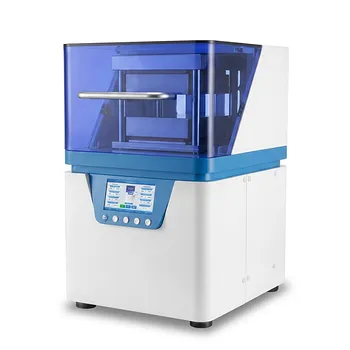
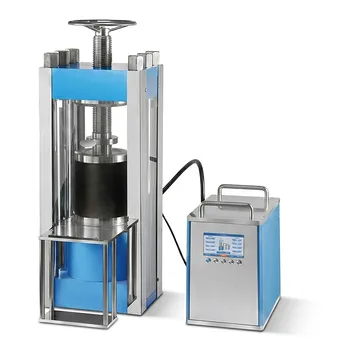
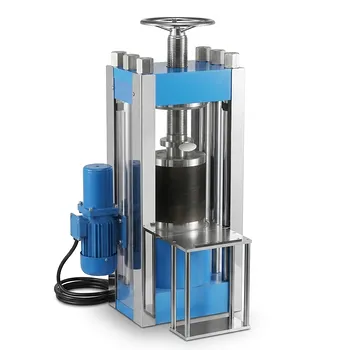
A heated press ensures sample quality by providing a synchronized thermal-pressure field that transforms Polypropylene (PP) and Polyaniline (PANI) into a structurally cohesive film. This equipment precisely manages the polymer’s transition to a molten state, typically around 165°C, while applying constant pressure (such as 15 MPa) to eliminate internal air pockets and force the polymer melt to fill the mold completely.
The core takeaway is that a heated press acts as a precision control environment that optimizes the physical entanglement between PP and PANI components. By regulating the thermal history and pressure holding times, the system ensures a dense internal structure, uniform thickness, and the elimination of internal stresses.
Achieving Thermal Homogeneity and Matrix Flow
Precise Melting Point Management
The heated press provides the controlled thermal energy required to reach the melting point of the polypropylene matrix, approximately 165°C to 180°C. Reaching this specific threshold is critical because it allows the thermoplastic PP to transition into a flowable state without degrading the PANI additives.
Benefits of Staged Heating
A staged heating process—such as holding at a lower temperature before reaching the final setpoint—ensures that PP granules soften uniformly from the exterior to the core. This technique prevents edge charring caused by rapid heating and ensures that there is no unmelted material remaining in the center of the film.
Enhancing Physical Entanglement
By maintaining the material at its melting point, the press allows the polymer chains to move freely and diffuse into the microscopic gaps of the PANI particles. This results in enhanced physical entanglement, which is the foundation of the composite film's mechanical strength and electrical consistency.
Pressure Dynamics and Structural Density
Eliminating Internal Voids
The application of high, constant pressure (often reaching 15 MPa or tens of kilonewtons) forces the molten PP to encapsulate the PANI fillers. This action effectively expels trapped air, eliminating internal voids that would otherwise create weak points or electrical discontinuities in the film.
Uniform Thickness and Morphology
A laboratory press uses simultaneous pressure and temperature compensation to compress the mixture into a dense, uniform film, often targeting specific thicknesses like 120 μm. This precise compression ensures that the resulting sample meets strict research standards for material morphology and physical performance.
Infiltration and Interfacial Bonding
High pressure ensures that the molten matrix fully infiltrates and coats any reinforcing elements or additives. This creates a strong interfacial bond, which is essential for reducing contact resistance and optimizing the mechanical integrity of the composite.
Crystallization and Stress Management
Controlled Cooling Rates
Quality is not only determined by heating but also by the stable cooling rates provided by the press. Proper cooling management provides a uniform crystallization environment, which is vital for the orientation of nanocrystals within the polypropylene matrix.
Eliminating Internal Stresses
Precise pressure holding times during the cooling phase help to stabilize the material as it solidifies. This process helps to eliminate internal stresses that could lead to warping, ensuring the final test specimens possess uniform mechanical properties across their entire surface.
Surface Integrity via Auxiliary Media
The use of metal molds and release media (such as Teflon or aluminum foil) ensures surface flatness and prevents the molten polymer from adhering to the press plates. These barriers facilitate the smooth removal of the sample, preserving its structural integrity and geometric dimensions.
Understanding the Trade-offs and Pitfalls
Risks of Inadequate Thermal Control
If the temperature is too low, the PP will not flow sufficiently, resulting in a porous structure with poor PANI distribution. Conversely, excessive heat or rapid "flash" heating can lead to thermal degradation or charring, which compromises the chemical properties of the polyaniline.
Balancing Pressure and Precision
While high pressure is necessary for density, excessive pressure without proper mold containment can lead to material squeeze-out, resulting in a film that is thinner than the target specification. Furthermore, inconsistent pressure application during the cooling phase can result in uneven shrinkage and localized weak spots.
How to Apply This to Your Project
To ensure the highest sample quality for your PP/PANI composite films, follow these guidelines based on your specific requirements:
- If your primary focus is mechanical strength: Prioritize the pressure holding time and stable cooling rates to maximize nanocrystal orientation and eliminate internal voids.
- If your primary focus is electrical conductivity: Ensure the staged heating process is optimized to allow full PP diffusion into PANI gaps, creating a more continuous conductive network.
- If your primary focus is geometric precision: Utilize high-quality metal molds and Teflon release sheets to maintain strict thickness control and surface flatness.
By masterfully balancing the thermal-pressure field, you can transform raw polymer mixtures into high-performance composite films with predictable and repeatable characteristics.
Summary Table:
| Feature | Function in PP/PANI Molding | Target Quality Outcome |
|---|---|---|
| Precise Heating | Reaches 165°C-180°C for PP melting | Complete matrix flow & PANI entanglement |
| Constant Pressure | Applies ~15 MPa force | Elimination of internal air pockets/voids |
| Staged Heating | Uniform core-to-exterior softening | Prevention of edge charring & unmelted cores |
| Controlled Cooling | Regulates crystallization rates | Optimized nanocrystal orientation & less stress |
| Release Media | Uses Teflon or aluminum foil | Surface flatness & easy sample removal |
Elevate Your Battery Research with KINTEK Precision
Achieve unmatched sample consistency in your composite material studies. KINTEK specializes in comprehensive laboratory pressing solutions tailored for high-stakes research. Our range includes:
- Manual & Automatic Heated Presses: For precise thermal-pressure synchronization.
- Multifunctional & Glovebox-Compatible Models: Ideal for sensitive battery research environments.
- Cold & Warm Isostatic Presses (CIP/WIP): For advanced structural density requirements.
Ready to optimize your hot-pressing workflow? Contact KINTEK today to discover the perfect pressing solution for your lab!
References
- Mehmet Kılıç, Orhan İçelli. The Effects of PANI Concentration on the Mechanical Properties of PP/PANI Composites. DOI: 10.5578/fmbd.67235
This article is also based on technical information from Kintek Solution Knowledge Base .
Related Products
- Automatic Hydraulic Hot Press with Large Plate and Precision Temperature Control for Advanced Material Sample Preparation and Industrial Research
- Automatic High Temperature Heated Hydraulic Press Machine with Heated Plates for Lab
- Warm Isostatic Press for Solid State Battery Research Warm Isostatic Press
- Automatic Hydraulic Heat Press Machine with Multi Stage Programmable Control and Integrated Water Cooling Plate Size 180x180mm
- Automatic Heated Hydraulic Lab Press with Programmable Touch Screen Controls and Precision Temperature Regulation
People Also Ask
- What are the specific features and applications of hydraulic hot press machines? Precision Solutions for Modern Labs
- How does an automatic hydraulic press operate? Achieve Precision and Consistency in Lab Pelleting
- What are the advantages and common applications of an automatic hydraulic press? Elevate Your Lab's Precision
- What is the technical significance of setting a precise dwell time? Achieve Peak Material Density and Stability
- When is an automatic hydraulic press more suitable than a manual press? Scale Your Lab with Precision & Speed