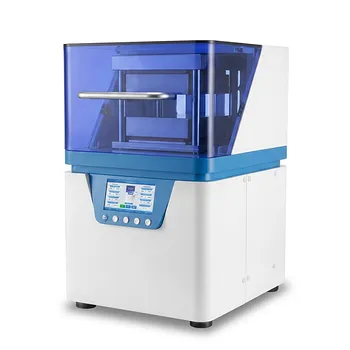
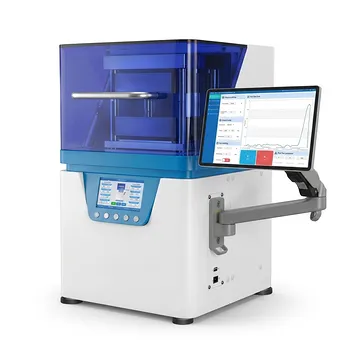
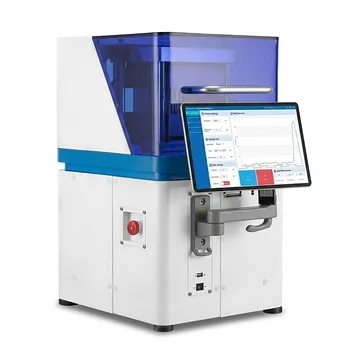
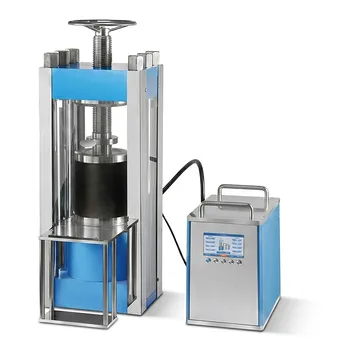
A heating press facilitates complete infiltration by simultaneously applying precise thermal conduction and high mechanical pressure to overcome the polymer's natural flow resistance. This process transforms solid PEEK powder into a low-viscosity melt and uses a constant thrust of approximately 100 kN to drive the liquid material into the microscopic voids of a salt particle template.
Core Takeaway: The heating press acts as a dual-force system that converts PEEK into a fluid state while providing the mechanical energy required to saturate a solid salt bed. This synergy is essential for eliminating air pockets and ensuring a dense, uniform composite structure.
The Role of Thermal Energy in Material Transition
Melting via Conductive Heating
The heating press utilizes thermal conduction to raise the mold temperature to approximately 420°C, well above the melting point of PEEK. This extreme heat is necessary to transition the semi-crystalline polymer from a solid powder into a molten, flowable state.
Overcoming Viscous Resistance
In its molten state, PEEK remains highly viscous, which would normally prevent it from entering tiny gaps between salt particles. The controlled temperature of the heating plates allows for precise regulation of this viscosity, ensuring the polymer is fluid enough to respond to mechanical pressure.
Mechanical Thrust and Fluid Dynamics
Driving the Melt into Microscopic Gaps
Once the PEEK is melted, the press applies a constant mechanical thrust of approximately 100 kN. This pressure acts as the primary driver, forcing the molten polymer to penetrate the interconnected microscopic gaps between the salt particles that gravity alone could not fill.
Pre-pressing for Template Density
Before infiltration, the press can apply a pre-pressing load of up to 600 kN to the salt bed. This step increases the packing density of the salt particles, which reduces the available volume for the polymer and allows for the precise regulation of the final component's porosity.
Elimination of Internal Defects
The application of simultaneous heat and pressure effectively squeezes out trapped air that would otherwise form bubbles. This results in a dense, uniformly thick composite sheet with high interfacial bonding strength between the PEEK and the salt or other additive particles.
Understanding the Trade-offs
Temperature and Polymer Degradation
While higher temperatures (up to 420°C) reduce viscosity and improve infiltration, exceeding these limits can lead to thermal degradation of the PEEK. Finding the balance between "easy flow" and "material integrity" is a critical technical challenge.
Pressure vs. Salt Template Integrity
Excessive pressure during the infiltration stage can crush the salt particles rather than just filling the gaps between them. If the salt structure collapses prematurely, the resulting component may lack the specific pore geometry required for applications like bone engineering.
Optimizing Your Infiltration Process
To achieve the best results when creating PEEK-salt composites, consider your specific structural requirements:
- If your primary focus is Maximum Porosity: Use lower pre-pressing loads on the salt bed to maintain larger gaps, ensuring the PEEK only fills the existing voids without compressing the template.
- If your primary focus is Mechanical Strength: Prioritize higher infiltration pressures and temperatures (up to 420°C) to ensure the elimination of all air bubbles and the strongest possible bond between material layers.
- If your primary focus is Pore Uniformity: Utilize the adjustable heating plates to maintain a perfectly constant temperature, preventing "cold spots" that could cause uneven polymer flow and inconsistent density.
By precisely balancing thermal energy and mechanical force, the heating press transforms raw powders into high-performance, porous biocomposites.
Summary Table:
| Stage | Mechanism | Operating Parameter | Key Benefit |
|---|---|---|---|
| Melting | Thermal Conduction | Up to 420°C | Reduces PEEK viscosity for flowability |
| Pre-pressing | Mechanical Load | Up to 600 kN | Increases salt bed density & regulates porosity |
| Infiltration | Mechanical Thrust | ~100 kN | Forces molten PEEK into microscopic voids |
| Finalization | Simultaneous Force | Combined Heat/Pressure | Eliminates air pockets & ensures high bonding strength |
Optimize Your Material Research with KINTEK
Elevate your lab's capabilities with KINTEK’s precision laboratory pressing solutions. Whether you are working on advanced PEEK biocomposites or battery research, our comprehensive range—including manual, automatic, heated, and isostatic presses—provides the exact thermal and mechanical control required for flawless material infiltration.
Unlock superior consistency and density in your samples—Contact KINTEK today to discuss your project!
References
- Abdur Rahman Siddiq, A.R. Kennedy. Compression moulding and injection over moulding of porous PEEK components. DOI: 10.1016/j.jmbbm.2020.103996
This article is also based on technical information from Kintek Solution Knowledge Base .
Related Products
- Automatic Hydraulic Heat Press Machine with Multi Stage Programmable Control and Integrated Water Cooling Plate Size 180x180mm
- Heated Hydraulic Press Machine with Heated Plates for Vacuum Box Laboratory Hot Press
- Automatic High Temperature Heated Hydraulic Press Machine with Heated Plates for Lab
- Heated Hydraulic Press Machine With Heated Plates For Vacuum Box Laboratory Hot Press
- Automatic Heated Hydraulic Press Machine with Heated Plates for Laboratory
People Also Ask
- How does a laboratory hydraulic heat press facilitate the molding of cellulose composite specimens? Precision Molding
- How is a hydraulic heat press used for sample preparation? Achieve Uniform, Void-Free Samples for Lab Analysis
- What is the role of a hydraulic heat press in material testing? Unlock Superior Data for Research & QC
- What is a hydraulic heat press? Discover Precision Material Bonding and Sample Preparation
- What are the industrial applications of a hydraulic heat press? Powering Lamination, Bonding, and R&D Efficiency