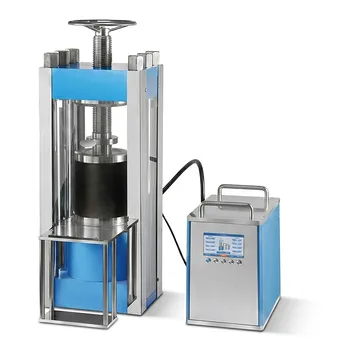
The hydraulic system serves as the mechanical engine for molecular transformation. By precisely regulating nip loads—often reaching 6 MPa to 8 MPa—it forces high-lignin fibers into the intimate physical contact necessary for bonding. This pressure acts as a prerequisite for lignin polymers to soften, flow, and undergo cross-interface interdiffusion, effectively "welding" the fibers together.
A laboratory-grade hydraulic system enables high-lignin pulp enhancement by providing the critical load required for lignin interdiffusion and "wood welding." This process transforms the pulp sheet into a dense, high-performance material where wet strength can reach up to 50 percent of dry strength.
The Role of Pressure in Molecular Interdiffusion
Achieving Intimate Fiber Contact
The primary function of the hydraulic system is to overcome the natural bulkiness of pulp fibers. By applying several tons of stable force, the system reduces the distance between adjacent fibers to a molecular level.
This physical proximity is essential because chemical bonding and polymer entanglement cannot occur across air gaps or loose voids.
Enabling "Wood Welding" Mechanisms
Under high-pressure conditions, the lignin within the fibers begins to behave like a thermoplastic adhesive. The hydraulic load forces these softened lignin polymers to flow toward the contact points between fibers.
This flow creates strong covalent bonds or physical entanglements, a phenomenon often referred to as "wood welding," which fundamentally changes the sheet's internal structure.
Enhancing Structural Integrity and Performance
Impact on Wet and Dry Strength
The most significant performance metric influenced by hydraulic pressure is the sheet's resilience to moisture. By facilitating lignin interdiffusion, the system helps create a water-resistant "welded" network.
Experiments show that this high-pressure hot-pressing can result in wet strength reaching 50 percent of the dry strength, a feat difficult to achieve without such precise mechanical force.
Increasing Contact Area and Hydrogen Bonding
Beyond lignin flow, the hydraulic system makes high-yield pulp fibers more plastic and flexible. This allows the fibers to conform more easily to one another during the pressing cycle.
As the fibers contract under pressure, they form a higher density of hydrogen bonds, which significantly boosts the overall modulus of elasticity and tensile strength.
Synergistic Effects of System Precision
Accuracy in Load Regulation
Laboratory-grade systems are equipped with specialized pressure gauges and controls that allow for precise adjustment. This precision ensures that the optimal nip load is maintained throughout the entire heating cycle.
Inconsistent pressure can lead to "weak spots" in the pulp sheet, where lignin failed to flow or fibers did not achieve sufficient contact.
Optimization of Heat Transfer
When the hydraulic system is used in conjunction with conductive additives, such as metal oxide nanoparticles, the contact efficiency is even more critical. Stable pressure ensures that heat is transferred effectively to the core of the sheet.
This accelerated heat transfer promotes faster polymerization of any added resins and ensures uniform lignin softening throughout the material's thickness.
Understanding the Trade-offs
Risk of Mechanical Fiber Damage
While high pressure is necessary for bonding, excessive force can lead to the mechanical crushing of the cellulose fibers. This degradation of the fiber backbone can actually decrease the final tear strength of the sheet.
Finding the "sweet spot" between enough pressure for lignin flow and too much pressure for fiber integrity is a key experimental challenge.
Management of Internal Vapor Pressure
Applying high hydraulic pressure during hot-pressing traps moisture within the sheet's core. If the pressure is released too quickly or if the temperature is too high relative to the pressure, the internal steam can cause delamination or "blowouts."
Operators must carefully balance the closure force with the degassing cycle to maintain the structural integrity of the final product.
How to Apply This to Your Project
Making the Right Choice for Your Goal
To achieve the best results with high-lignin pulp, your hydraulic strategy must align with your specific performance targets:
- If your primary focus is Maximum Wet Strength: Utilize higher nip loads (up to 8 MPa) to ensure total lignin interdiffusion and "wood welding" across all fiber interfaces.
- If your primary focus is Dimensional Stability: Monitor the hydraulic system to ensure a steady, high-pressure environment that reduces thickness swelling by maximizing internal bond strength.
- If your primary focus is Fiber Preservation: Opt for moderate pressure (near 4 MPa–6 MPa) combined with higher temperatures to encourage bonding without mechanically damaging the cellulose structure.
The precision of the hydraulic system is the determining factor in whether a pulp sheet remains a collection of fibers or becomes a high-performance consolidated material.
Summary Table:
| Factor | Mechanism | Impact on Performance |
|---|---|---|
| Nip Load (6-8 MPa) | Physical Proximity | Enables lignin flow and molecular interdiffusion |
| Wood Welding | Covalent Bonding | Wet strength reaches up to 50% of dry strength |
| Precision Control | Uniform Stress | Prevents fiber damage and internal delamination |
| Heat Transfer | Thermal Polymerization | Promotes faster resin curing and lignin softening |
Elevate Your Material Research with KINTEK Precision
Achieving the perfect "wood welding" effect requires more than just force—it requires absolute precision. KINTEK specializes in comprehensive laboratory pressing solutions tailored for high-performance material and battery research. Whether you need manual, automatic, heated, multifunctional, or glovebox-compatible models, our systems provide the stable load regulation essential for lignin interdiffusion and structural integrity.
We also offer specialized cold and warm isostatic presses designed to meet the rigorous demands of advanced pulp and energy storage experiments. Don't let inconsistent pressure compromise your data.
Contact our laboratory specialists today to find your ideal pressing solution!
References
- Tove Joelsson, Per Engstrand. Lignin Interdiffusion– A Mechanism Behind Improved Wet Strength. DOI: 10.15376/frc.2022.1.105
This article is also based on technical information from Kintek Solution Knowledge Base .
Related Products
- Automatic Hydraulic Hot Press with Large Plate and Precision Temperature Control for Advanced Material Sample Preparation and Industrial Research
- Automatic High Temperature Heated Hydraulic Press Machine with Heated Plates for Lab
- Heated Hydraulic Press Machine with Heated Plates for Vacuum Box Laboratory Hot Press
- Heated Hydraulic Press Machine With Heated Plates For Vacuum Box Laboratory Hot Press
- Automatic Heated Hydraulic Press Machine with Hot Plates for Laboratory
People Also Ask
- What are the specific features and applications of hydraulic hot press machines? Precision Solutions for Modern Labs
- How does an automatic hydraulic press operate? Achieve Precision and Consistency in Lab Pelleting
- What are the advantages and common applications of an automatic hydraulic press? Elevate Your Lab's Precision
- What is the technical significance of setting a precise dwell time? Achieve Peak Material Density and Stability
- When is an automatic hydraulic press more suitable than a manual press? Scale Your Lab with Precision & Speed