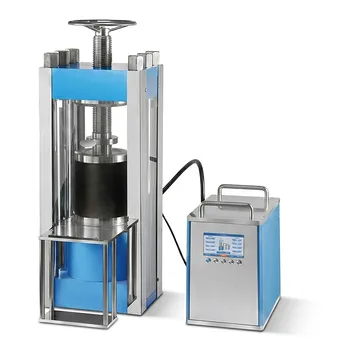
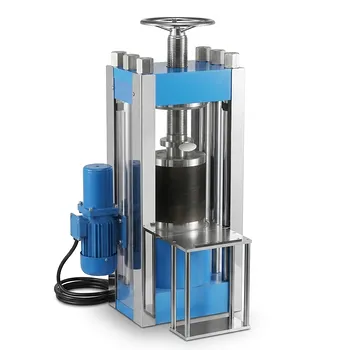
The laboratory heated press serves as the critical catalyst for material transformation. It provides a synchronized environment of constant high temperature and steady pressure to facilitate the chemical cross-linking of resins while physically shaping the composite into a dense, void-free structure. This dual action ensures that bio-fillers are perfectly encapsulated within the polymer matrix, resulting in high-performance materials with standardized physical properties and specific geometric shapes.
A laboratory heated press is the essential bridge between raw bio-components and a finished structural composite. By precisely managing thermal and mechanical energy, it drives chemical curing while simultaneously forcing the material into a uniform, high-density geometry.
Facilitating Chemical Transformation and Matrix Consolidation
Initiating Cross-Linking Reactions
The press provides the thermal energy required to trigger the chemical cross-linking of thermosetting resins. Maintaining a precise temperature (ranging from 130°C to 180°C) ensures the reaction reaches completion, creating a stable, three-dimensional molecular network that binds the bio-fillers together.
Enhancing Resin Flow and Wetting
Heating the material above its glass transition temperature or melting point significantly reduces its viscosity. This allows the polymer matrix to flow adequately throughout the mold, fully encapsulating bio-fillers such as feather powder, lignin, or oil palm fibers.
Eliminating Internal Defects
Continuous unit pressure (often reaching 10 MPa or several tons) forces air and volatiles out of the material during the curing phase. This process eliminates internal voids and bubbles, which are critical weak points that would otherwise compromise the material's structural integrity and braking performance.
Precision Control of Physical Morphology
Regulating Thickness and Density
The press ensures the material fills the mold cavity uniformly to achieve a specific geometric shape. This creates standardized sheets with uniform thickness and high bulk density, which are vital for accurate mechanical testing and industrial reproducibility.
Influencing Microscopic Structure
By accurately adjusting the temperature distribution and the cooling rate, researchers can finely control crystallization behavior and phase separation. This level of control allows for the fine-tuning of the material's microscopic morphology and final performance characteristics.
Bonding Multilayer Structures
In applications involving veneers or laminates, the press ensures tight contact between layers by overcoming surface irregularities. This eliminates bonding gaps, consolidating multiple layers into a single, unified structure with superior mechanical strength.
Understanding the Trade-offs
Balancing Temperature and Bio-degradation
Excessive heat can accelerate the curing reaction but may also thermally degrade sensitive bio-fillers. Finding the specific thermal window where the resin cures without scorching the organic fibers is a primary challenge in bio-composite engineering.
Pressure vs. Fiber Integrity
While high pressure is necessary for density, excessive force can crush delicate bio-structures or cause "resin starvation" by squeezing too much matrix out of the mold. Precise calibration is required to maintain the ideal fiber-to-resin ratio for the intended application.
How to Optimize Your Pressing Parameters
Selecting the right settings depends on the specific mechanical and aesthetic requirements of your bio-composite project.
- If your primary focus is mechanical strength: Prioritize high unit pressure and adequate dwell time at the curing temperature to ensure maximum density and the total elimination of internal voids.
- If your primary focus is surface finish: Focus on the precise temperature distribution of the heating plates and a controlled cooling rate to prevent warping or surface irregularities.
- If your primary focus is bio-filler integrity: Use the lowest effective curing temperature and optimize the resin chemistry to avoid thermal degradation of the organic components.
Ultimately, the laboratory heated press is not just a molding tool, but a precision instrument for engineering the internal architecture of sustainable materials.
Summary Table:
| Process Step | Role of Heated Press | Key Impact on Bio-Composites |
|---|---|---|
| Curing | Provides thermal energy for cross-linking | Creates a stable 3D molecular network |
| Encapsulation | Reduces viscosity for resin flow | Fully wets bio-fillers like lignin/fibers |
| Consolidation | Applies unit pressure (up to 10 MPa) | Eliminates internal voids and air bubbles |
| Morphology | Controls thickness and cooling rates | Uniform density and standardized geometry |
Master Your Bio-Composite Research with KINTEK
Precision is non-negotiable when engineering sustainable materials. KINTEK specializes in comprehensive laboratory pressing solutions, offering manual, automatic, heated, multifunctional, and glovebox-compatible models, as well as cold and warm isostatic presses widely applied in battery research and advanced material science.
Whether you need to eliminate internal voids or precisely control thermal windows for delicate bio-fillers, our equipment delivers the consistency your research demands. Contact us today to find the perfect press for your lab!
References
- Roxana Dinu, Alice Mija. Bio-Based Composites from Industrial By-products and Wastes as Raw Materials. DOI: 10.5539/jmsr.v9n2p29
This article is also based on technical information from Kintek Solution Knowledge Base .
Related Products
- Automatic Large Format Laboratory Heated Hydraulic Press 400x400mm Plate Capacity
- 24T 30T 60T Heated Hydraulic Lab Press Machine with Hot Plates for Laboratory
- Heated Hydraulic Press Machine with Heated Plates for Vacuum Box Laboratory Hot Press
- Automatic Heated Hydraulic Lab Press 120x120mm Plate Fully Automated Material Research Press
- Laboratory Split Manual Heated Hydraulic Press Machine with Hot Plates
People Also Ask
- Why is a laboratory heated hydraulic press required? Ensure Precise Vulcanization for NBR/EPDM Nanocomposites
- What role does a Laboratory Heated Hydraulic Press play in rubber vulcanization? Master Precision Specimen Molding
- How does a laboratory heated hydraulic press improve the performance of dried composite solid-state membranes? Guide
- What role does a laboratory heated hydraulic press play in PLA/MCC molding? Achieve superior composite density.
- Role of Laboratory Heated Hydraulic Presses in Solid Electrolyte Fabrication: Enhance Density & Ionic Conductivity