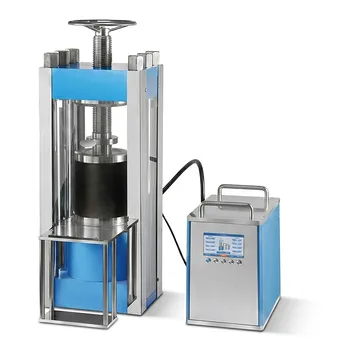
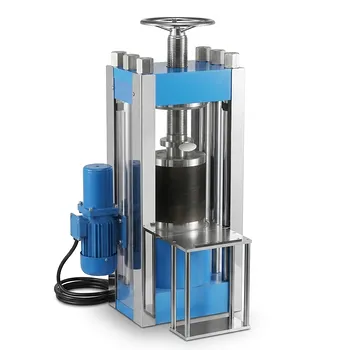
A laboratory heated press is essential for converting irregular polymer pellets into uniform, void-free discs required for precise rheological measurement. By applying controlled thermal energy and mechanical pressure, the press consolidates raw material into repeatable specimens—typically 1 mm thick—that fit perfectly into rotational or Multi-Pass Rheometers (MPR). This process is foundational for ensuring that the data collected reflects the polymer’s intrinsic properties rather than flaws in the sample itself.
The primary purpose of a laboratory heated press is to create high-density, geometrically consistent specimens that are free of internal voids and air bubbles. This standardization is critical for eliminating "thermal history" and ensuring that rheological tests are both accurate and repeatable across different batches.
Eliminating Internal Defects and Voids
Removing Entrapped Air
Raw polymer pellets or powders naturally contain air in the spaces between particles. A heated press uses high pressure to drive this air out as the material reaches its melting point, preventing bubbles that would otherwise cause "slippage" or irregular torque readings during rheological testing.
Ensuring Uniform Density
The application of stepped pressure (such as increasing from 5 MT to 15 MT) eliminates density gradients within the sample. This creates a high-quality, dense plaque that ensures the rheometer interacts with a homogenous material, leading to stable and reliable data.
Physical Cross-linking and Flow
The combination of heat and pressure facilitates the softening of the polymer, allowing different components to flow and cross-link physically. This ensures that the final "flake-like" sample is a single, cohesive unit rather than a collection of compressed but separate particles.
Achieving Geometric and Mechanical Consistency
Precise Thickness Control
Rheological equations are highly sensitive to the thickness (gap) of the sample. Heated presses allow for precise control over the sample’s thickness and surface flatness, ensuring the specimen perfectly matches the geometry of the rheometer platens.
Repeatable Test Specimens
By using standardized molds and controlled conditions, the lab press produces specimens with identical dimensions every time. This repeatability is vital for comparing different polymer grades or monitoring batch-to-batch consistency in a production environment.
Optimized Loading for Rheometers
Flake-like discs are the ideal geometry for loading into rotational rheometers. A uniform, pre-molded disc ensures that the material fills the measurement gap completely without overflowing or leaving empty spaces at the edges of the geometry.
Managing Thermal and Processing History
Erasing Molecular Memory
Polymers "remember" the stresses of their previous processing (such as extrusion or pelletization). By remelting the material in a heated press, you reset this thermal history, ensuring the rheological test measures the polymer’s base properties rather than its previous processing defects.
Standardizing Internal Stress
Controlled heating and cooling rates within the press minimize internal processing stresses. This provides a "blank slate" for the material, which is necessary for accurate subsequent characterization through Small-Angle X-ray Scattering (SAXS) or Wide-Angle X-ray Scattering (WAXS).
Consistent Crystallinity
The rate at which a polymer cools significantly affects its crystallinity and, consequently, its rheological behavior. A laboratory press allows for precise control over the cooling cycle, ensuring that every sample has a consistent crystalline structure before testing begins.
Understanding the Trade-offs
Risk of Thermal Degradation
Subjecting a polymer to high temperatures for too long in the press can lead to thermal degradation or chain scission. This alters the molecular weight distribution and results in rheological data that does not accurately represent the original material.
Pressure Management Issues
If pressure is applied too rapidly, it can cause "flash" (material escaping the mold) or trap air in the center of the plaque. Conversely, insufficient pressure may lead to a lack of consolidation, resulting in a sample that is too porous for accurate testing.
Impact of Cooling Rates
While rapid cooling saves time, it can "freeze in" internal stresses or prevent proper crystal growth. Finding the balance between throughput and sample stability is a common challenge for lab technicians.
How to Apply This to Your Project
Recommendations Based on Your Goals
- If your primary focus is standardizing QC data: Use a press that follows international standards (like ISO or ASTM) to ensure your plaques are compliant for tensile and rheological comparisons.
- If your primary focus is high-viscosity materials (like PVC): Utilize a press with stepped pressure control to ensure maximum density and the total elimination of air bubbles.
- If your primary focus is research and development: Prioritize a press with highly accurate temperature and cooling rate controls to study how thermal history impacts molecular structure.
- If your primary focus is spectroscopic analysis: Focus on achieving very thin, uniform films by using high-pressure settings and precision-ground platens.
Proper sample preparation via a heated press transforms inconsistent raw materials into the high-precision specimens required for definitive rheological analysis.
Summary Table:
| Feature | Benefit for Rheological Testing |
|---|---|
| Void Elimination | Removes entrapped air to prevent torque fluctuations and slippage. |
| Thickness Control | Ensures precise sample geometry for exact gap matching in rheometers. |
| Thermal Reset | Erases 'molecular memory' and processing history for base property testing. |
| Density Uniformity | Eliminates internal gradients, leading to stable and repeatable data. |
| Controlled Cooling | Standardizes crystallinity and minimizes internal stresses in the material. |
Elevate Your Material Analysis with KINTEK Precision
Don't let sample imperfections compromise your research data. KINTEK specializes in comprehensive laboratory pressing solutions designed to deliver the high-density, geometrically consistent specimens your rheological testing demands.
From advanced battery research to polymer characterization, our versatile equipment range includes:
- Manual & Automatic Heated Presses for effortless sample preparation.
- Multifunctional & Glovebox-Compatible Models for sensitive environments.
- Cold and Warm Isostatic Presses for specialized material consolidation.
Ready to eliminate thermal history and ensure internal uniformity? Our experts are here to help you find the perfect pressing solution for your application.
Contact KINTEK today to optimize your lab's performance!
References
- C. D. Reynolds, Tom McLeish. Pressure and shear rate dependence of the viscosity and stress relaxation of polymer melts. DOI: 10.1122/1.5012969
This article is also based on technical information from Kintek Solution Knowledge Base .
Related Products
- Automatic Large Format Laboratory Heated Hydraulic Press 400x400mm Plate Capacity
- 24T 30T 60T Heated Hydraulic Lab Press Machine with Hot Plates for Laboratory
- Laboratory Split Manual Heated Hydraulic Press Machine with Hot Plates
- Automatic Heated Hydraulic Lab Press 120x120mm Plate Fully Automated Material Research Press
- Heated Hydraulic Press Machine with Heated Plates for Vacuum Box Laboratory Hot Press
People Also Ask
- Why is a laboratory heated hydraulic press required? Ensure Precise Vulcanization for NBR/EPDM Nanocomposites
- What role does a Laboratory Heated Hydraulic Press play in rubber vulcanization? Master Precision Specimen Molding
- How does a laboratory heated hydraulic press improve the performance of dried composite solid-state membranes? Guide
- What role does a laboratory heated hydraulic press play in PLA/MCC molding? Achieve superior composite density.
- Role of Laboratory Heated Hydraulic Presses in Solid Electrolyte Fabrication: Enhance Density & Ionic Conductivity