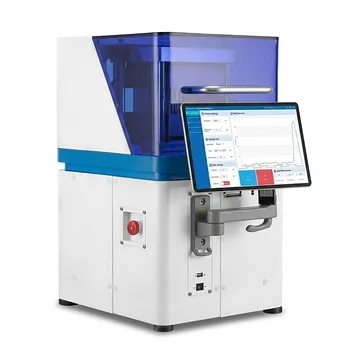
A laboratory heated hydraulic press is the primary tool for vulcanizing NBR/EPDM nanocomposites because it provides the simultaneous thermal energy and mechanical force required to transform raw polymers into high-performance materials. By maintaining a constant high temperature (typically 150°C–160°C) and synchronized pressure (ranging from 4 MPa to over 30 Bar), the press triggers the specific chemical cross-linking reactions needed for vulcanization while ensuring the polymer matrix fully encapsulates the nanofillers. This dual-control environment is essential for eliminating internal voids and ensuring the resulting rubber sheets meet strict dimensional and mechanical standards.
Core Takeaway: Precise temperature and pressure control are required to drive the chemical cross-linking of molecular chains while physically consolidating the nanocomposite, ensuring a dense, defect-free structure with optimized mechanical and dielectric properties.
Orchestrating the Chemical Transformation
Triggering the Vulcanization Reaction
The application of stable, high temperature is the catalyst for the cross-linking reaction between rubber molecular chains and vulcanizing agents. This process transforms the material from a plastic compound into a three-dimensional elastic network, which is the foundation of its final strength.
Maintaining the Optimal Flow Window
Precise temperature control reduces the viscosity of the NBR/EPDM matrix, allowing it to behave like a molten fluid. This "flow window" is critical because it enables the polymer to migrate into the porous network of pre-deposited nanoparticles and facilitates the intercalation or exfoliation of clay layers.
Managing Reaction Completeness
Inconsistent heating can lead to under-vulcanization, where the network is too weak, or over-vulcanization, which makes the material brittle. Stable laboratory presses ensure that the chemical reaction is uniform throughout the entire thickness of the specimen, maximizing thermal stability and flame retardancy.
Achieving Structural Integrity and Density
Eliminating Internal Voids and Gases
High mechanical pressure is required to compress the powder components and exclude gases trapped within the raw compound. By forcing air bubbles out of the mold, the press prevents internal defects that would otherwise act as failure points under mechanical stress.
Driving Nanoparticle Infiltration
During the consolidation phase, continuous pressure forces the molten polymer into microscopic gaps within the filler materials, such as fibers or nanoparticle clusters. This creates strong mechanical anchoring and chemical interfacial bonding, which are vital for the material’s electrical conductivity and durability.
Ensuring Dimensional Accuracy
A hydraulic press maintains a set pressure to ensure the rubber compound fully fills every corner of the mold cavity. This results in high dimensional accuracy and specific specimen thicknesses (e.g., 2 mm), which are mandatory for meeting international mechanical performance testing standards.
Understanding the Trade-offs
Balancing Temperature and Time
Higher temperatures can accelerate the vulcanization process but increase the risk of thermal degradation of the polymer chains. Researchers must carefully calibrate the press to find the "sweet spot" where the reaction is fast enough for efficiency but slow enough to avoid damaging the nanocomposite's delicate chemistry.
Pressure Limits and Mold Wear
While high pressure (such as 38 bar) is effective for removing voids, excessive force can cause flash (material leaking from the mold) or premature wear on expensive steel molds. Over-pressurization can also lead to the crushing of certain fragile nanofillers, potentially altering the intended dielectric response of the composite.
Implementing Precise Control for Your Research
How to Apply This to Your Project
To achieve the best results with NBR/EPDM nanocomposites, the curing cycle must be tailored to the specific filler and polymer ratio used in your formulation.
- If your primary focus is mechanical strength: Prioritize high, stable pressure (30+ bar) to ensure maximum density and the complete elimination of air-induced stress concentrators.
- If your primary focus is dielectric performance: Focus on ultra-precise temperature control to facilitate the perfect exfoliation of clay layers and a uniform distribution of nanoparticles.
- If your primary focus is standardized testing: Utilize precision-ground molds and a press with a thickness-stop setting to ensure every specimen meets the exact 2 mm requirement.
Mastering the synergy between thermal activation and mechanical consolidation is the only way to unlock the full potential of advanced rubber nanocomposites.
Summary Table:
| Feature | Role in Vulcanization | Key Benefit |
|---|---|---|
| Precise Temperature | Triggers chemical cross-linking | Eliminates under/over-vulcanization |
| High Pressure | Excludes gases & voids | Ensures high density & structural integrity |
| Hydraulic Stability | Drives nanoparticle infiltration | Optimized mechanical & dielectric properties |
| Dimensional Control | Mold-filling consistency | Meets international testing standards |
Achieve Unmatched Precision in Your Research with KINTEK!
Are you looking to optimize the vulcanization of high-performance NBR/EPDM nanocomposites? KINTEK specializes in comprehensive laboratory pressing solutions tailored for advanced material science and battery research.
Our laboratory solutions include:
- Manual & Automatic Models: For operational flexibility and throughput.
- Heated & Multifunctional Presses: Essential for precise thermal-mechanical synchronization.
- Glovebox-Compatible & Isostatic Presses: Designed for specialized research environments.
Ensure your samples meet the highest mechanical and dielectric standards with equipment designed for reliability and precision. Contact KINTEK today to find the perfect press for your lab!
References
- Abeer reffaee, A. I. Khalaf. Structural, magnetic and dielectric properties of waste magnetic filler rubber nanocomposites. DOI: 10.1007/s00289-023-04835-0
This article is also based on technical information from Kintek Solution Knowledge Base .
Related Products
- 24T 30T 60T Heated Hydraulic Lab Press Machine with Hot Plates for Laboratory
- Automatic Large Format Laboratory Heated Hydraulic Press 400x400mm Plate Capacity
- Automatic Heated Hydraulic Lab Press with Programmable Touch Screen Controls and Precision Temperature Regulation
- Automatic Heated Hydraulic Lab Press 120x120mm Plate Fully Automated Material Research Press
- Laboratory Split Manual Heated Hydraulic Press Machine with Hot Plates
People Also Ask
- Function of a Laboratory Hydraulic Press with Heated Platens in SSE? Enhance Battery Density & Conductivity
- Why is a laboratory hydraulic press with heating plates required for PLA/TEC films? Achieve Precise Sample Integrity
- What role does a laboratory heated hydraulic press play in LTCC? Essential for High-Density Ceramic Lamination
- What role does a laboratory heated hydraulic press play in PI/PA based SPE membranes? Optimize Solid Battery Performance
- What is the primary function of a laboratory heated hydraulic press? Mastering Thermoplastic Carbon Fiber Composites