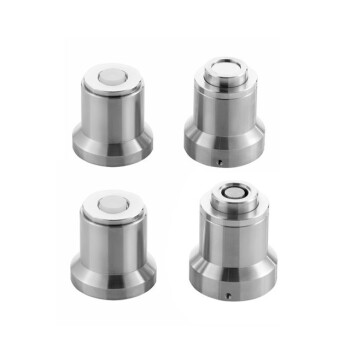
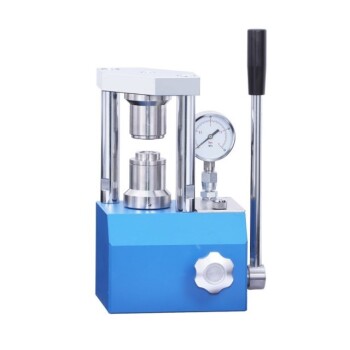
A laboratory high-pressure molding machine serves as the critical enabler of structural integrity in all-solid-state batteries (ASSBs) by applying immense static pressure to the laminated layers of the device. By exerting forces typically exceeding 200 to 300 MPa, this equipment physically overcomes the contact resistance between solid particles, forcing the creation of a dense, unified solid-solid interface that is mandatory for battery operation.
Core Insight: Unlike traditional batteries where liquid electrolytes naturally "wet" the electrodes to create contact, solid-state batteries rely entirely on mechanical force. The molding machine's primary role is to induce plastic deformation and pore elimination, ensuring that ions can move freely across boundaries that would otherwise be impassable due to microscopic voids.
The Critical Challenge of Solid Interfaces
Overcoming Contact Resistance
In a loose powder state, the active materials and solid electrolytes only touch at specific points. This results in extremely high contact resistance.
The primary reference indicates that applying pressure above 200 to 300 MPa is essential to crush these independent particles together. This transforms point contacts into area contacts, drastically reducing the resistance that impedes electron and ion flow.
Eliminating Voids and Pores
Microscopic voids (air pockets) between particles act as insulators, blocking the path of lithium ions.
High-pressure treatment physically squeezes these voids out of the structure. By maximizing the density of the electrode and electrolyte layers, the machine ensures there are no gaps to interrupt the electrochemical reactions.
Mechanisms of Performance Enhancement
Inducing Plastic Deformation
To achieve a truly integrated structure, the materials must do more than just touch; they must physically adapt to one another.
Supplementary data highlights that pressures (sometimes reaching up to 1000 MPa for composite electrodes) induce plastic deformation. This causes the solid electrolyte particles to change shape and "flow" around the electrode particles, filling interstitial spaces much like a liquid would, but retaining solid mechanical properties.
Establishing Ion Transport Pathways
The ultimate goal of this densification is connectivity.
By creating a compact structure, the molding machine establishes continuous, uninterrupted pathways for lithium-ion transport. This reduction in grain boundary resistance (the resistance found at the edges of particles) is directly responsible for the battery's ability to charge and discharge efficiently.
Minimizing Mechanical Relaxation
During testing, materials can shift or relax, leading to inconsistent results.
A high-precision press minimizes this mechanical relaxation. By creating a stable, pre-compressed structure, the equipment ensures that the interface remains intact during the expansion and contraction cycles of battery operation, preventing the layers from delaminating.
Understanding the Trade-offs
The Balance of Pressure vs. Integrity
While high pressure is beneficial, it is not a case of "the higher, the better" without limit. The application must be precise.
Insufficient pressure (e.g., below the plastic deformation threshold of the electrolyte) leaves voids, resulting in high impedance and poor performance. Conversely, uncontrolled pressure application could theoretically damage sensitive active materials or current collectors. The objective is densification without destruction.
Application Method Matters
The impact on performance depends on how the pressure is applied.
Supplementary references distinguish between pelletizing (creating the electrolyte base, often ~120 MPa) and lamination (integrating the full cell, often 300+ MPa). Using the wrong pressure setting for the specific stage of assembly will fail to yield the required interfacial density or mechanical strength.
Optimizing Integration for Specific Goals
To maximize the performance of an all-solid-state battery, the molding machine must be used to target specific structural outcomes:
- If your primary focus is Electrolyte Conductivity: Ensure the pressure is sufficient to densify the electrolyte powder into a pore-free pellet (typically around 120 MPa) to minimize grain boundary resistance before adding electrodes.
- If your primary focus is Full Cell Cycling Stability: Apply significantly higher static pressure (typically >300 MPa) to the final laminated structure to induce plastic deformation and ensure the interface survives repeated charge/discharge cycles.
- If your primary focus is Research Accuracy: Utilize high-precision molds to prevent mechanical relaxation, ensuring that performance data reflects the material's chemistry rather than assembly defects.
Ultimately, the laboratory high-pressure molding machine is not just a shaping tool; it is the defining instrument that dictates the electrochemical efficiency of the solid-solid interface.
Summary Table:
| Integration Factor | Typical Pressure Range | Core Impact on Battery Performance |
|---|---|---|
| Electrolyte Pelletizing | ~120 MPa | Minimizes grain boundary resistance for ion flow. |
| Full Cell Lamination | 200 - 300+ MPa | Creates area contact via plastic deformation. |
| Void Elimination | >200 MPa | Removes air pockets to prevent electrochemical insulation. |
| Structural Integrity | Up to 1000 MPa | Prevents delamination during charge/discharge cycles. |
Maximize Your Battery Research Precision with KINTEK
Unlock superior electrochemical performance by mastering the solid-solid interface. KINTEK specializes in comprehensive laboratory pressing solutions, offering manual, automatic, heated, multifunctional, and glovebox-compatible models, alongside advanced cold and warm isostatic presses specifically designed for cutting-edge battery research.
Our equipment ensures precise pressure control to eliminate voids and induce the plastic deformation necessary for high-efficiency lithium-ion transport.
Ready to elevate your structural integration?
Contact us today to find the perfect press for your lab
References
- Yi Zhang, Guo-Wei Zhao. Advancing sulfide solid electrolytes via green Li2S synthesis. DOI: 10.1038/s41467-025-64924-8
This article is also based on technical information from Kintek Solution Knowledge Base .
Related Products
- Lab Cylindrical Press Mold for Laboratory Use
- Lab Infrared Press Mold for Laboratory Applications
- Carbide Lab Press Mold for Laboratory Sample Preparation
- Warm Isostatic Press for Solid State Battery Research Warm Isostatic Press
- Special Shape Lab Press Mold for Laboratory Applications
People Also Ask
- What is the purpose of incorporating cartridge heaters into a lab press mold for MLCC block compression? Optimize Results
- Why is precise cooling management of the lab press mold necessary? Protect Core Integrity in Thermoforming
- What is the function of a pressing tool in thermoplastic panels? Master Precision Shaping & Fusion Bonding
- Why is a high-performance laboratory molding press critical for in-situ electrolyte formation? Unlock Battery Success
- How does the geometry of laboratory molds influence mycelium-based composites? Optimize Density and Strength